
This set has 7 free tooth brushing charts, and every one of them gives each day two boxes instead of one — a sun box for the morning brush and a moon box for the night brush. Pick by what your child can already do and by how long you want to track: a page with no words at all for ages 2-4, a named-day weekly grid for ages 3-10, a whole month on one sheet, or big squares if you are using stickers. Every page is US Letter, pure black and white, and free to download with no signup.
The design decision behind the whole set is the split box. Most brushing charts hand a child one square per day, which cannot show the difference between a day with one brush and a day with two — and twice a day is the rhythm dentists commonly recommend. So I drew every chart here as a pair: two boxes per row, each labelled with a picture rather than a word, so a child who cannot read yet still knows which one to fill in.
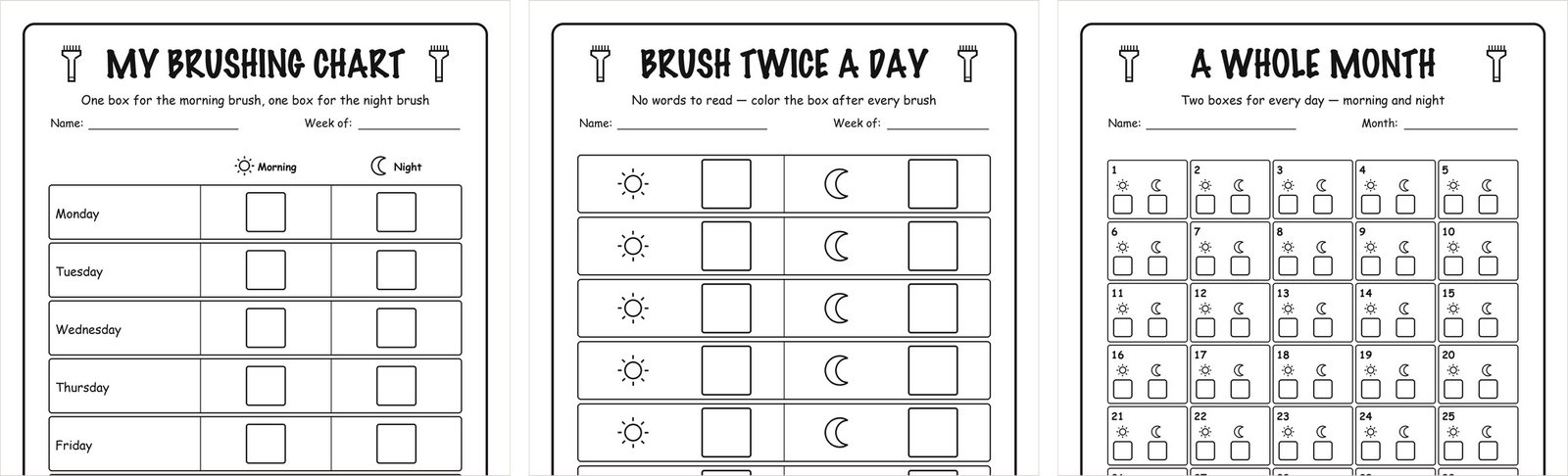
All 7 tooth brushing charts
Every page below has its own Download PDF and Print button.
What the two boxes on every row mean
The left box is the morning brush and carries a sun; the right box is the night brush and carries a crescent moon. Two boxes a day, two minutes each time, is the rhythm dentists commonly recommend — these pages record it, they do not advise on it.
The two icons are drawn as different shapes rather than as two circles, which matters more than it sounds: a sun with eight straight rays and a crescent with an open curve stay apart from each other even at the smallest size used here, the 0.32 in tick boxes on the monthly chart. On the picture-only chart they are drawn at full size on the row itself, so nothing on that page has to be read.
Which tooth brushing chart fits your child
Choose on two questions: can the child read the day names yet, and how long do you want one sheet to last — a week, two weeks, or a month.
A toddler needs a page where the icons carry the whole meaning, so the picture-only chart is the only one of the seven with no words inside the grid. A school-age child can read Monday through Sunday and will get more out of a longer run, which is what the two-week and monthly sheets are for. And if stickers are the reward rather than a crayon mark, the boxes have to be sized for the sticker, not for a tick.
- Ages 2-4, cannot read yet — the picture-only chart, sun and moon on every row.
- Ages 3-10, one week at a time — the weekly chart with named days.
- Using reward stickers — the sticker chart with 0.95 in squares.
- Tracking a whole month — the monthly chart, 31 days and 62 boxes.
- Working toward one agreed reward — the two-week chart with a reward line.
- Teaching where the brush goes — the “where I brush” chart with four pictures to color.
- Anything else — the blank chart, where you write the column headings.
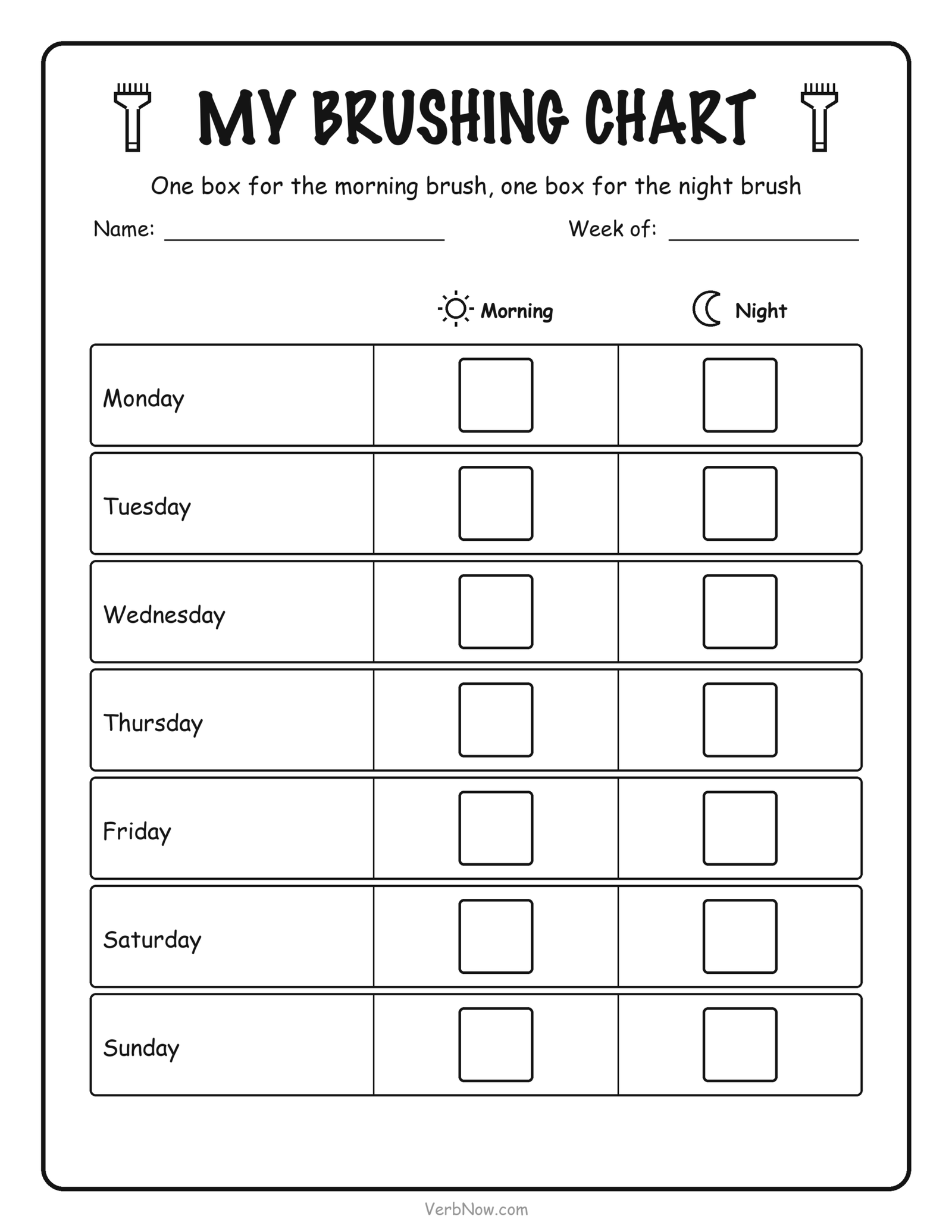
The weekly chart with a sun box and a moon box (ages 3-10)
This is the plain one: seven named day rows, two boxes each, fourteen boxes in total, with a name line and a “Week of” line at the top.
Each row is drawn about 0.97 in tall and each check box about 0.67 in across, which is wide enough for a crayon mark or a large tick from a child rather than a neat adult pen stroke. The day names sit in a 2.5 in column on the left so Wednesday fits on one line at a readable size — the reason the boxes sit right of centre rather than filling the row.
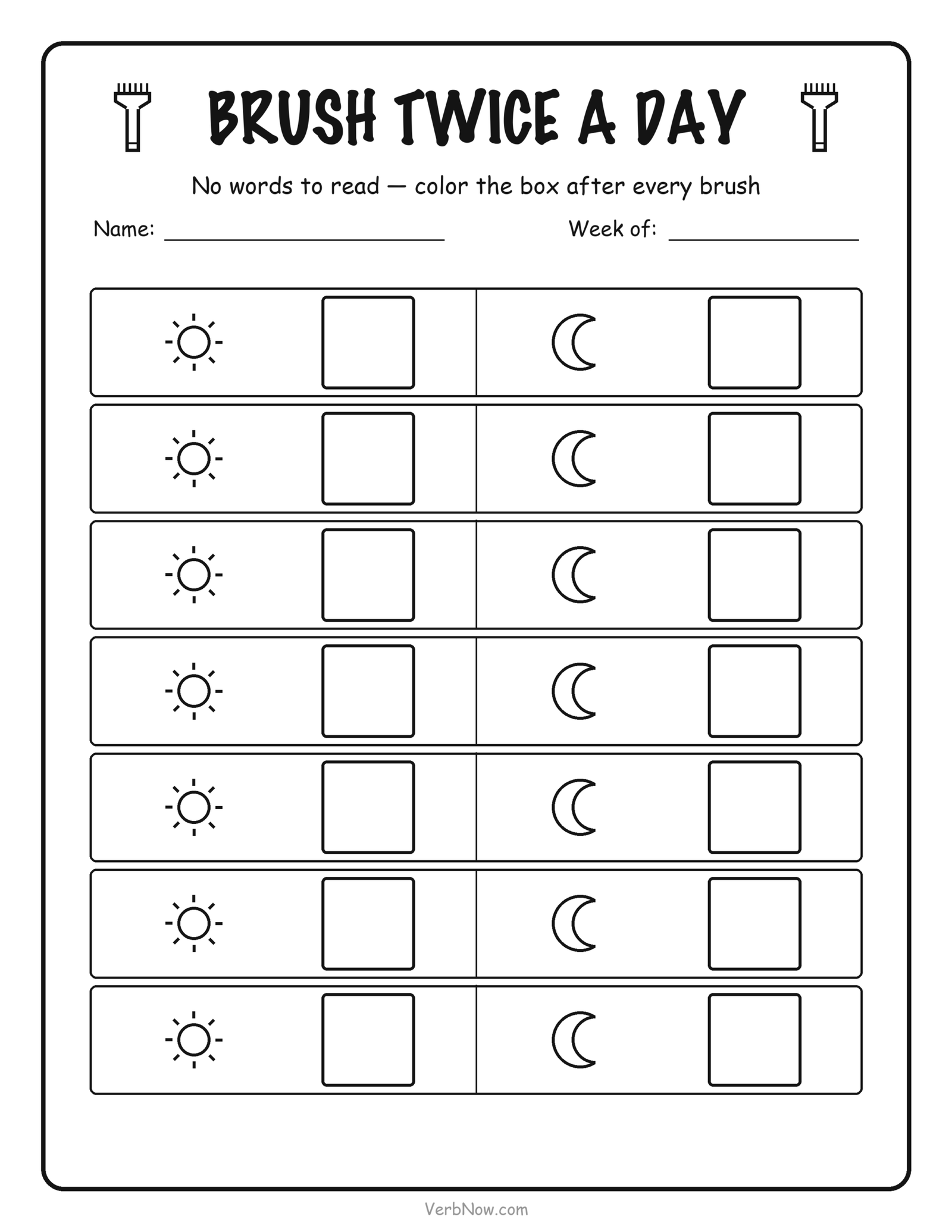
A picture-only chart for kids who cannot read yet (ages 2-4)
This page has no words anywhere inside the grid — seven rows, each carrying a sun with its box and a moon with its box.
The boxes here are the second largest in the set at about 0.83 in, because a two-year-old colouring a square is not aiming carefully. There are no printed day names, which is deliberate: a toddler cannot use them, and leaving them off means the same sheet works whether you start it on a Monday or on a Thursday.
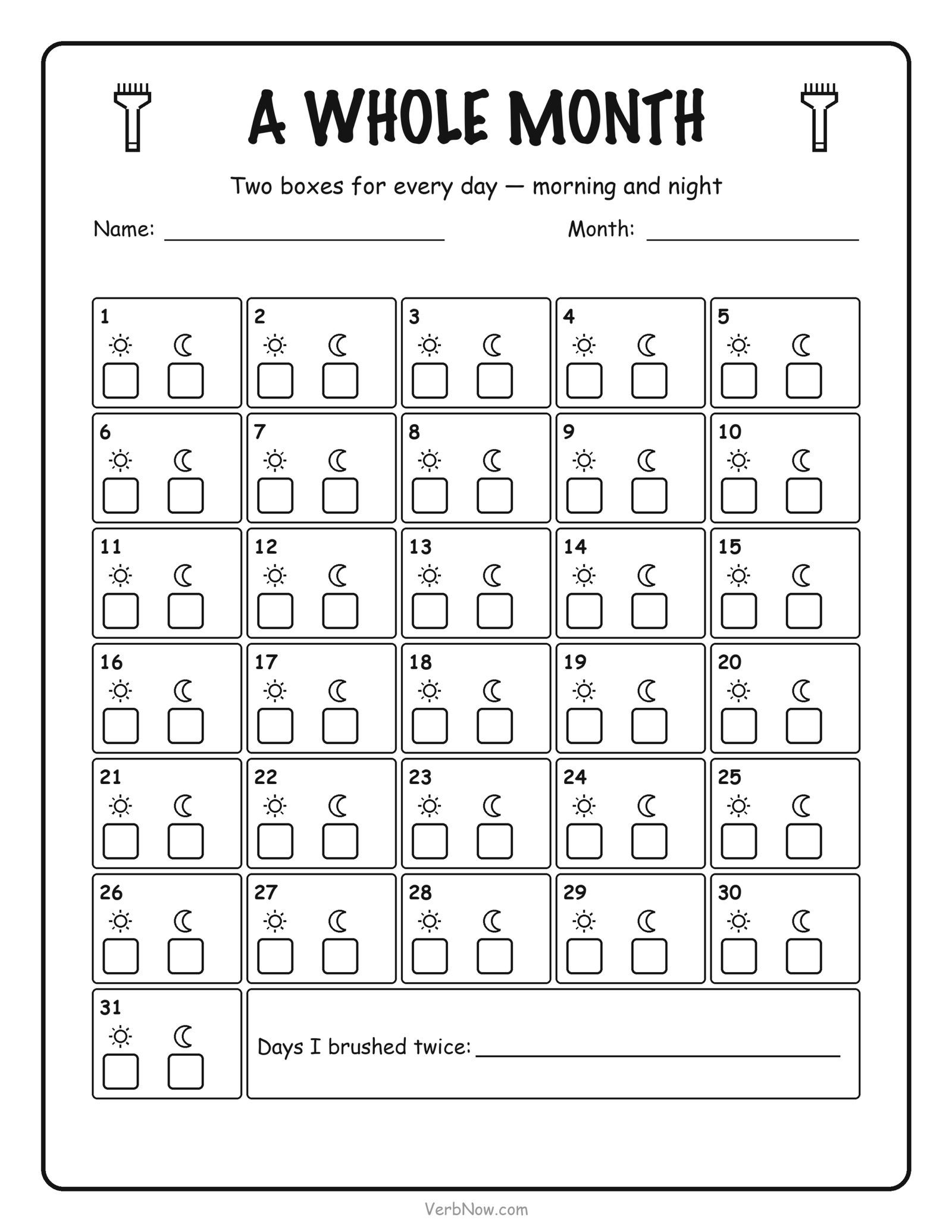
A month on one page (62 boxes)
The monthly chart holds 31 numbered day squares, each with its own morning and night box — 62 boxes in total — plus a “Days I brushed twice” line at the bottom.
Each day cell is about 1.38 in wide and 1.03 in tall, with the date number in the top-left corner and a small sun and moon above the two tick boxes so the pair never gets read the wrong way round. The tick boxes are the smallest in the set at 0.32 in, which is a fair trade for the thing this page does that no weekly sheet can: show a month of habit in one glance on the fridge.
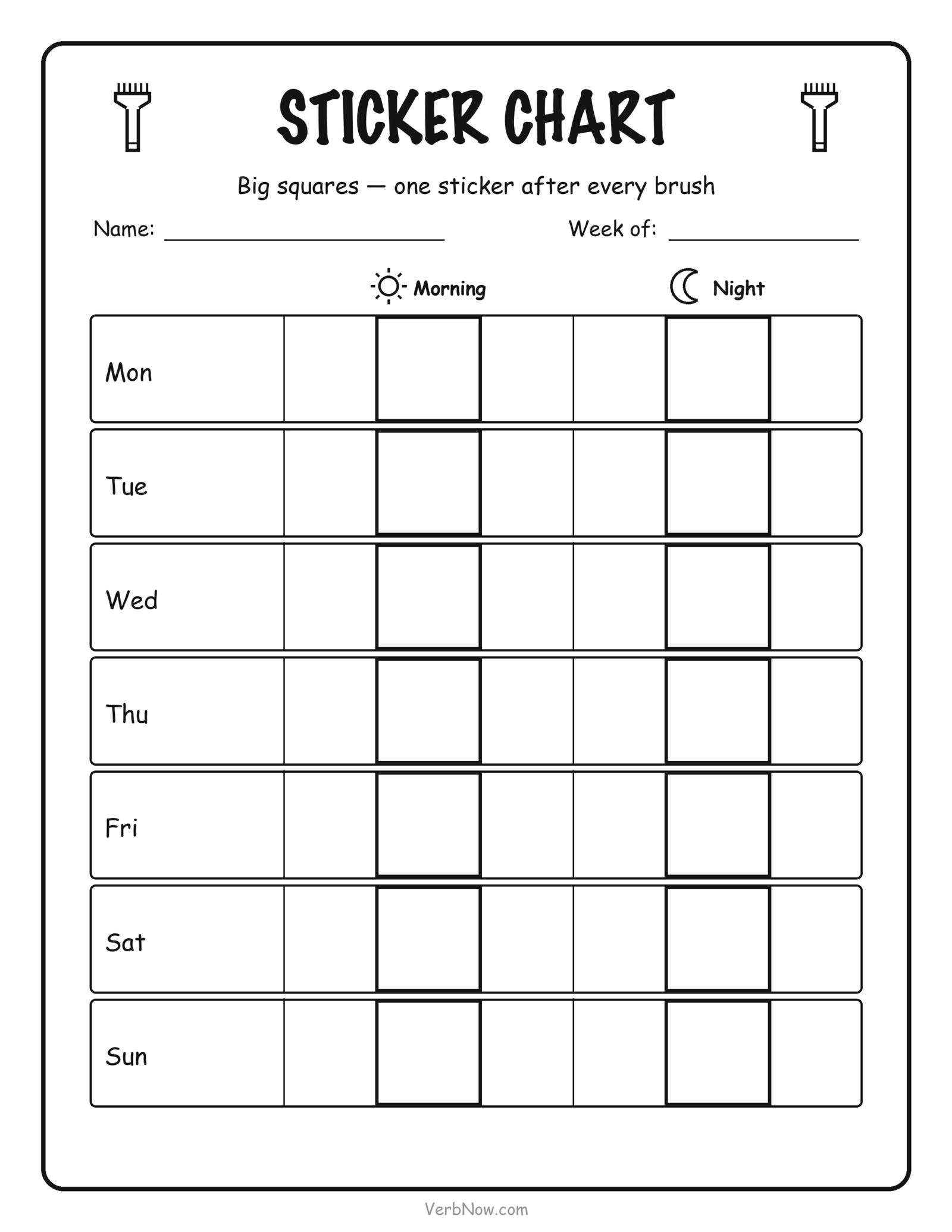
The sticker version with bigger boxes
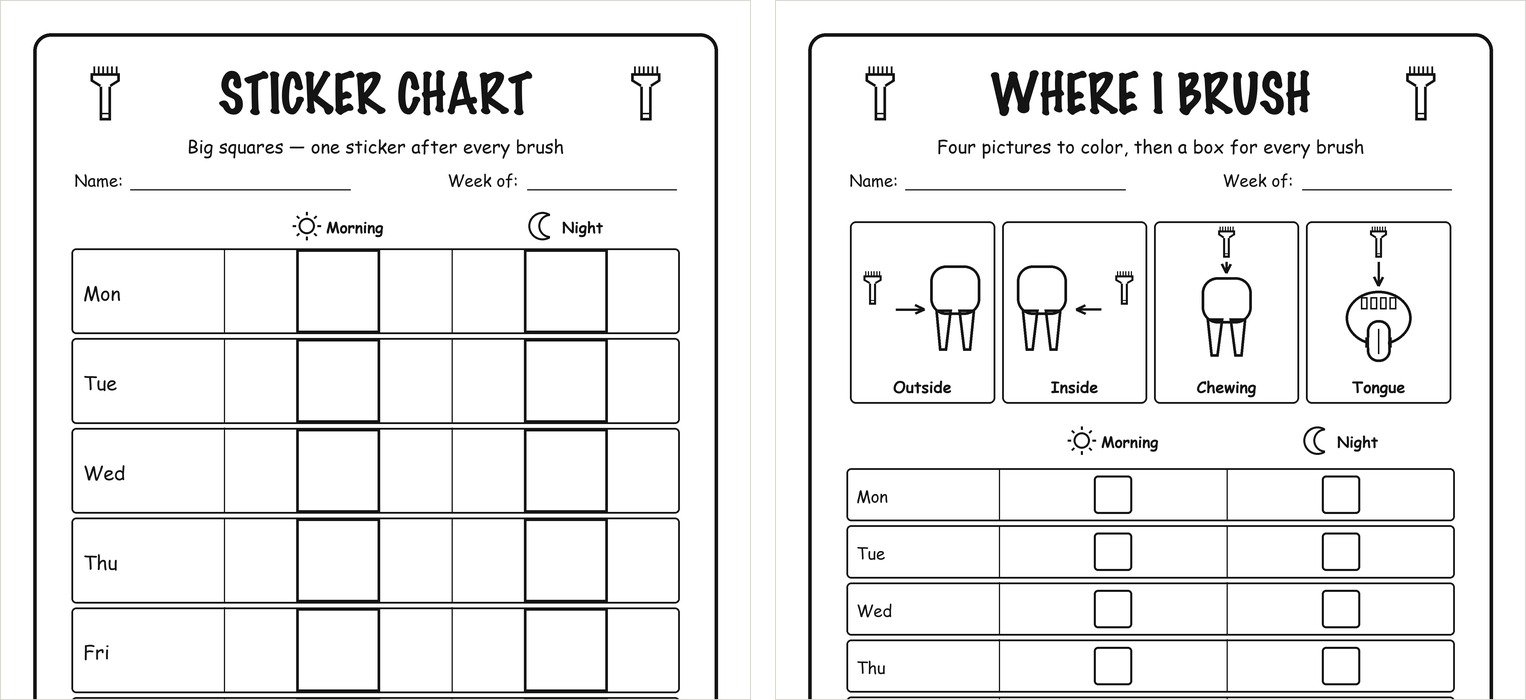
The sticker chart trades the ruled look for space: fourteen open squares of about 0.95 in, two per day, drawn with a heavier outline and nothing printed inside them.
That size is set by the reward, not by the page. Standard round reward stickers sold on rolls run roughly half to three quarters of an inch, so a 0.95 in square takes one without the edges overhanging the printed line, which is what makes a sticker chart look finished rather than messy. Day names are shortened to Mon through Sun here to buy the extra width the squares need.
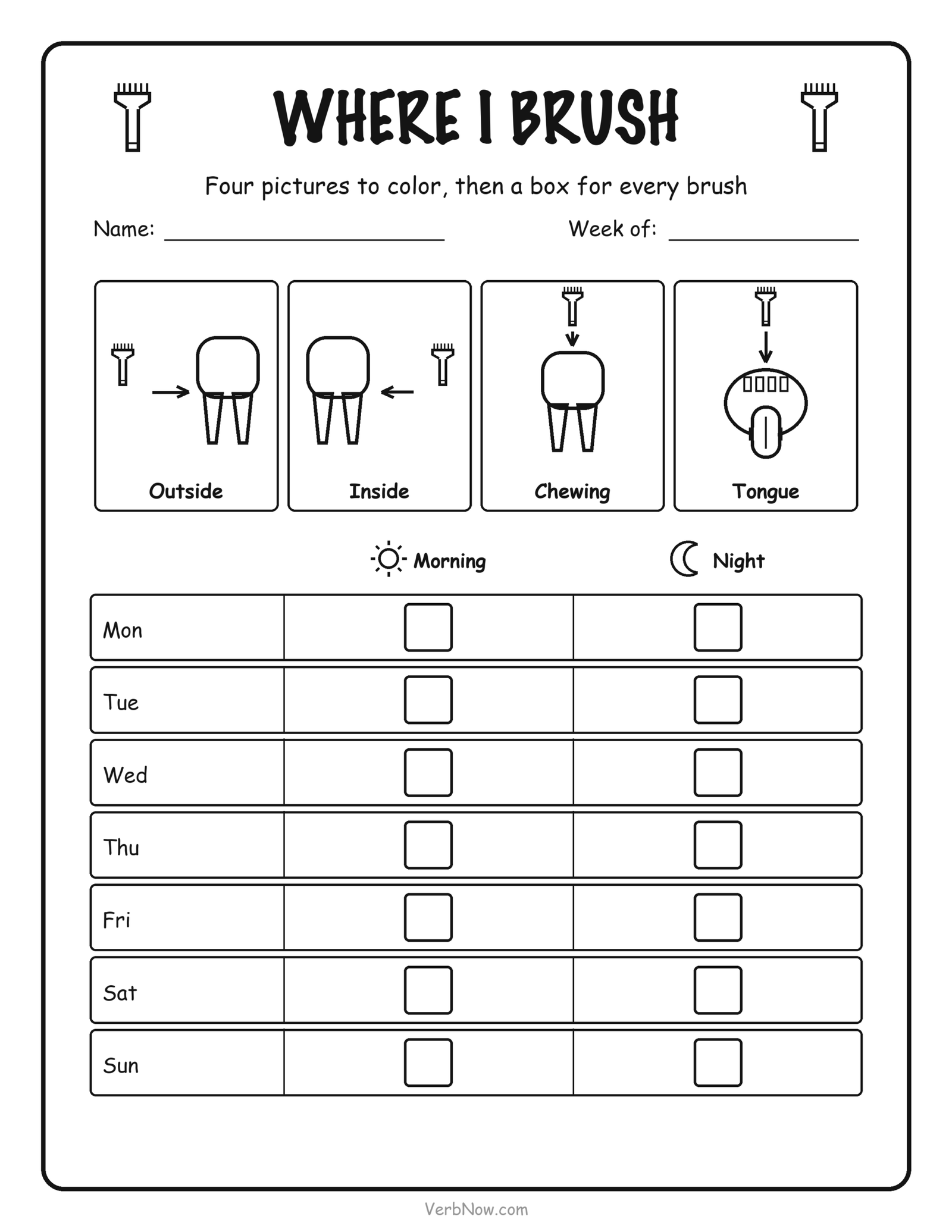
A chart that shows the four places to brush
This page puts four drawings to color across the top — labelled Outside, Inside, Chewing and Tongue — above a shortened seven-day grid with the same morning and night boxes.
The same tooth is drawn in three of the four pictures, with only the brush position changing, so the pictures read as one idea rather than four separate objects. The fourth shows an open mouth with the tongue. The grid underneath is compressed to 0.43 in boxes because the pictures take the top third of the sheet; if you want the bigger boxes, use the weekly chart and keep this one as the colouring page it mostly is.
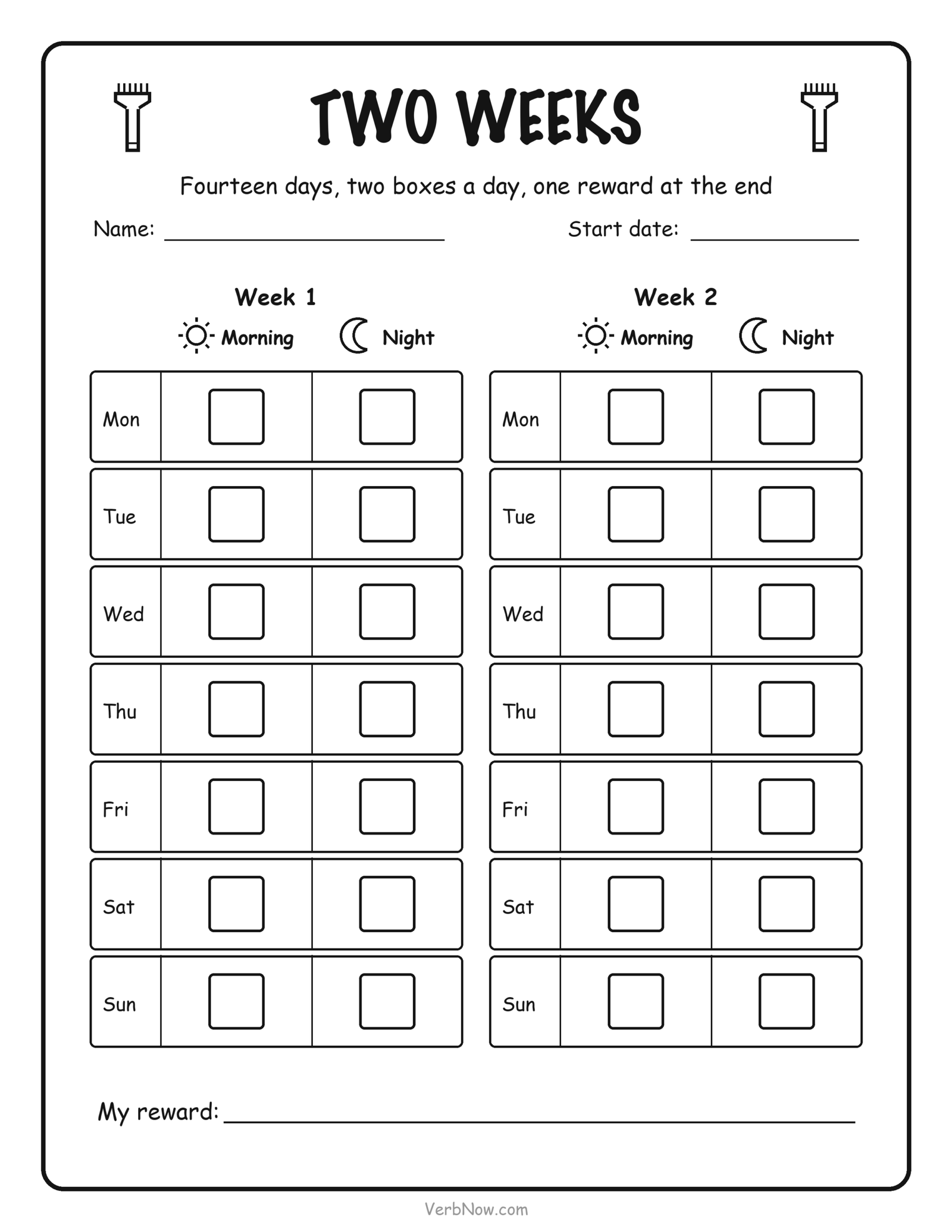
A two-week chart with a reward line
The two-week chart runs Week 1 and Week 2 side by side, seven rows each, two boxes per row — 28 boxes — with a “My reward” line printed at the bottom of the same sheet.
Fourteen days stacked in a single column would have squeezed each row under half an inch, so the weeks sit as two columns instead and the boxes stay at 0.50 in. Putting the reward line on the sheet rather than on a second piece of paper is the point of this version: the goal and the prize stay in the same place, and the child can see both at once.
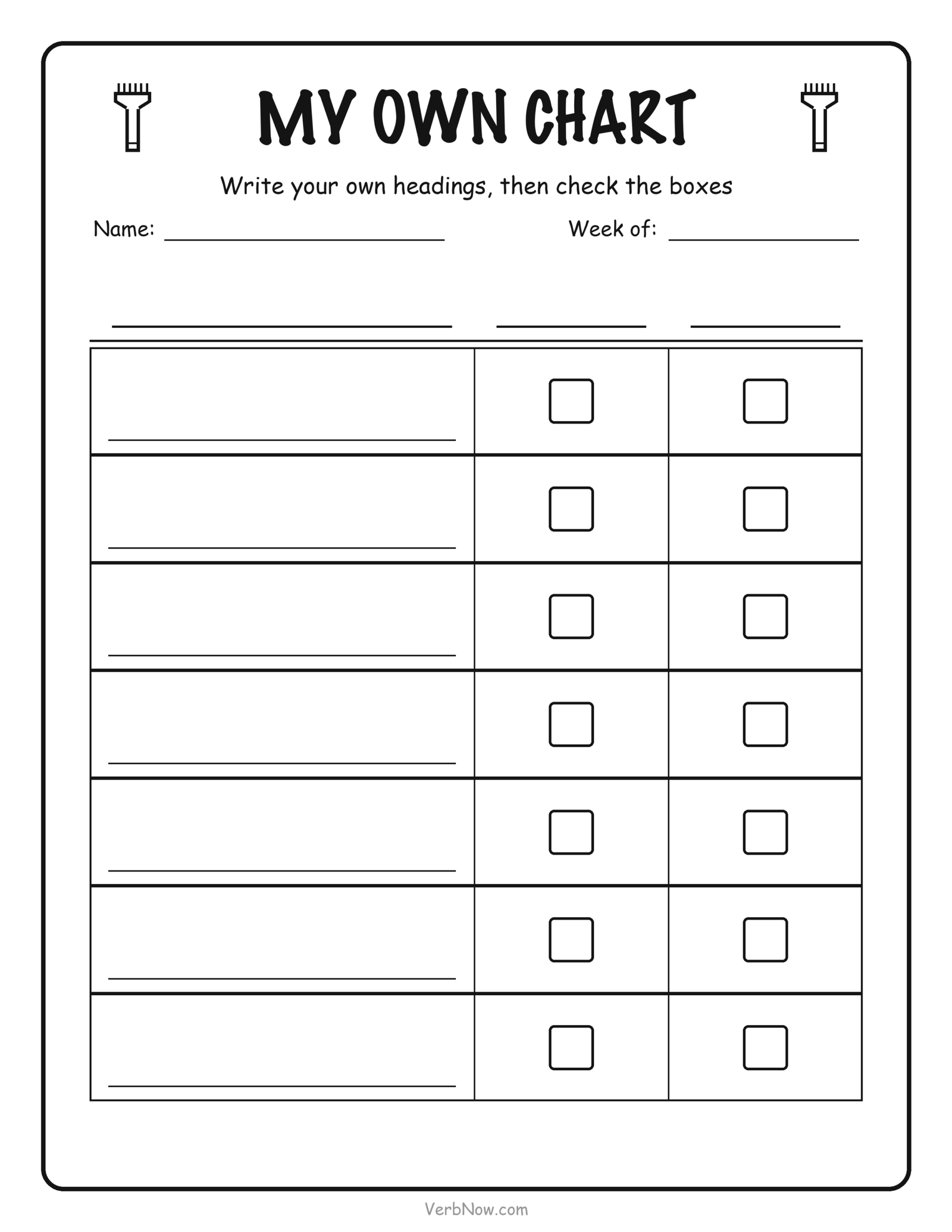
A blank chart you label yourself
The blank chart prints three empty column headings and seven ruled rows with paired check boxes and nothing else.
Households track different things next to brushing — flossing for one child, mouthwash for another, a bedtime cutoff for a third — and no fixed template covers that. Writing the headings by hand takes ten seconds and beats crossing out a printed column. Rows are about 0.96 in tall here so the write-on line is usable by the child rather than only by an adult.
How to print and use these
All 7 pages are US Letter (8.5 × 11 in) with half-inch margins and print in pure black and white, so no color ink is used. Set your printer to Actual Size rather than Fit to Page — Fit to Page shrinks the sheet by a few percent, which is enough to pull the sticker squares under the size a standard round sticker needs. For repeat use, slide the weekly, monthly or blank chart into a plastic sleeve and fill it in with a dry-erase marker; the boxes are drawn large enough to wipe clean. Tape it at the child’s eye height next to the sink, not at adult eye height.
One boundary worth stating plainly: anything about your child’s actual teeth — when to start flossing, which toothpaste and how much of it, whether a brushing habit is going well — belongs with your dentist, not with a chart. These pages track the habit. They are not dental advice, and nothing here is a claim about what brushing will or will not do.
Tooth brushing chart FAQ
What should a tooth brushing chart for a 2 year old look like?
It should have no words inside the grid. A two-year-old cannot read Monday or Morning, so the meaning has to sit in the pictures: a sun for the morning brush, a moon for the night one, drawn large enough to tell apart across the room. The picture-only chart here does exactly that, with 0.83 in boxes for a whole-hand crayon grip.
How many boxes should a brushing chart have for one week?
Fourteen — seven days with two boxes each. A chart with seven boxes for seven days records that brushing happened, not how often, and the difference between one brush and two is the whole thing a parent is usually watching. Every weekly page in this set is built as 7 × 2.
Do I need stickers to use these charts?
No. Six of the seven charts are drawn for a crayon, marker or pen mark, and the boxes range from 0.32 in on the monthly sheet up to 0.83 in on the toddler one. Only the sticker chart is sized around a sticker, at 0.95 in per square, and it works just as well coloured in.
Can I print one chart and reuse it every month?
Yes. The weekly, monthly and blank charts have a “Week of” or “Month” line instead of printed dates, so one printed copy in a plastic sleeve works all year with a dry-erase marker. The two-week chart is meant to be kept rather than wiped, since the reward line at the bottom is part of the record.
Why do the charts have two boxes a day?
Because brushing twice a day, for two minutes each time, is the schedule dentists commonly recommend, and a chart with one box a day cannot show whether it happened once or twice. The pages record that pattern; they do not judge it. For anything specific about your child’s teeth or brushing routine, ask your dentist.
These charts sit next to the other tracking pages here: the printable chore charts cover recurring jobs, the routine charts cover the order of a morning or a bedtime and already include a brush-teeth step, and the behavior charts and reward charts track progress toward a goal. If your child would rather colour than tick, the dentist coloring pages cover the same subject as pictures instead of a grid.