
This set has 7 free homework planner printables, and each one plans a different span of time: one night, one school week, one month, or the last two minutes before the work goes in the bag. Pick by grade rather than by looks — a big-print page with four columns for grades 1-3, a six-column page with priority and estimated time for middle school. Every page is US Letter, pure black and white, and free to download as a PDF with no signup.
The design decision that shaped all seven is the one most planners get wrong: the writing rows have to fit the handwriting of the child who owns the page. I set a hard floor of 0.70 in per writing row for the elementary pages and let the layout fail the build if it dropped below — the daily planner came out at 0.83 in per row and the grades 1-3 page at 1.18 in. The middle school page is the only one that goes below that, at 0.59 in, and it buys two extra columns with the space.
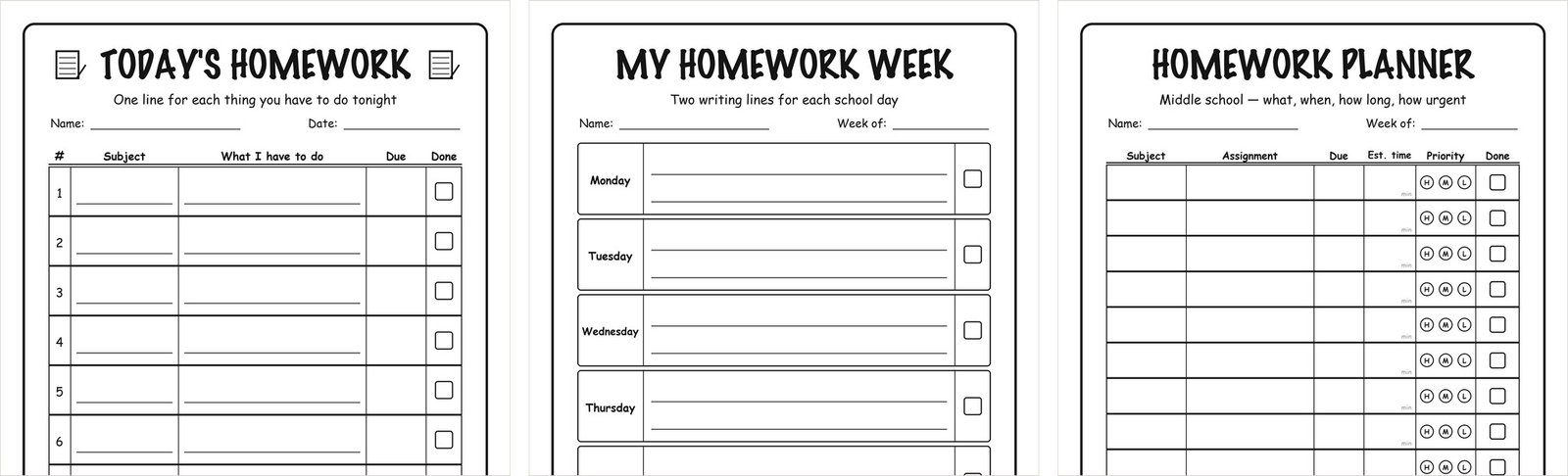
All 7 homework planners
Every page below has its own Download PDF and Print button.
Which homework planner fits your child’s grade
Choose on two questions: how fast the child writes, and whether homework arrives one night at a time or one week at a time.
A second grader copying an assignment off the board needs wide rows and few of them, because the writing itself is the slow part. A seventh grader with five teachers needs the opposite — more rows, narrower, plus somewhere to record which assignment is due first. And a child who gets a packet on Monday for the whole week does not need a nightly page at all; that child needs the week on one sheet.
- Grades 1-3, still forming letters — the big-print planner, 6 rows at 1.18 in each.
- Grades 3-5, homework given nightly — the daily planner, 8 rows at 0.83 in.
- Any grade, homework given weekly — the weekly planner, one row per school day.
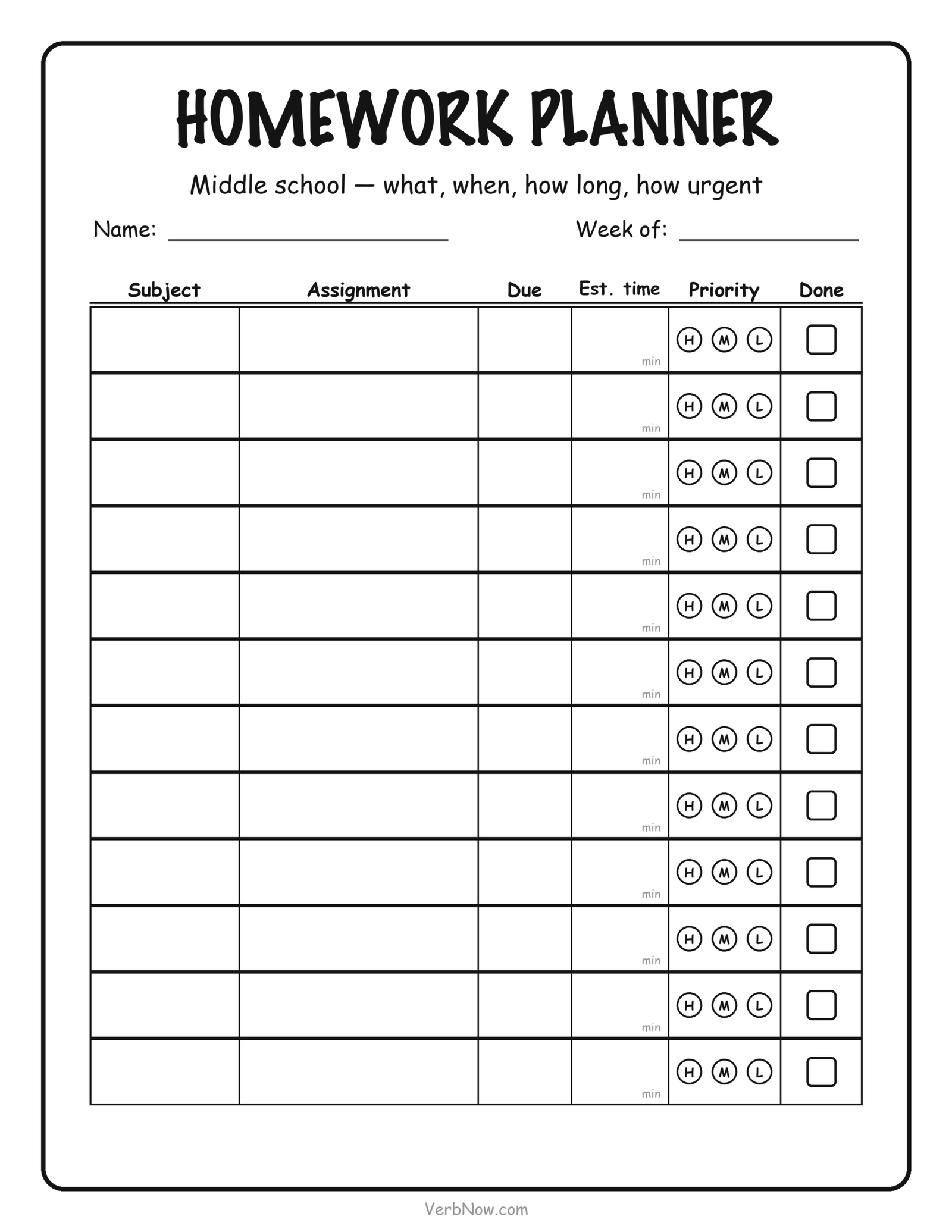
- Middle school, several teachers — the 12-row planner with due date, estimated time and priority.
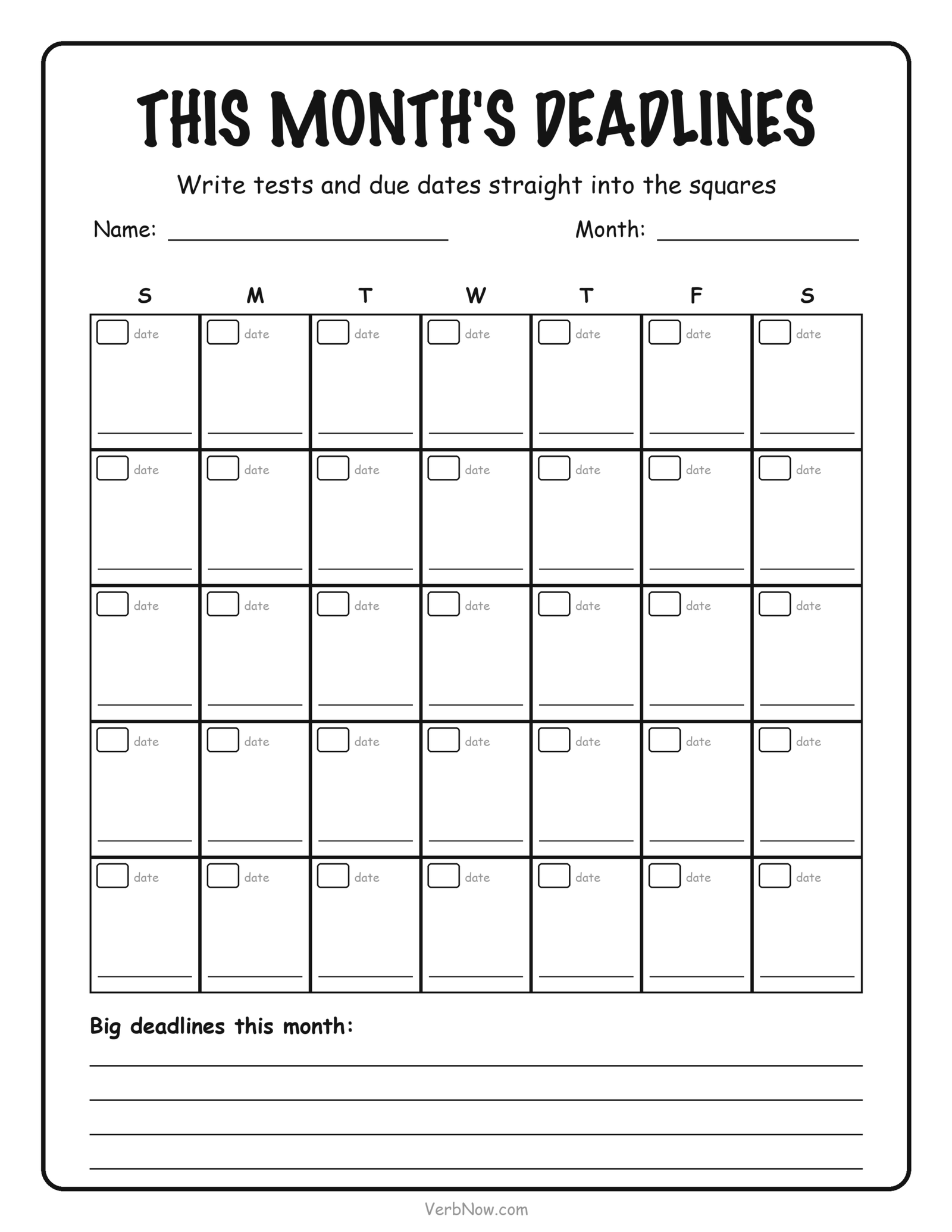
- Tests and projects weeks away — the monthly assignment tracker.
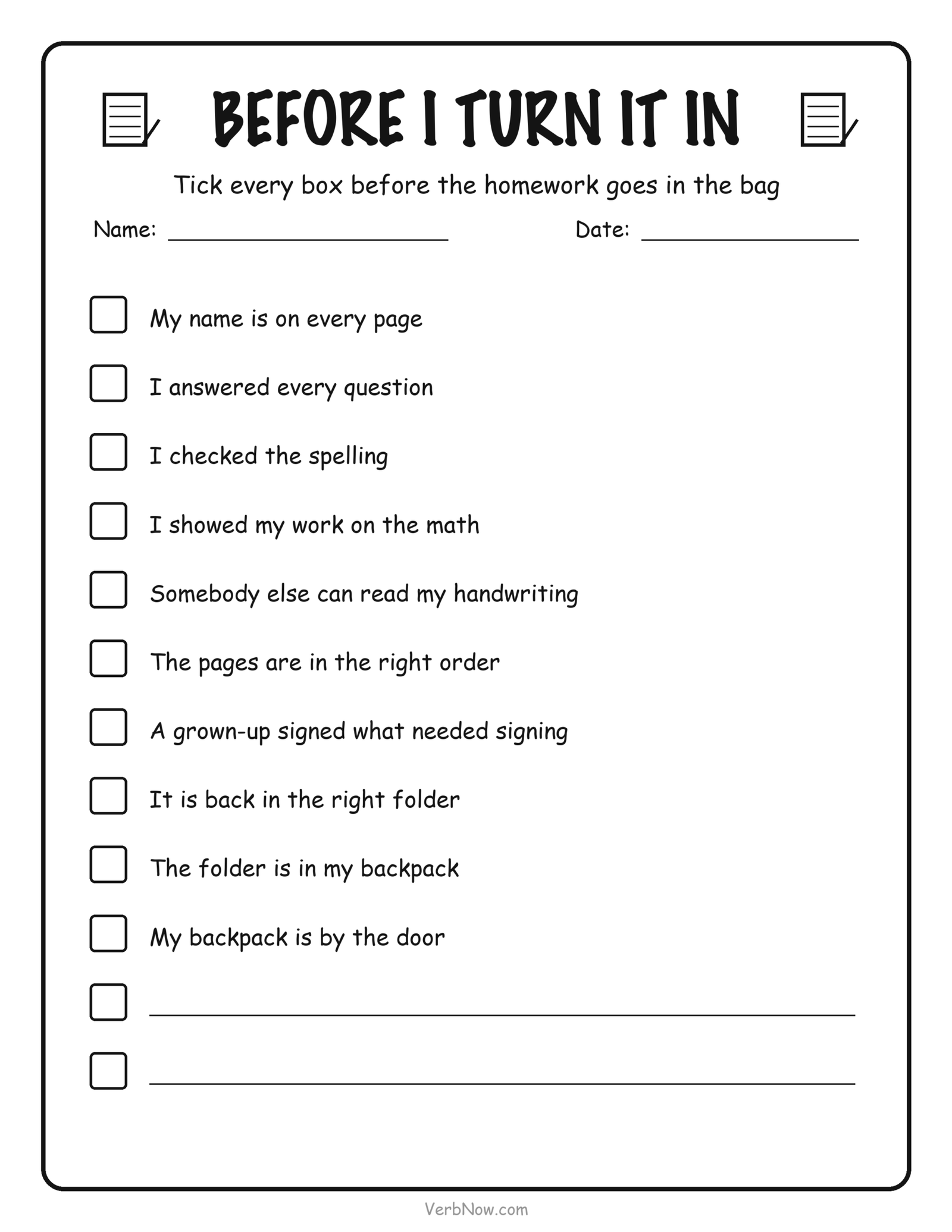
- Work that gets finished but not handed in — the before-I-turn-it-in checklist.
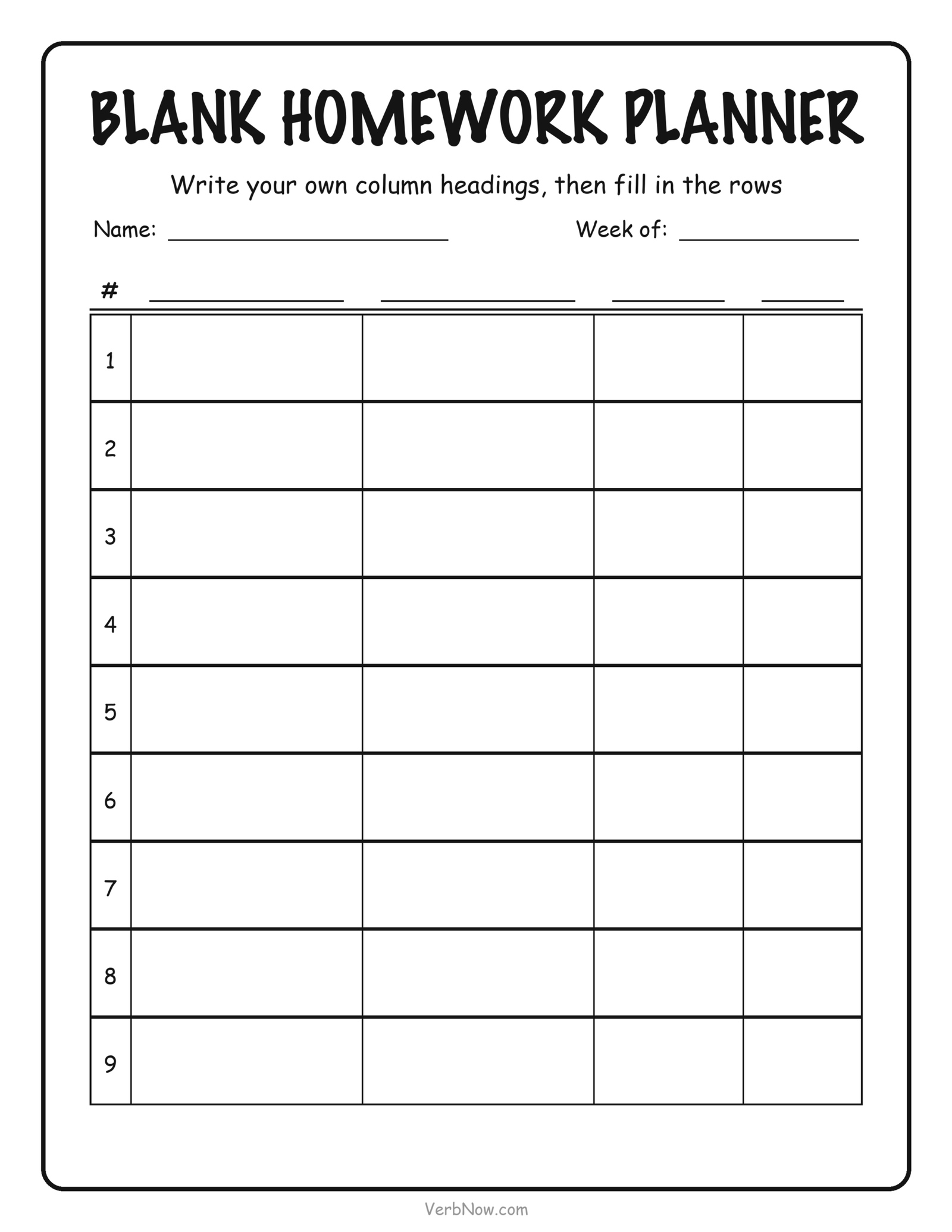
- A teacher’s own format — the blank planner, where you write the headings.
The daily homework planner (one night at a time)
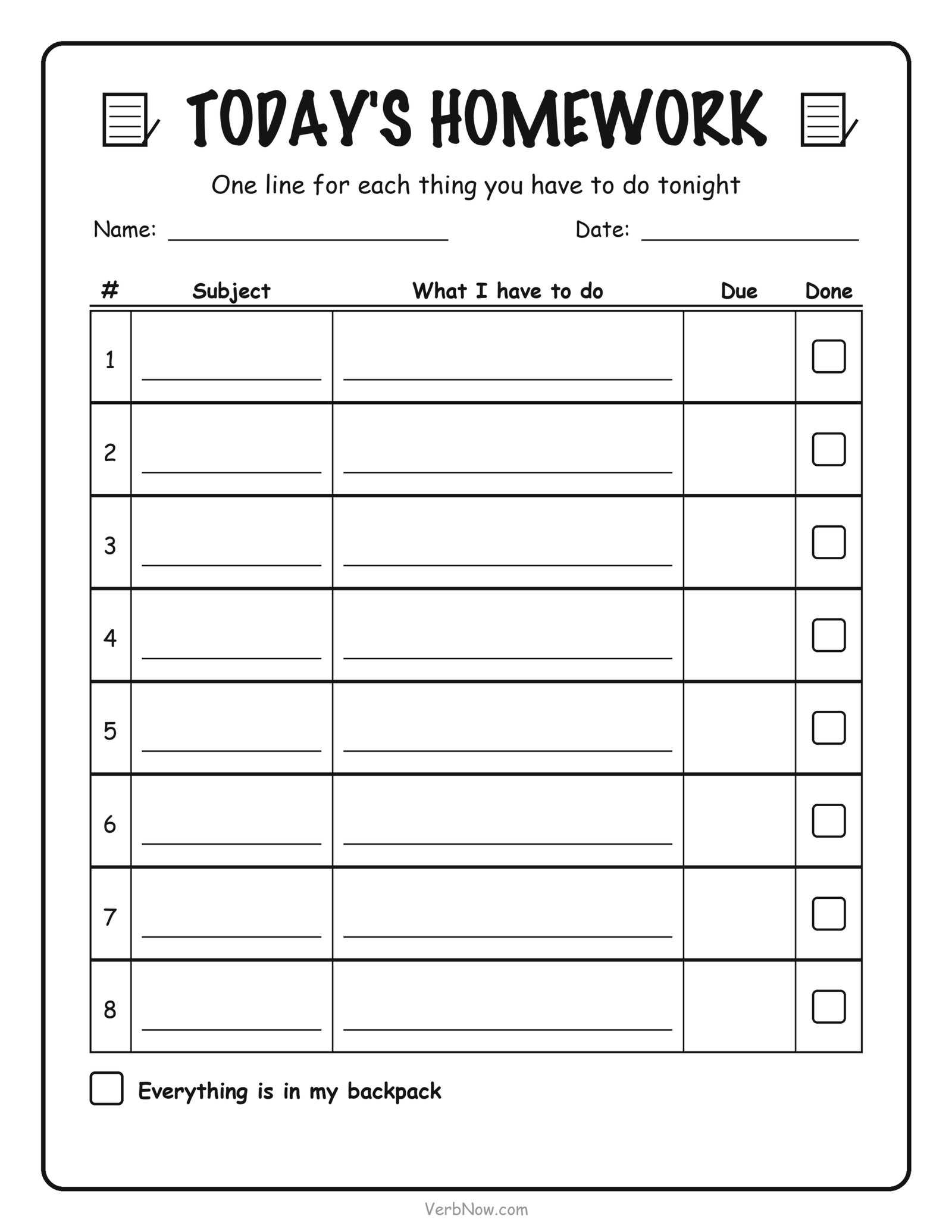
The daily page is an eight-row table with five columns: number, subject, what I have to do, due, and a done box.
Eight rows is the deliberate limit. Fitting twelve or more on one sheet would drop each row under 0.60 in, and a child writing “read chapter 4 and answer questions 1-6” in that space runs out of room before the sentence ends. The “what I have to do” column is the widest at 3.13 in because it always holds the longest text on the row, while “due” gets 1 in and the done box 0.60 in — neither ever holds more than a date or a tick. A single check box sits under the table for “everything is in my backpack”, which is the step that gets skipped.
The weekly homework planner (Monday to Friday on one page)
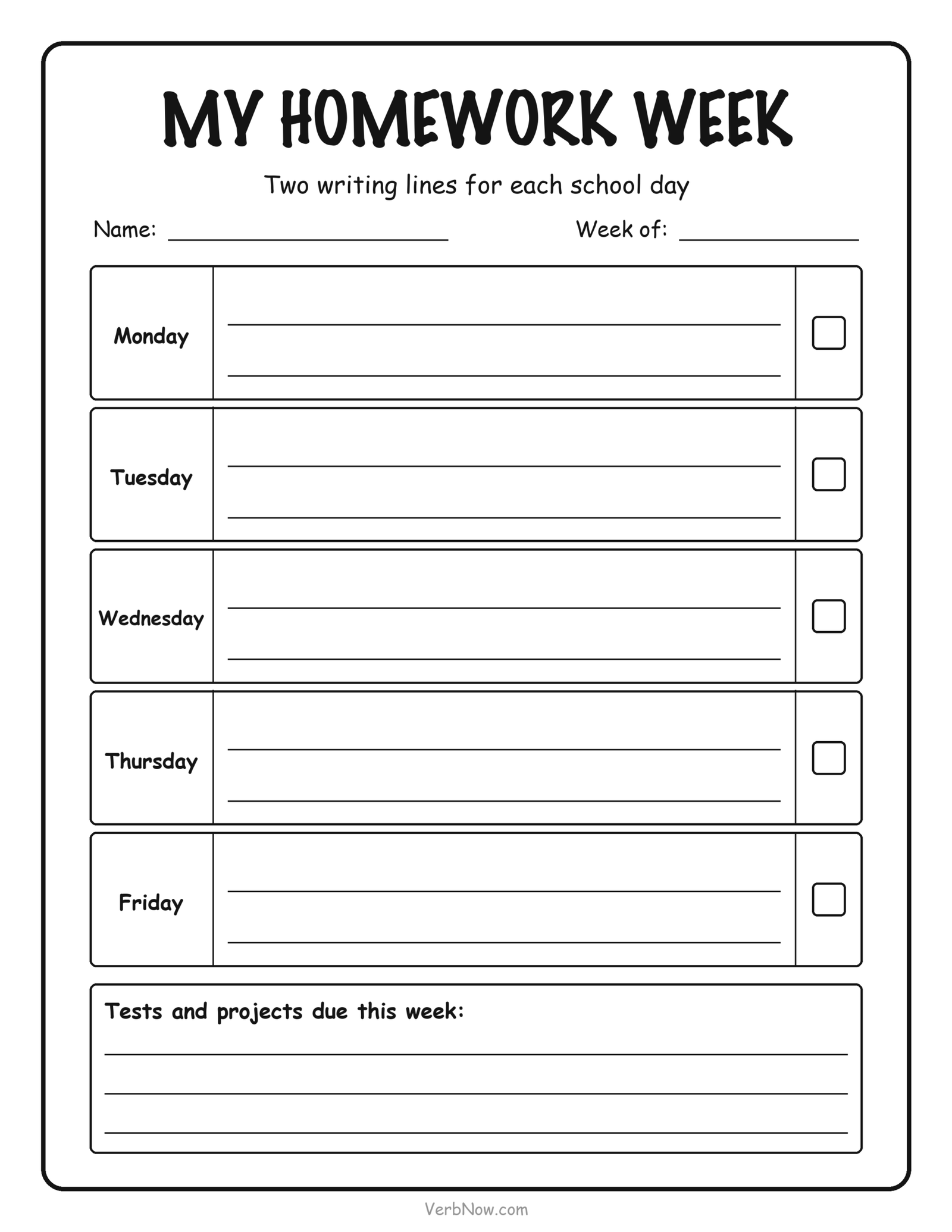
The weekly page gives one row per school day with two ruled writing lines inside it, a tick box at the end of each day, and a box at the bottom for tests and projects due that week.
Each day cell is 1.21 in tall, which is what makes two usable lines fit rather than one cramped one. Two lines is a decision about how homework actually arrives — most nights have one or two things, not six, and a row that promises six empty slots makes a normal Tuesday look like a failure. The weekend is left off on purpose: five days, five rows, and the space goes into the rows that get used.
A big-print planner for grades 1-3
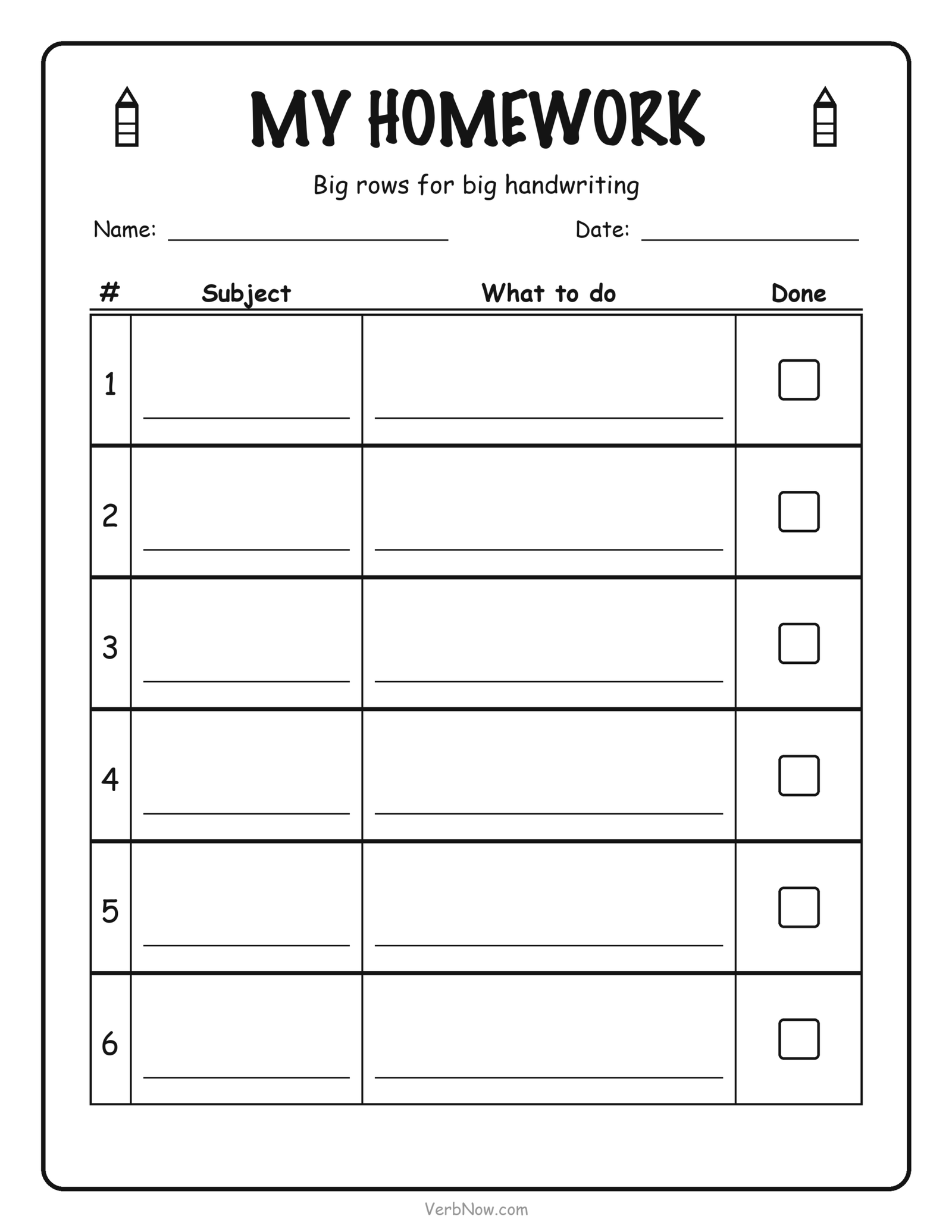
The big-print page holds six rows at 1.18 in each, four columns, and a 0.37 in check box — the fewest entries of any page here and the largest writing space.
Early elementary handwriting is tall before it is neat, and letters formed at that size need close to an inch of clear height, not a ruled band sized for an adult. Each of the two writing columns carries a printed baseline near the bottom of the cell so the child has something to sit the letters on, which is how primary handwriting paper works. Six rows is enough for a night of first-grade homework and small enough that the page never looks like a form.
The middle school homework planner, with priority and time
The middle school page is a free printable PDF with 12 rows and six columns: subject, assignment, due, estimated time, priority, and done. Priority is three printed circles marked H, M and L, so it is circled rather than written.
This is the only page in the set that drops under the 0.70 in floor, down to 0.59 in per row, and that is the trade being made: a middle schooler writes smaller than a second grader, so the same sheet of paper buys two more columns instead of taller rows. The estimated time column carries a small printed “min” so the number written there means minutes without anyone having to decide. Twelve rows covers a full week across five or six subjects, which is why the header line says “week of” rather than “date”.
A monthly tracker for tests and long projects
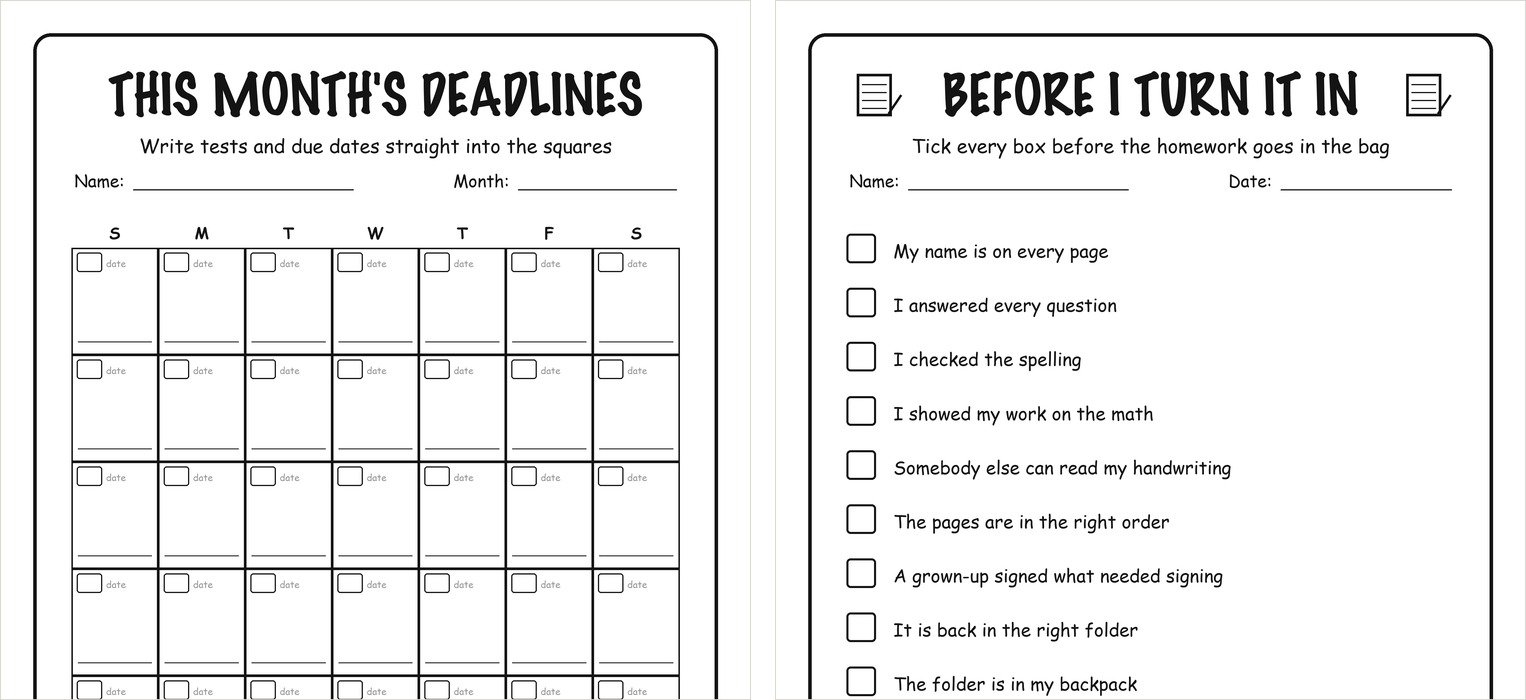
The monthly tracker is a calendar of 35 squares, each about 0.99 in wide and 1.21 in tall, with a small box for the date and a writing line underneath, plus four ruled lines at the bottom for the month’s biggest deadlines.
A nightly planner cannot show a test that is three weeks out, and that is exactly the homework children miss. This page is meant to be filled in once, when a syllabus or a project sheet comes home, and then left on a wall — the squares hold a few words each rather than a full assignment. The date boxes are empty so one printed copy works for any month, in any year.
The before-I-turn-it-in checklist
The checklist has 10 printed steps and 2 blank rows, each with a 0.33 in tick box: name on every page, every question answered, spelling checked, work shown on the math, handwriting readable, pages in order, signatures collected, back in the right folder, folder in the backpack, backpack by the door.
The last three steps are the reason the page exists. Finished homework and handed-in homework are two different things, and the gap between them is a folder, a bag and a doorway. The tick boxes are drawn at 0.33 in rather than the small squares a form would use, so a child can mark them with whatever is already in their hand. The two blank rows at the bottom are for the rule your child’s classroom has that nobody else’s does.
A blank planner you label yourself
The blank planner gives four empty column headings and nine numbered rows at 0.79 in each, with a ruled line above each column where you write the heading.
Classroom requirements vary in ways no fixed template covers — some teachers want a parent signature per subject, some want minutes, some want a page range or a reading level. Writing four headings by hand takes a few seconds and beats crossing out a printed column every night. Nine rows fit here rather than twelve because columns you name yourself tend to hold longer entries than a column labelled “due”.
How to print and use these
All 7 pages are US Letter (8.5 × 11 in) with half-inch margins and print in pure black and white, so no color ink is used. Print at 100% rather than “fit to page” — scaling down is what shrinks the writing rows below the heights above. For repeat use, slide the weekly planner, the monthly tracker or the checklist into a plastic sleeve and fill it in with a dry-erase marker; every one of those three has a Week of or Month line instead of printed dates, so the same sheet works all year.
Homework planner FAQ
What should a homework planner for elementary school look like?
Few rows, wide rows, and no more than four columns. A row under about 0.70 in tall is shorter than the line height on primary handwriting paper, so a child forming letters at normal size writes outside the box and the page starts to feel like a test. The big-print page here uses six rows at 1.18 in for that reason, and the daily page eight rows at 0.83 in.
What is the difference between a daily and a weekly homework planner?
A daily planner has one line per assignment and gets a fresh sheet every night; a weekly planner has one row per school day and lasts the whole week. Use the daily one when homework is handed out night by night and there are several pieces at a time. Use the weekly one when a packet or list arrives on Monday for the whole week, since a nightly page then just copies the same list five times.
Should a homework planner have a column for how long the work will take?
It helps once a child has more than one teacher, and it is wasted space before that. An estimated time column turns “I have three things” into an amount of evening, which is what makes a child start with the long one instead of the easy one. Only the middle school page here carries that column; the elementary pages spend the width on writing space instead.
What is a good free homework planner for middle school?
One that records the due date and the size of the job, not just the assignment. The middle school PDF here has 12 rows and six columns — subject, assignment, due, estimated time, priority and done — which covers a week across five or six teachers on a single sheet. It downloads free, prints on US Letter in black and white, and needs no account.
How do I stop homework getting finished but not handed in?
Separate the two steps and give the second one its own page. The before-I-turn-it-in checklist ends with three steps that have nothing to do with the work itself — back in the right folder, folder in the backpack, backpack by the door — because that is where finished homework usually stops. The daily planner carries the same idea as a single box under the table.
Can I print one homework planner and reuse it every week?
Yes, for three of the seven. The weekly planner, the monthly tracker and the blank planner all have a Week of or Month line rather than printed dates, so one copy in a plastic sleeve works all year with a dry-erase marker. The daily planner and the checklist are single-use by design, since a fresh sheet each night is the point.
Homework planners sit next to the other tracking pages here: the printable chore charts cover jobs around the house, the routine charts cover the order of a morning or a bedtime, the reading logs track books and minutes read, and the behavior charts track progress toward a goal. If the school year is only just starting, the back to school printables cover the first-day pages and supply checklists.