
This set has 8 free potty training chart printables, and each one records something different: one square per success, a week at a glance, the six steps in picture order, fourteen days with words, a path toward one prize, or a certificate at the end. Pick by what your child can already do — a page with no reading on it for a two-year-old, a worded table once they can read. Every page is US Letter, pure black and white, and free to download with no signup.
The design decision behind the whole set is the one most potty charts get wrong: the squares have to fit a sticker and a toddler’s aim, not an adult’s. I drew the sticker chart at 30 squares instead of 50 so each one lands at about 1.04 in (26 mm) — a hair over the standard 1 in reward sticker, so a child who places it crooked still lands inside the box. Fewer squares per page, bigger squares.
These are tracking and encouragement charts, not a training method and not medical advice. Children reach this milestone on their own timeline, and questions about readiness, setbacks or anything that worries you belong with your pediatrician.
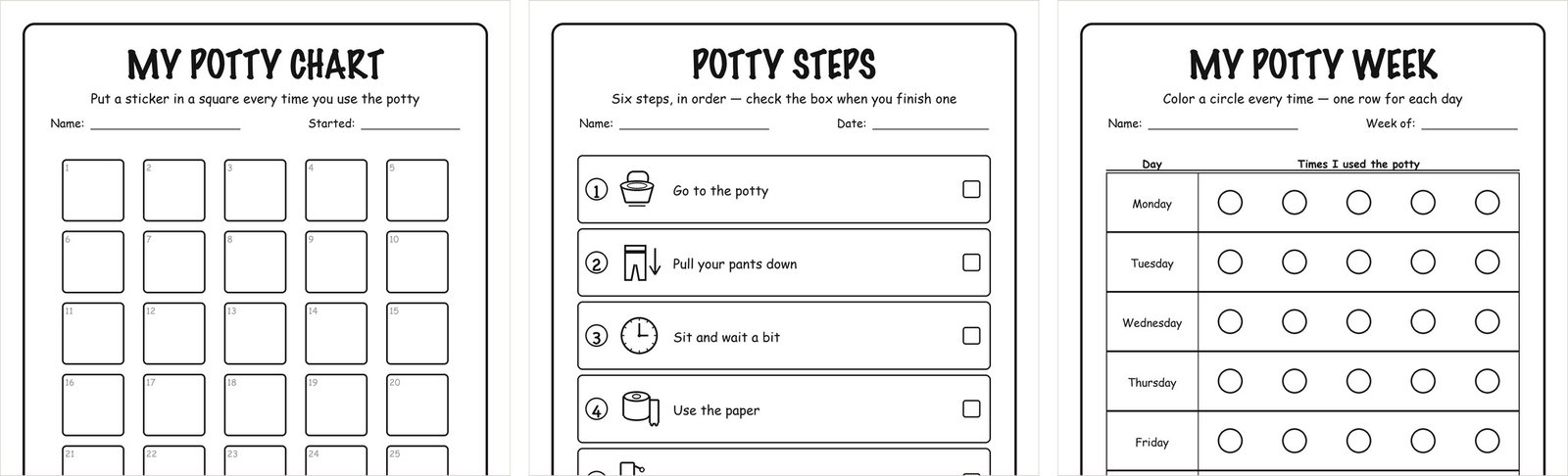
All 8 potty training charts
Every page below has its own Download PDF and Print button.
Which potty chart to print
Choose on two questions: can the child read yet, and what are you actually counting — single successes, whole days, or the steps themselves.
A child who cannot read needs a page with nothing to decode, so the sticker chart and the picture step chart are the only two that work on their own. A child who reads short words can handle a column heading, which is what the big kid chart and the blank chart assume. And if the thing you want on the fridge is a week rather than a running total, that is a different page again.
- Cannot read yet, counting single successes — the 30-square sticker chart.
- Cannot read yet, learning the order — the six-step picture chart.
- One week at a time on the fridge — the weekly chart, 7 rows of 5 circles.
- Reads short words — the big kid chart with three worded columns.
- Working toward one agreed prize — the 20-circle reward path.
- Finished, and it deserves marking — the certificate.
- Travel, daycare, or a second copy — the sheet of four mini charts.
- Anything else — the blank chart, where you write the column headings.
The sticker chart for a child who cannot read yet
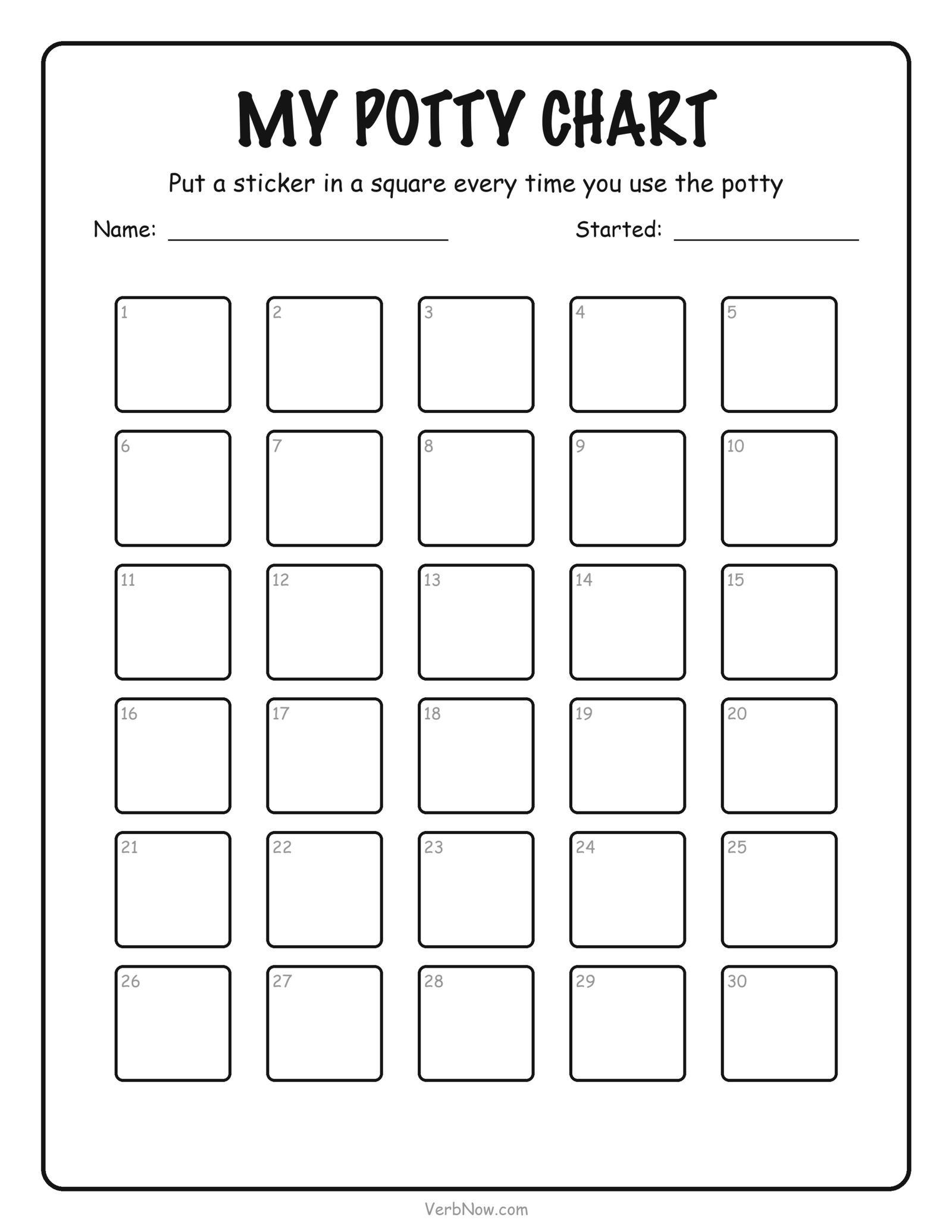
This page holds 30 numbered squares and asks for no reading at all — one square gets a sticker, or a scribble of crayon, for each success.
Each square is drawn at about 1.04 in (26 mm), which is the measurement that matters most on this page. Standard reward stickers are sold at 1 in, so a square cut to exactly 1 in leaves no tolerance and a toddler’s sticker ends up half on the line. The numbers sit small and grey in the top-left corner of each square rather than in the middle, so they never compete with the sticker for space, and the interior of every square is completely empty.
A week on one page
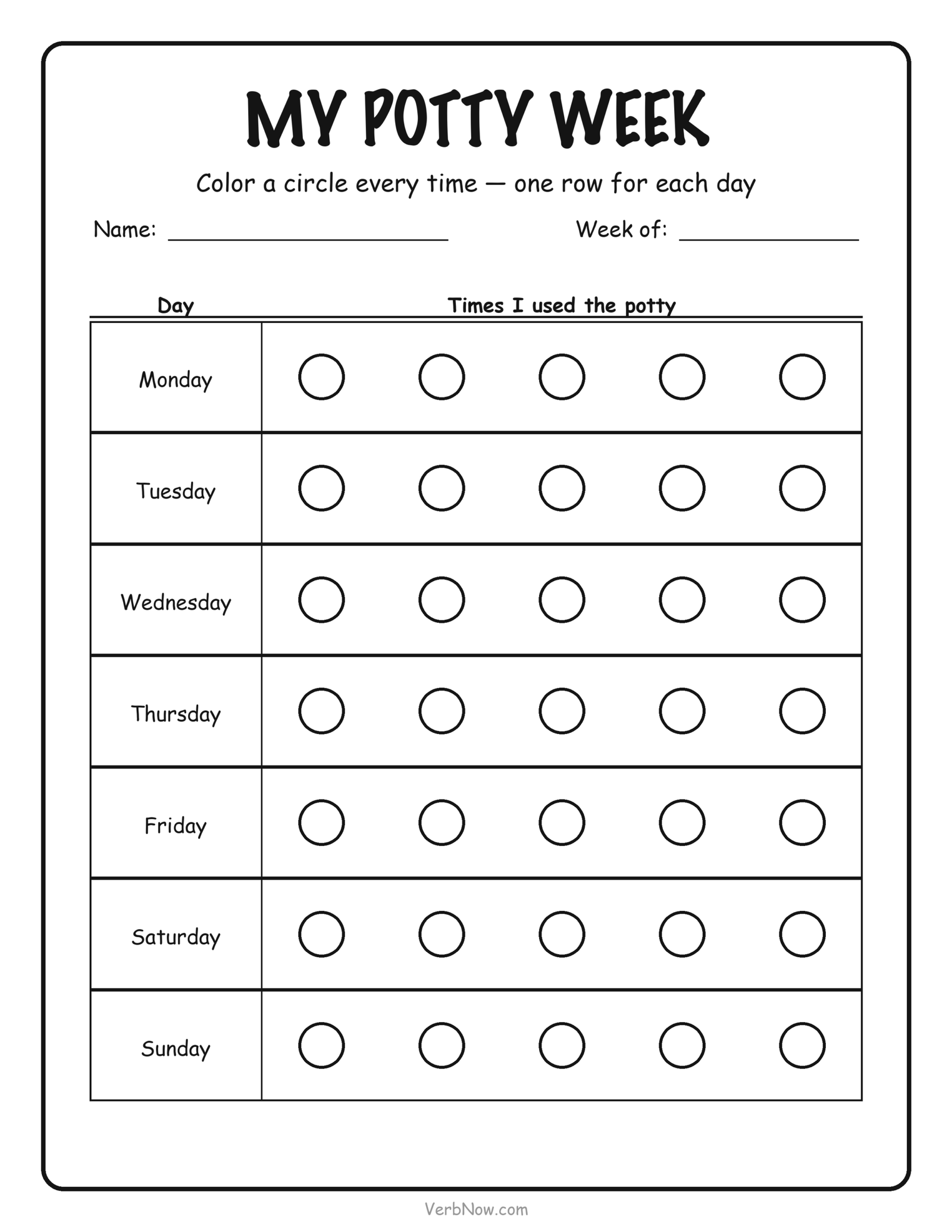
The weekly chart is seven day rows with five circles in each, 35 circles in total, and a row height of a full inch.
Five circles per day is a deliberate ceiling rather than a target. A row with twelve circles on it reads as a quota, and a row with two reads as already failed by lunchtime; five sits in the middle and leaves the page honest whether the day filled up or not. The circles are 0.41 in across and spaced 1.07 in apart, far enough that a crayon filling one does not stray into the next.
The picture chart that shows the steps in order
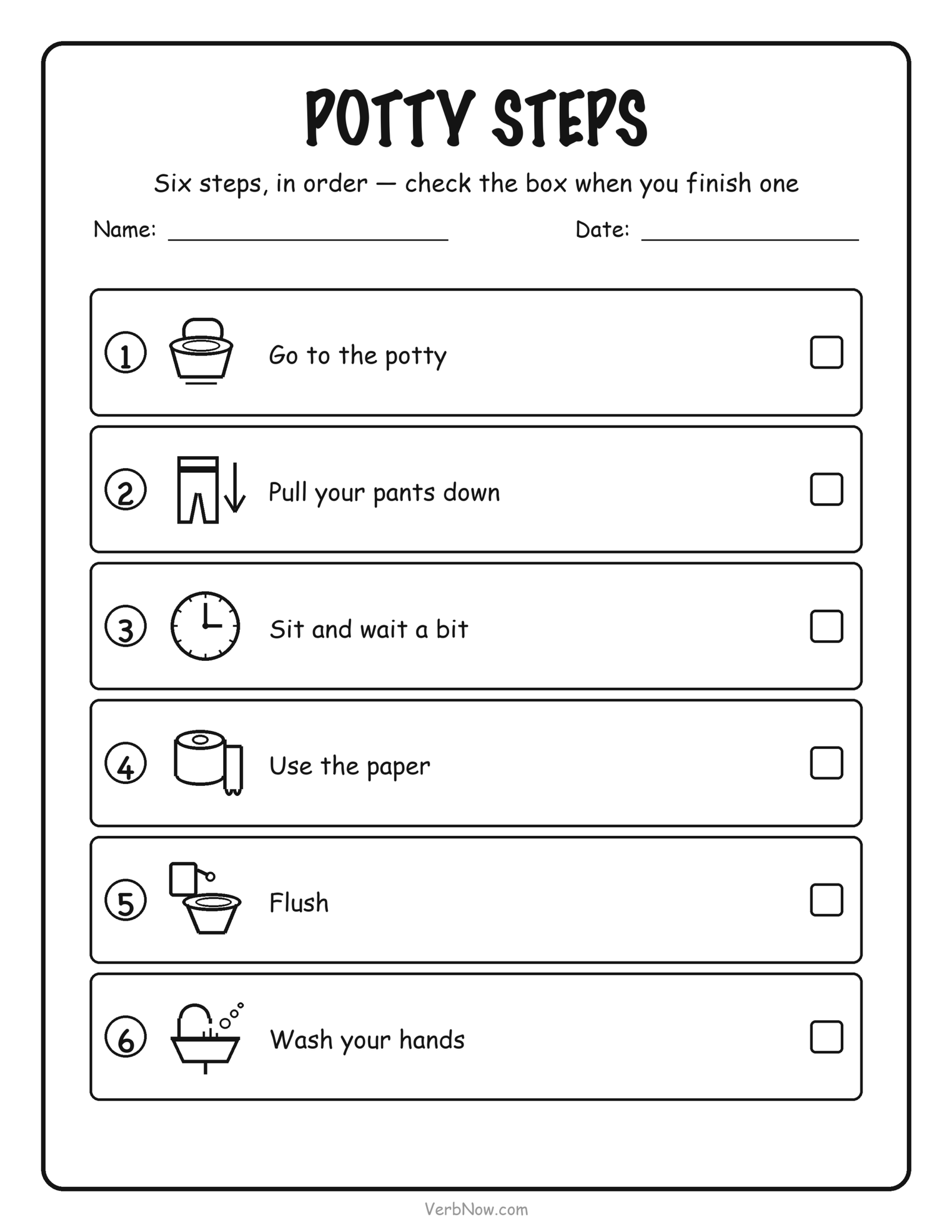
The step chart lays out six steps in picture form — go to the potty, pull your pants down, sit and wait a bit, use the paper, flush, wash your hands — each with a number, a drawing and a check box.
The drawings carry the page, so they were the hardest part to get right. The potty in step one and the toilet in step five are drawn as deliberately different silhouettes: step one is a low pot with a seat ring and a backrest, step five is a full toilet with a tall cistern and a handle. Drawn at similar heights they would collapse into the same shape and the sequence would stop making sense. Each icon is 0.73 in tall in a row 1.22 in deep, which leaves the word label room to sit beside it rather than under it.
A big-kid chart with words
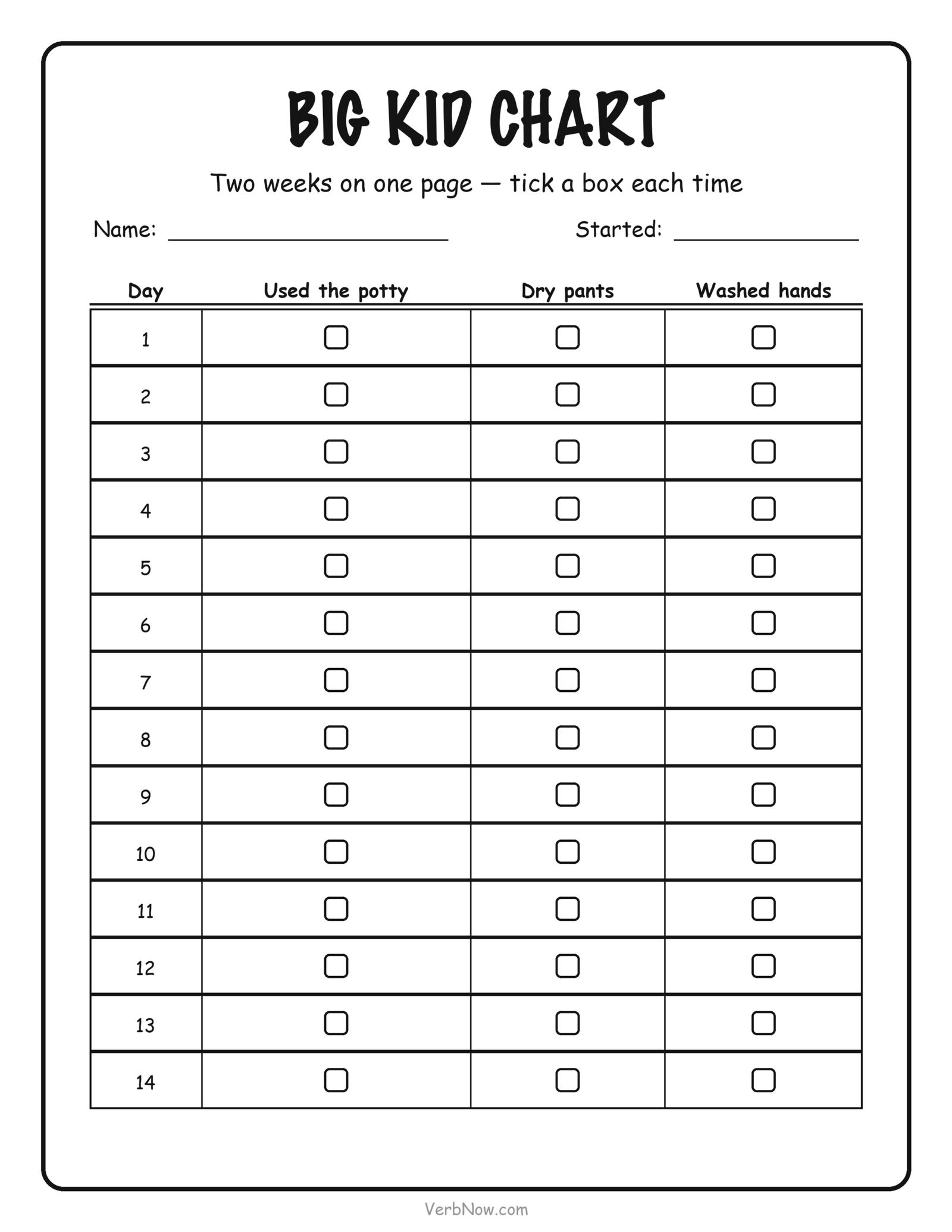
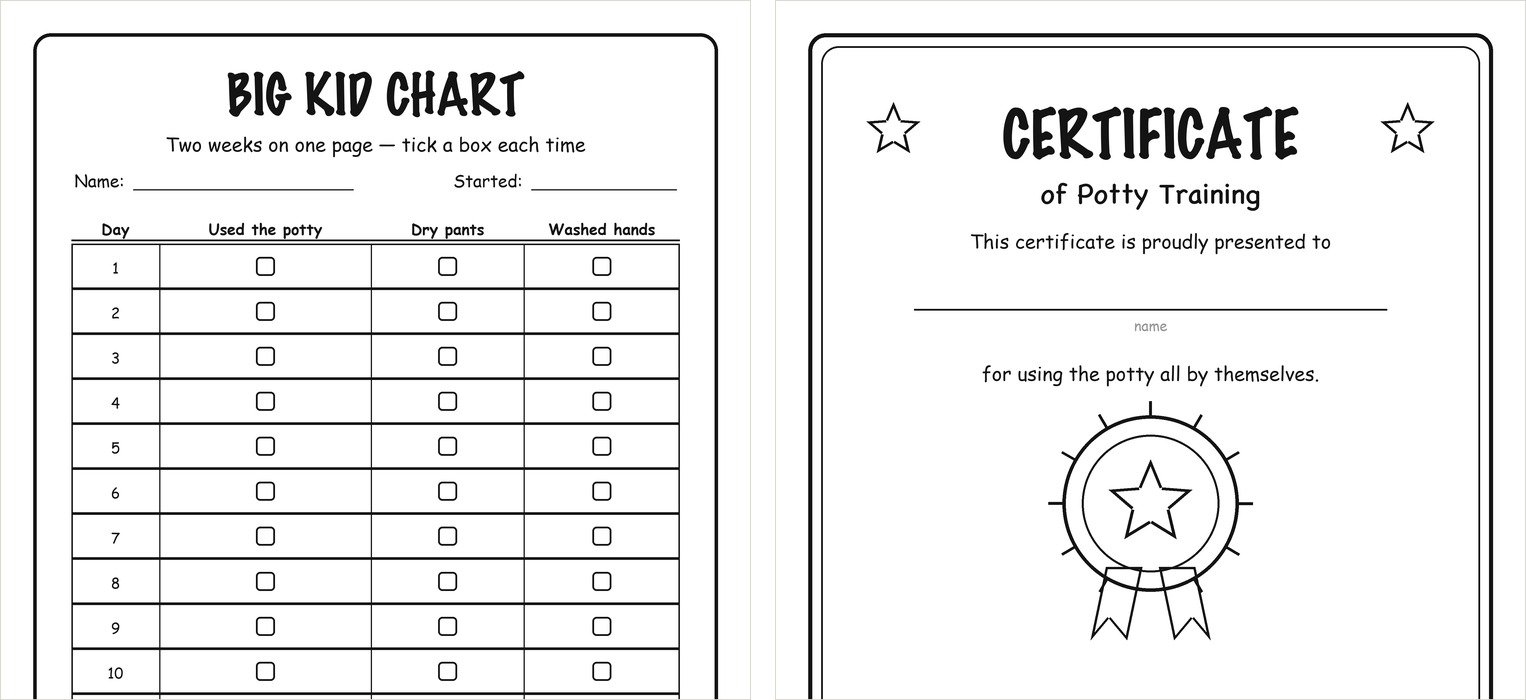
The big kid chart is a fourteen-row table with three worded columns — used the potty, dry pants, washed hands — for 42 check boxes in total.
Fourteen rows is what fits two full weeks on one sheet without dropping the row height below half an inch. Washed hands earns its own column on purpose: it is the step that gets skipped once the novelty wears off, and a column makes the omission visible without anyone having to say anything. The boxes are 0.21 in, sized for a tick from a child rather than a sticker.
A reward path with 20 steps
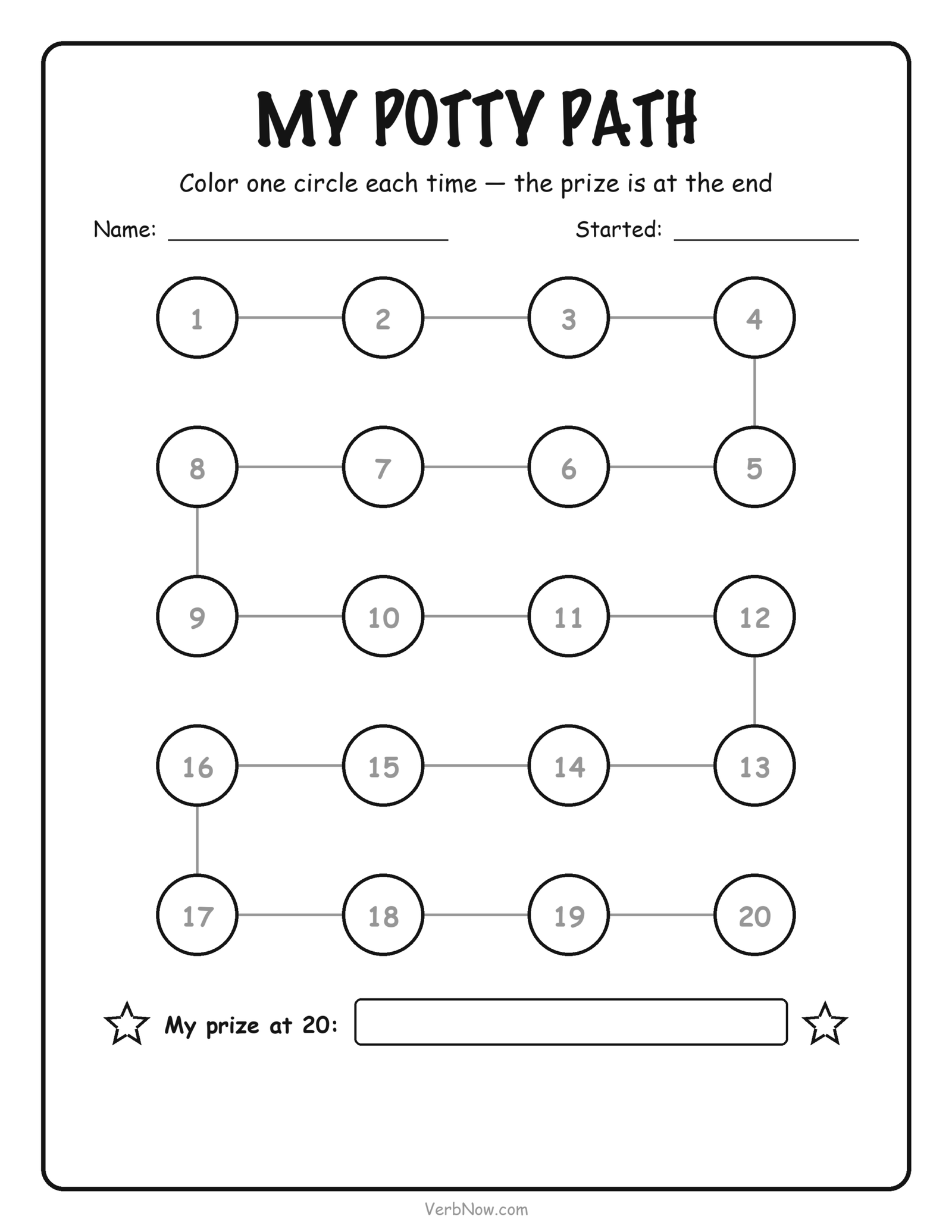
The reward chart is 20 numbered circles joined into a winding path, with a box at the bottom to write the agreed prize.
The circles are 0.73 in across, large enough to fill with a marker in one pass, and the path snakes left to right then right to left so the next circle is always the nearest one — a straight grid makes a child hunt for where they were. The prize box is left blank rather than pre-filled with a suggestion, because the only useful prize is the one already negotiated at your kitchen table.
A certificate to print at the end
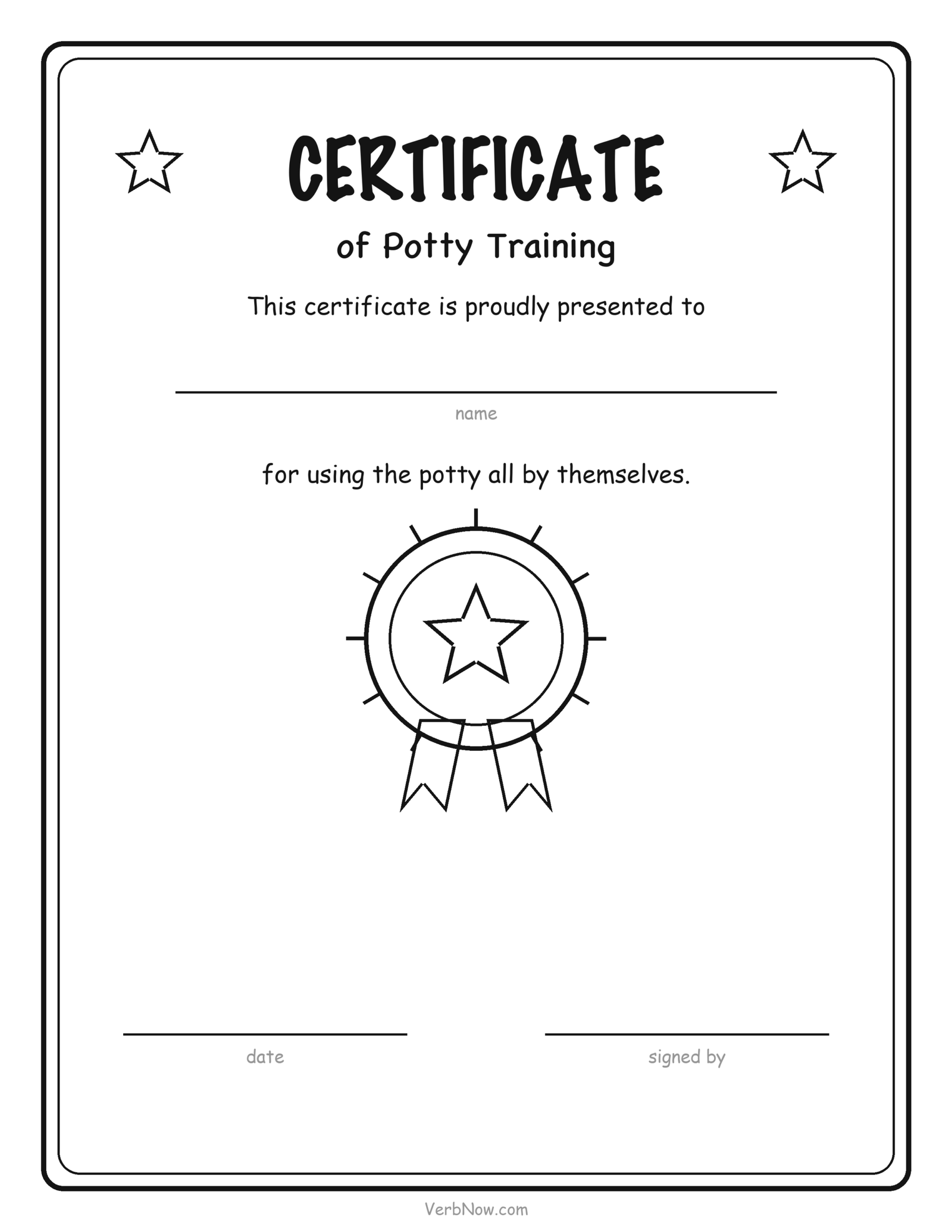
The certificate has three lines to fill in — the child’s name, the date, and a grown-up’s signature — around a star medal with ribbons.
The name line runs nearly the full width of the page, which is more room than a name needs and exactly as much as a child wants when they write it themselves. I drew the medal as a rosette rather than a plain star so there is something worth coloring after the writing is done, and left the whole thing in outline for that reason.
Four mini charts on one page
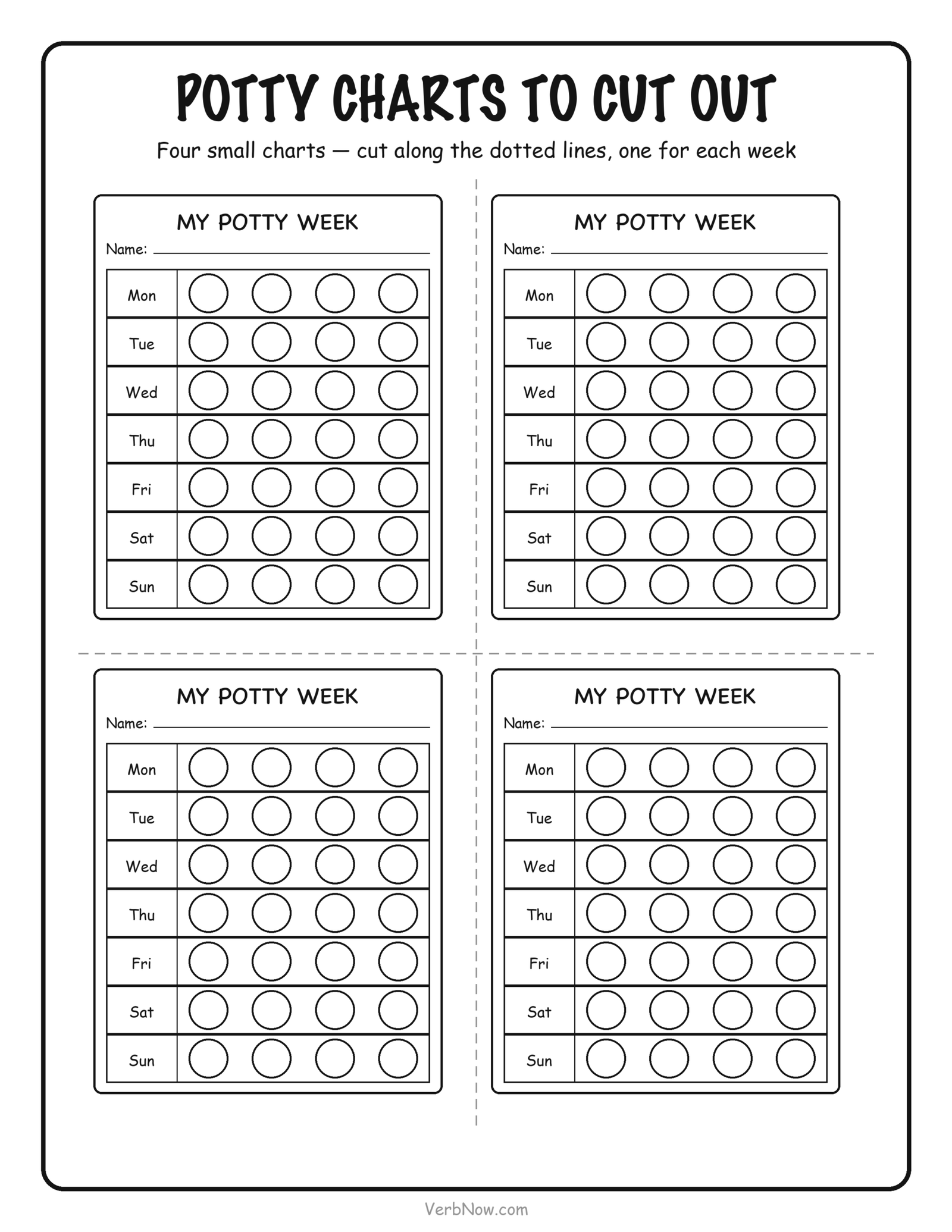
This sheet holds four identical small charts, each 3.1 by 3.8 in, with seven day rows and four circles a day. Dotted cut lines run between them.
The mini charts exist for the places a full sheet does not go: a diaper bag, a grandparent’s fridge, a daycare cubby, a suitcase pocket. Four copies also means a month of weeks from a single print. The circles drop to 0.35 in here, which is the smallest size on any page in this set and the reason these are marked with a pen or a small sticker rather than a fat crayon.
A blank chart you label yourself
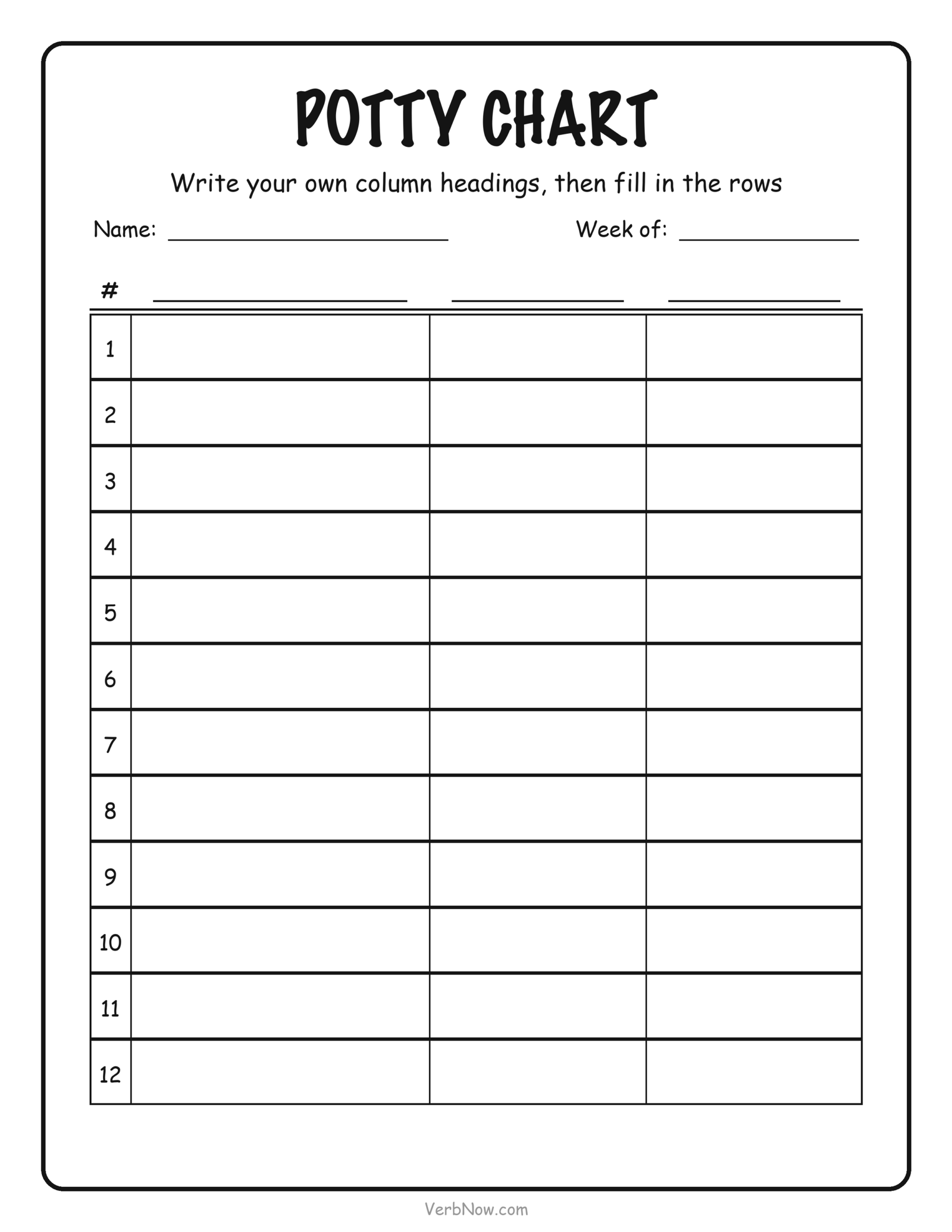
The blank chart gives you three empty column headings and twelve ruled rows, with the row numbers already printed.
Every worded chart in this set makes an assumption about what you are tracking, and some households are tracking something else — nap-time only, one specific bathroom, a nursery’s own wording. The rows are 0.59 in, tall enough to write a short word inside, and the headings sit on ruled lines rather than in printed boxes so a long heading is not forced to fit a box.
How to print and use these
Every page is built at US Letter, 8.5 by 11 in, with a 0.5 in safe margin, so nothing important sits where a home printer’s grip rollers cut off. Print at 100% or “actual size” rather than “fit to page” — scaling shrinks the sticker squares below the 1 in sticker they were sized for.
- Black and white only. No page uses grey fill or a colored background, so a draft-quality or economy setting still prints clean lines.
- Plain copy paper is enough for the charts. The certificate is the only page worth putting on card stock.
- To reuse a page, slide it into a plastic sleeve or laminate it and mark it with a dry-erase marker. The weekly chart, the mini charts and the blank chart all have a Week of line instead of printed dates, so one copy works all year.
- Tape it at child height, not adult eye level. Every page is portrait with the name line at the top, so it reads correctly taped low on a bathroom door or the side of a cabinet.
Frequently asked questions
What should a potty training chart look like for a 2 year old?
It should have nothing on it to read. At that age a child can place a sticker, color a circle and see a page filling up, but printed column headings are decoration to them. The sticker chart and the picture step chart here are the two built on that basis — the first asks only for a sticker, the second replaces every instruction with a drawing.
How many squares should a potty chart have?
Enough that the page fills in a reasonable stretch rather than a number chosen to look impressive. These pages hold 30 squares, 35 circles, 42 boxes, 20 circles or 28 per mini chart, so you can pick a page whose length already suits how often you plan to mark it instead of stretching one target to fit.
Do we need stickers, or can my child color the chart in?
Either works, and the squares are drawn for both. At 1.04 in a square takes a standard 1 in reward sticker with room to spare, and it is also wide enough for a crayon held in a whole-hand grip. Nothing on any page requires a sticker to be bought.
Can I print a potty training chart for free without signing up?
Yes. Every page on this list downloads as a PDF from its own button above, with no email address, no account and no watermark across the middle. The only mark on the page is the small VerbNow line at the very bottom.
Should the chart go on the bathroom wall or the fridge?
That depends which page you printed. The weekly chart and the big kid chart are designed to be read by an adult at a glance, which suits a fridge; the picture step chart is meant to be read by the child while they are standing in the bathroom, so it belongs on the back of the door at their height. All eight are portrait, so none of them need turning sideways to tape up.
Can I reuse one chart instead of printing a new one each week?
Yes — the weekly chart, the four mini charts and the blank chart all carry a Week of line rather than printed dates, so one laminated copy and a dry-erase marker last indefinitely. The sticker chart, the reward path and the certificate are single-use by design, since a finished page is the whole point of them. As above, these pages only track and encourage; they are not a training method or medical advice, and a pediatrician is the right person for anything beyond the paper.
Potty charts sit next to the other tracking charts here: the printable chore charts cover recurring jobs, the routine charts cover the order of a morning or bedtime, and the reward charts and behavior charts track progress toward a goal. The full set lives in charts and planners.