
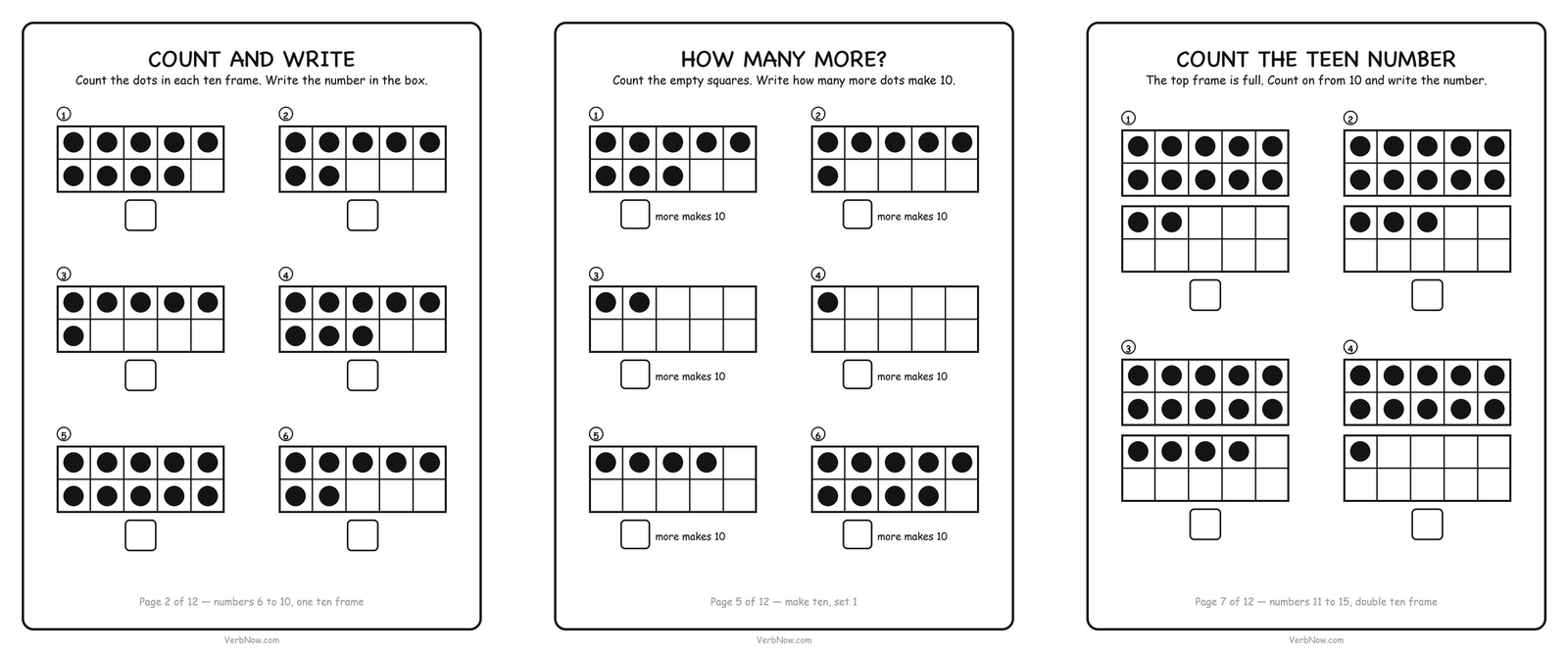
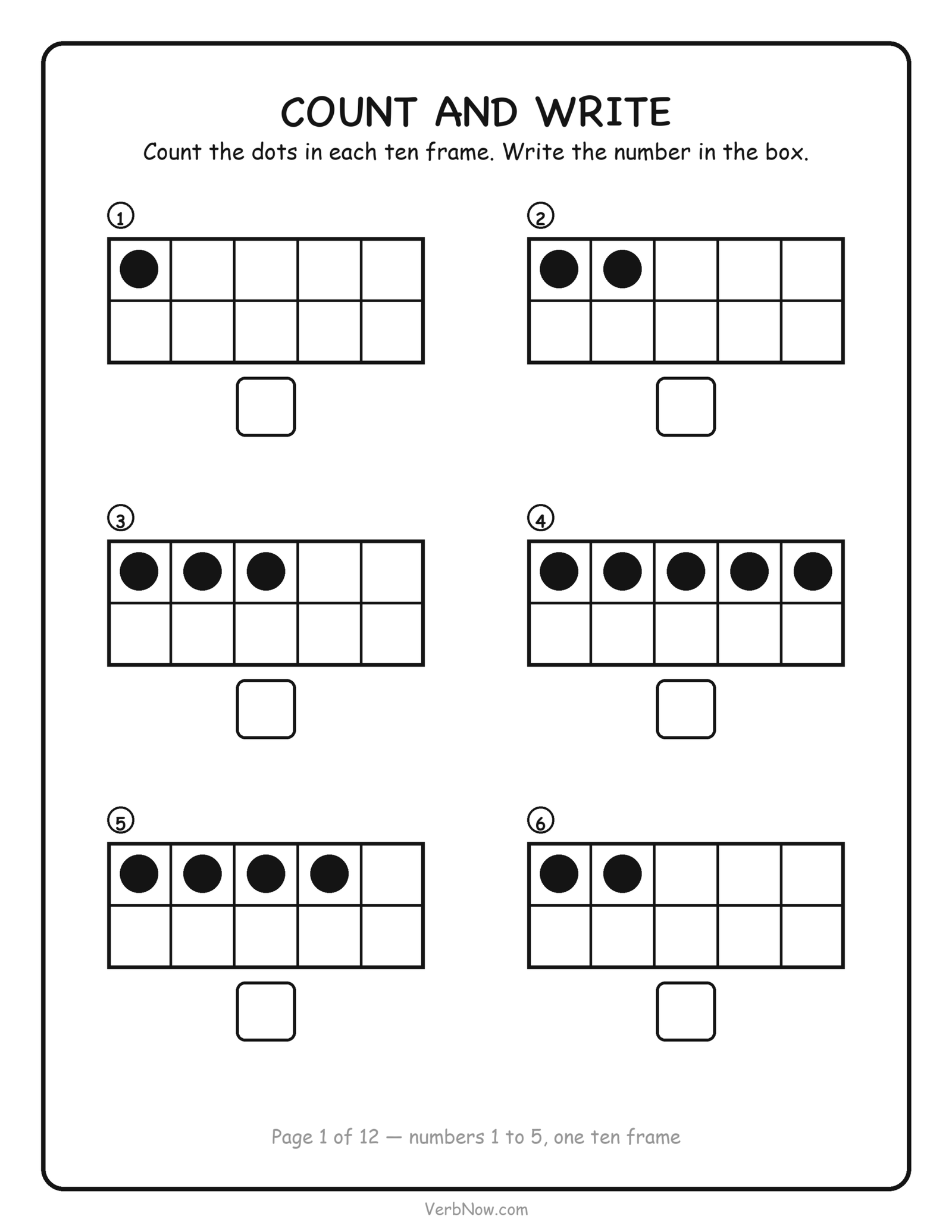
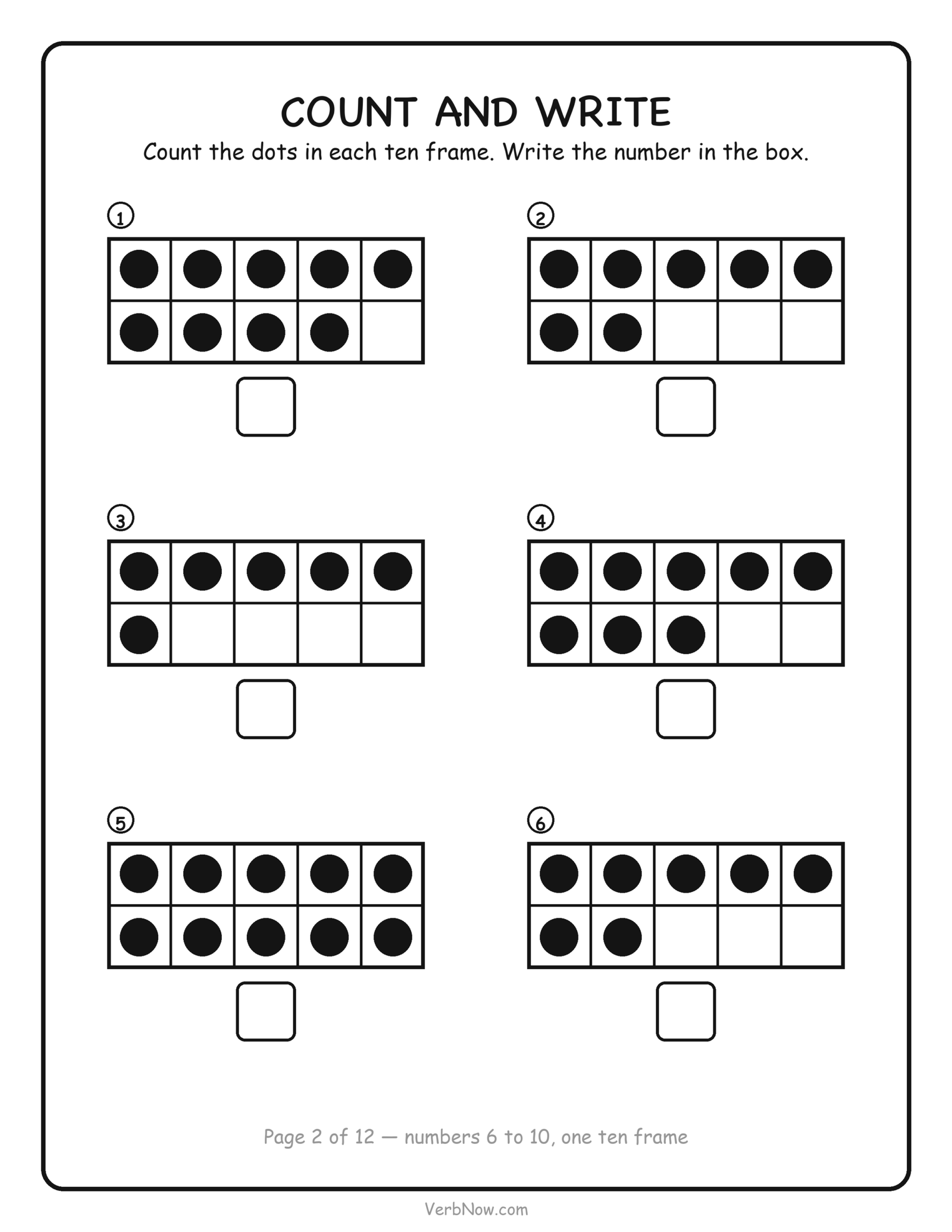
This is a free set of 12 printable ten frame worksheets for kindergarten and first grade, covering the numbers 1 to 20. The pages run through five stages: count the dots and write the number, draw the dots for a number you are given, work out how many more make 10, read and fill double ten frames for the teen numbers, and add with two frames. Altogether that is 82 ten frames and 56 practice items, plus a blank page of 6 empty frames at the end. An answer key for the 40 items that have a fixed answer is further down this page. Everything is drawn in black and white at US Letter size for a home printer.
What a ten frame is, and why the dots go in that order
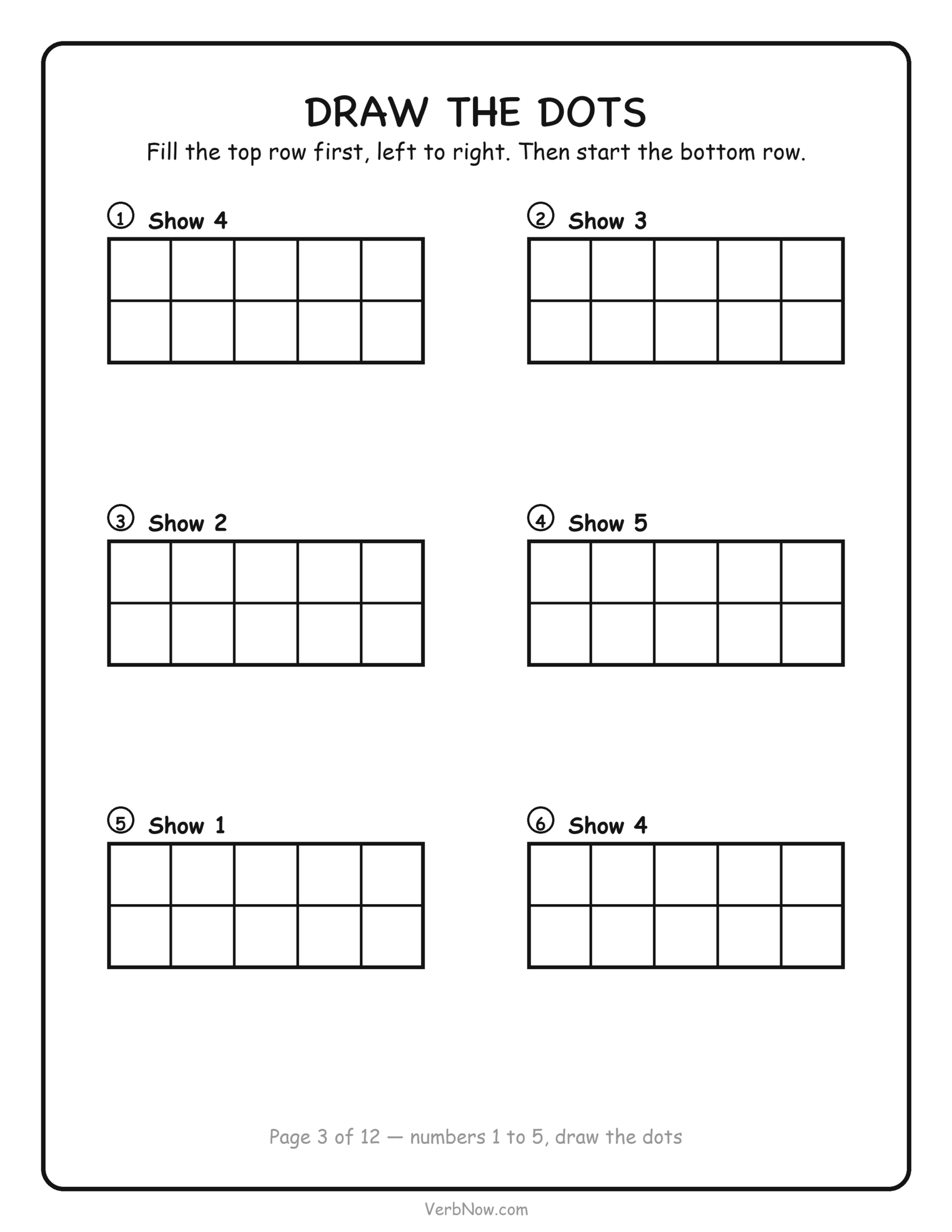
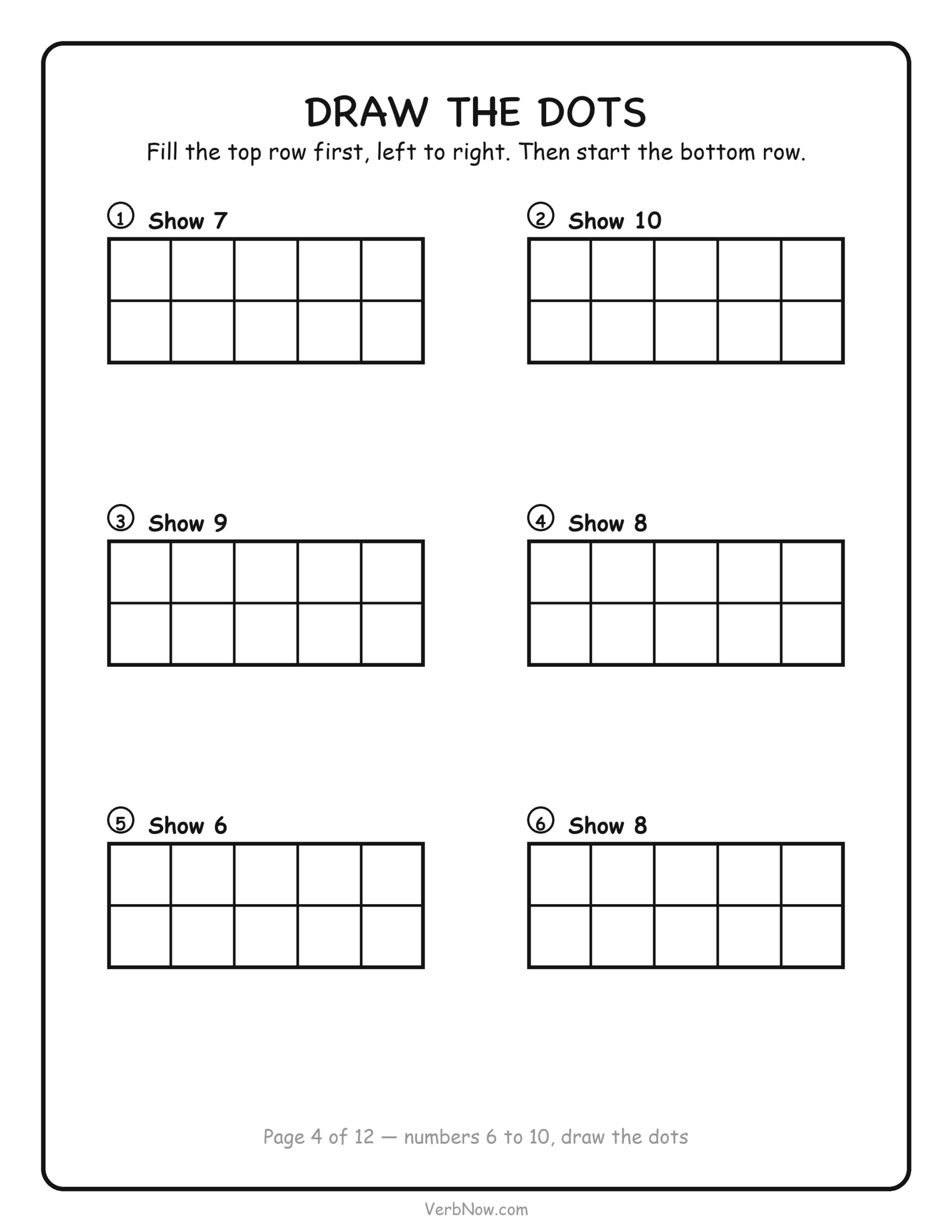
A ten frame is a grid of ten squares, two rows of five, that you fill with dots or counters to show a number. The dots go in a fixed order: fill the top row left to right first, and only then start the bottom row, again left to right. A number is finished when the dots stop.
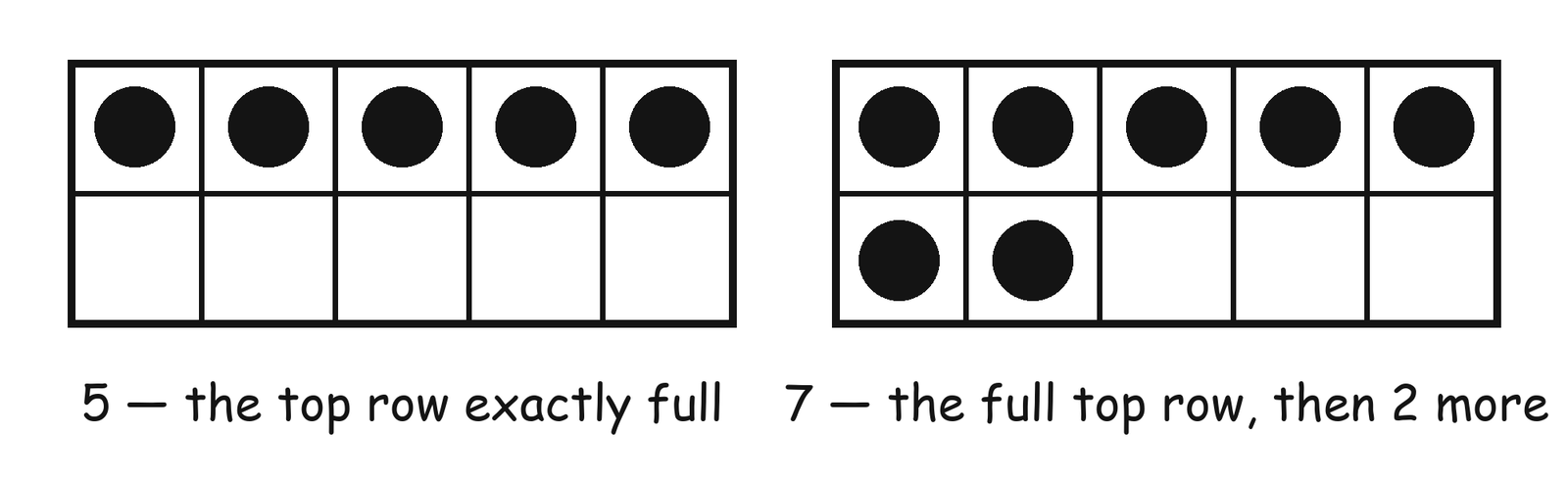
That order is what makes the frame worth printing. Because five dots always fill the top row exactly, a child stops counting 1, 2, 3, 4, 5, 6, 7 and starts reading seven as a full row and two more. Ten is both rows. Nine is one gap short of full. Those are shapes, not counts, and they are the reason a ten frame is faster than a row of pictures once a child knows it.
Scatter the dots and all of that disappears — the frame becomes ten boxes with some things in them, and the child is back to counting one at a time. Every filled frame in this set is drawn top row first, all 82 of them, and I keep the drawn dot count and the answer key generated from the same source, so a page cannot print one number and be marked as another.
What is on the 12 pages
Each page holds one kind of task, with the stage printed along the bottom edge so a stack of loose pages sorts back into order. The layout does not change between stages; what changes is what the child is asked to produce.
| Stage | Pages | What the child does | Numbers used |
|---|---|---|---|
| 1. Count and write | 1, 2 | Counts the dots already in the frame and writes the number in the box | 1 to 10 |
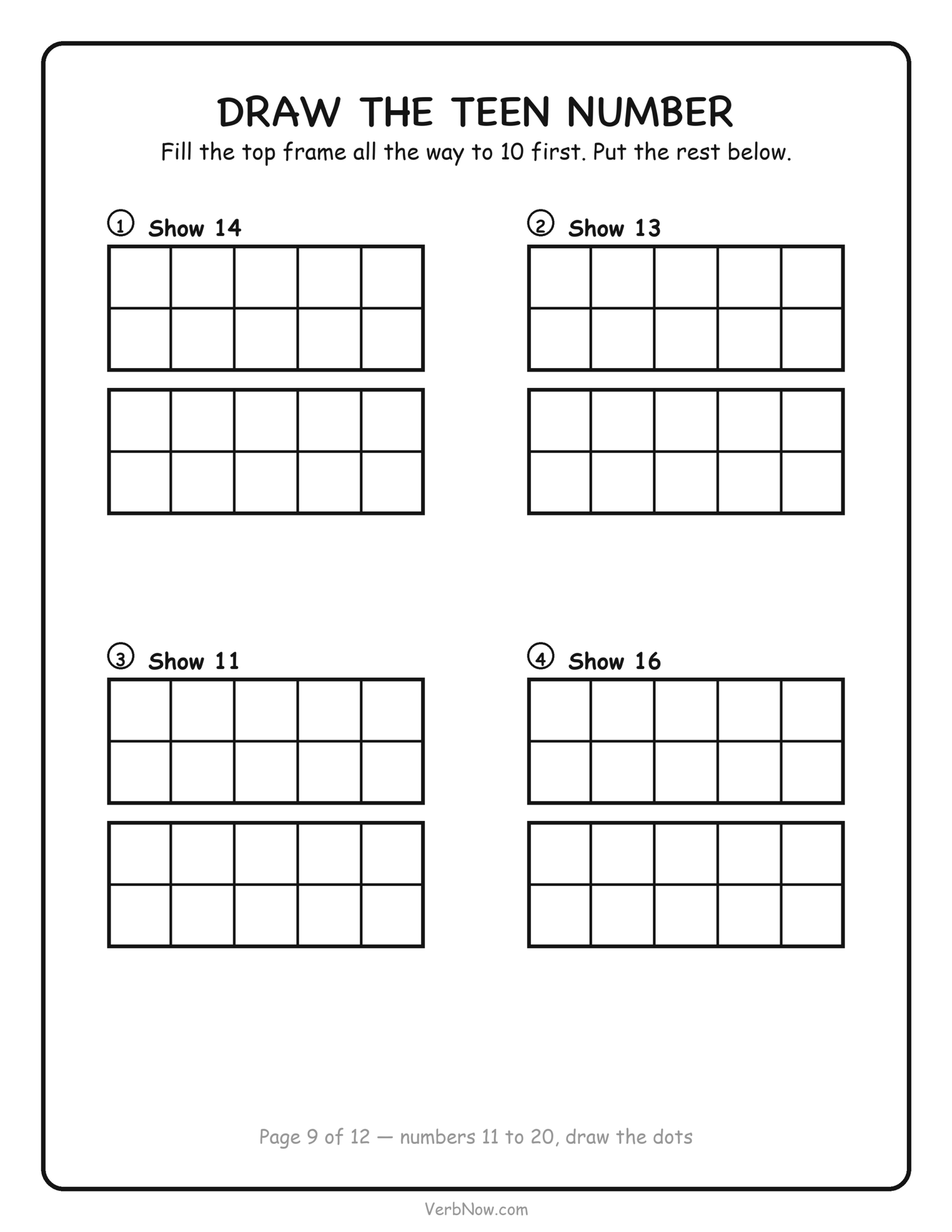
| 2. Draw the dots | 3, 4 | Gets a number and fills the empty frame themselves | 1 to 10 |
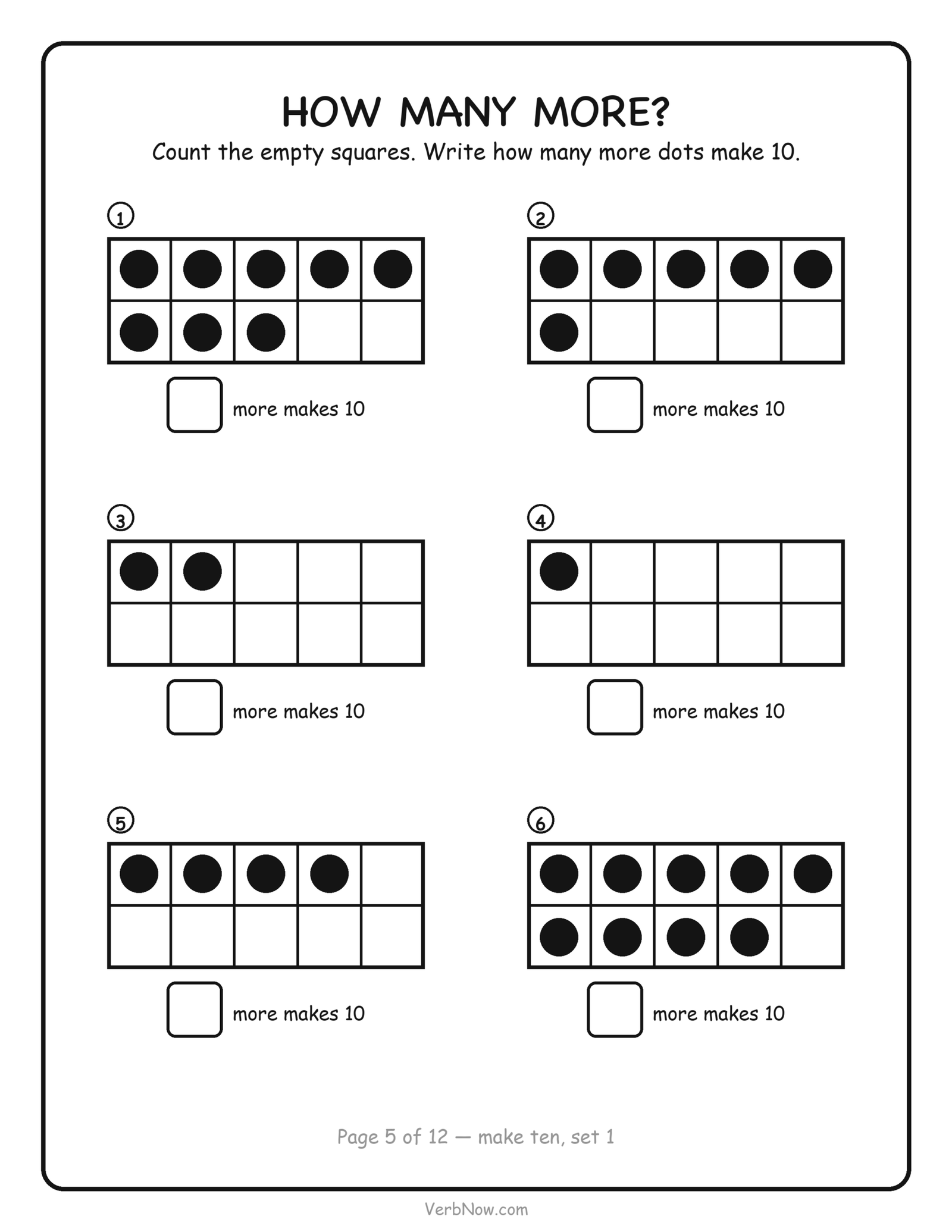
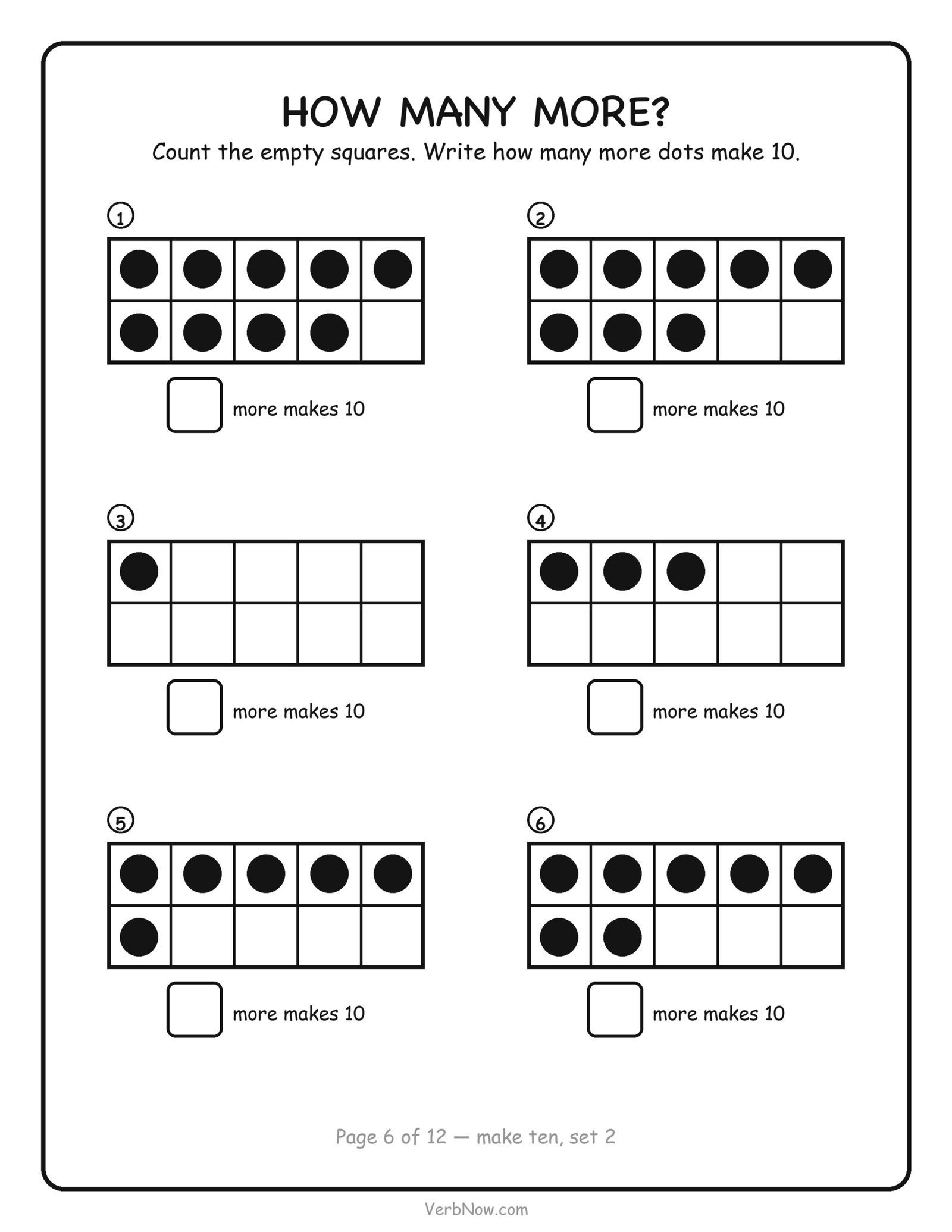
| 3. How many more make 10 | 5, 6 | Counts the empty squares and writes how many more dots finish the frame | 1 to 9 shown |
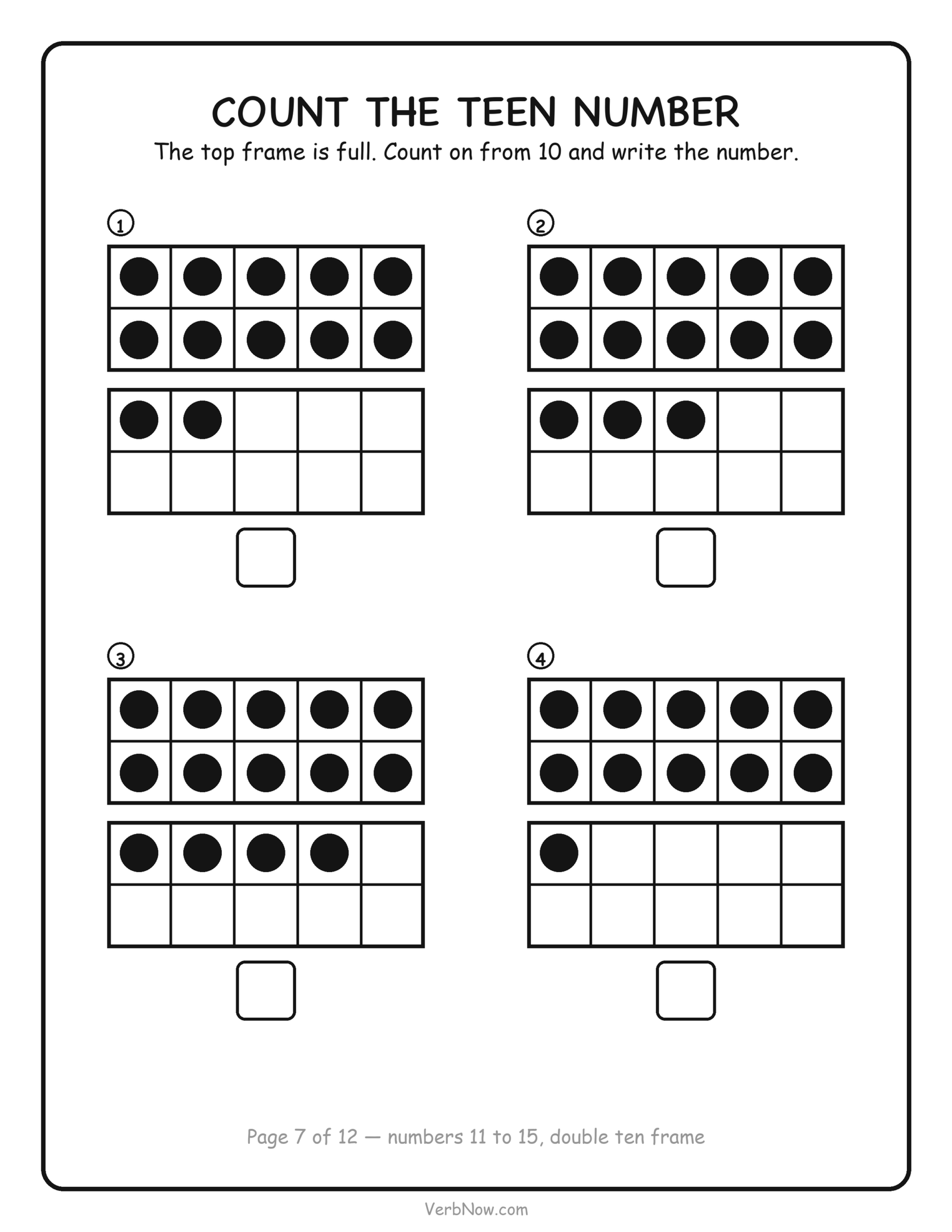
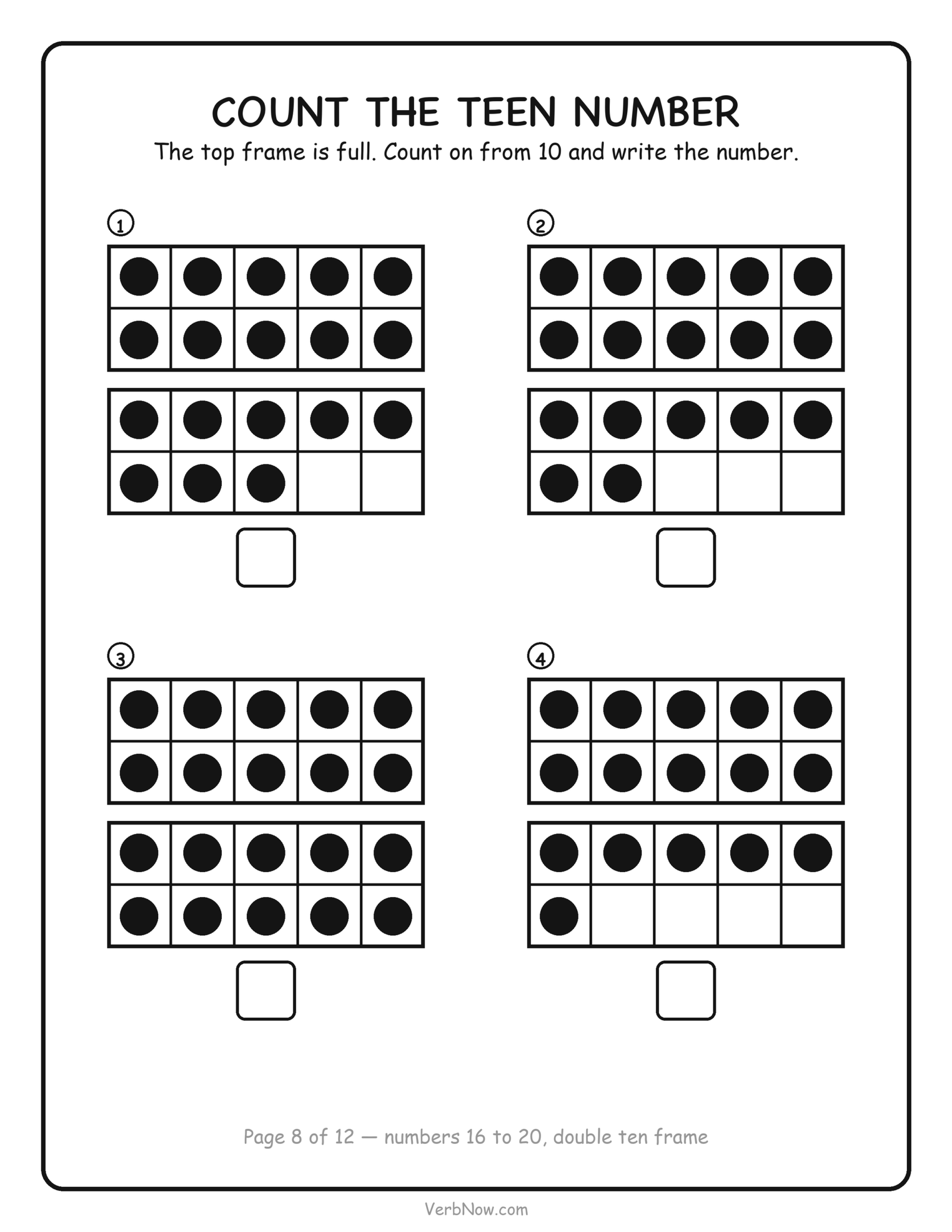
| 4. Teen numbers | 7, 8, 9 | Reads or fills a double ten frame | 11 to 20 |
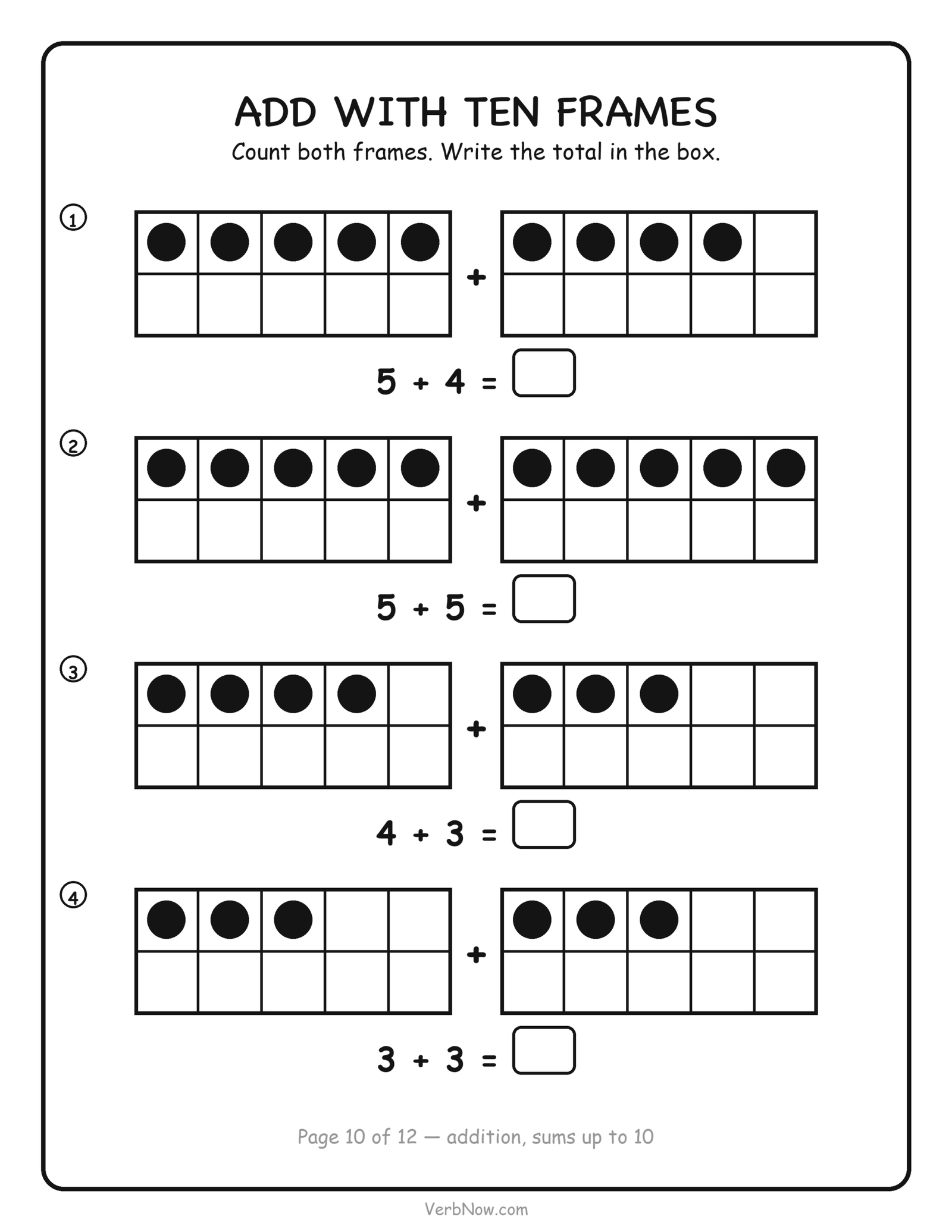
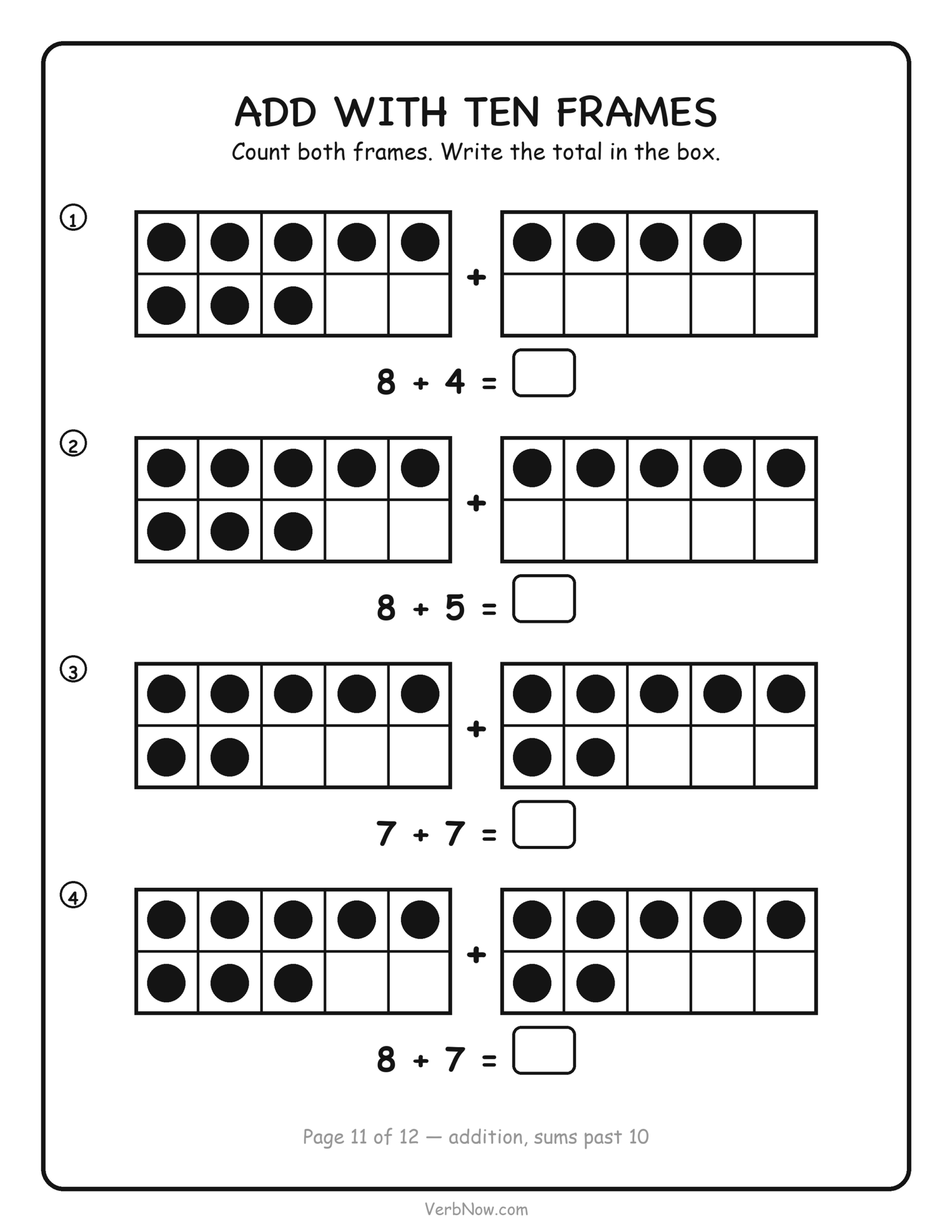
| 5. Add with ten frames | 10, 11 | Counts two frames and writes the total | Sums 6 to 15 |
| Blank | 12 | Six empty frames for counters or any number you choose | — |
The order these five stages follow
The five stages match the sequence US classrooms use, and each one only asks for one new thing. Counting out and showing numbers to 20 is a kindergarten expectation (Common Core K.CC.B.4). Finding how many more make ten from a number below ten sits in the same year (K.OA.A.4). Reading a teen number as ten and some more is first grade (1.NBT.B.2).
Three things make that order work rather than just look tidy. Counting the dots is recognition, so it comes first and costs a child nothing but attention. Making ten is where the frame starts paying: the empty squares are visible, so 6 and 4 stop being two separate facts and become one picture. And the teen numbers are the payoff — once a full frame reads as ten without counting, 14 is one full frame and four, which is the sentence a child needs before place value makes any sense.
If a child stalls, the stage printed at the bottom of the page tells you where to drop back to. That is the only reason it is printed there.
Reading a ten frame and filling one in are two different jobs
Reading is recognition: the dots are already placed and the child names what they see. Filling is production: the child decides how many dots to draw and where each one goes, with nothing on the page to copy. A child who reads frames confidently can still drop dots into the bottom row first, or spread six dots across both rows, and that is the moment you find out the fill order has not landed yet.
That is why the set alternates. Pages 1 and 2 read, pages 3 and 4 fill; pages 7 and 8 read, page 9 fills. Read twice, then produce once, at each size of number.
How the double ten frames show teen numbers
On pages 7, 8 and 9 each item is two ten frames stacked, and the top one is always filled to exactly ten before a single dot goes in the bottom one. So 14 is a full frame of ten and four more, and the child counts on from ten instead of starting at one.
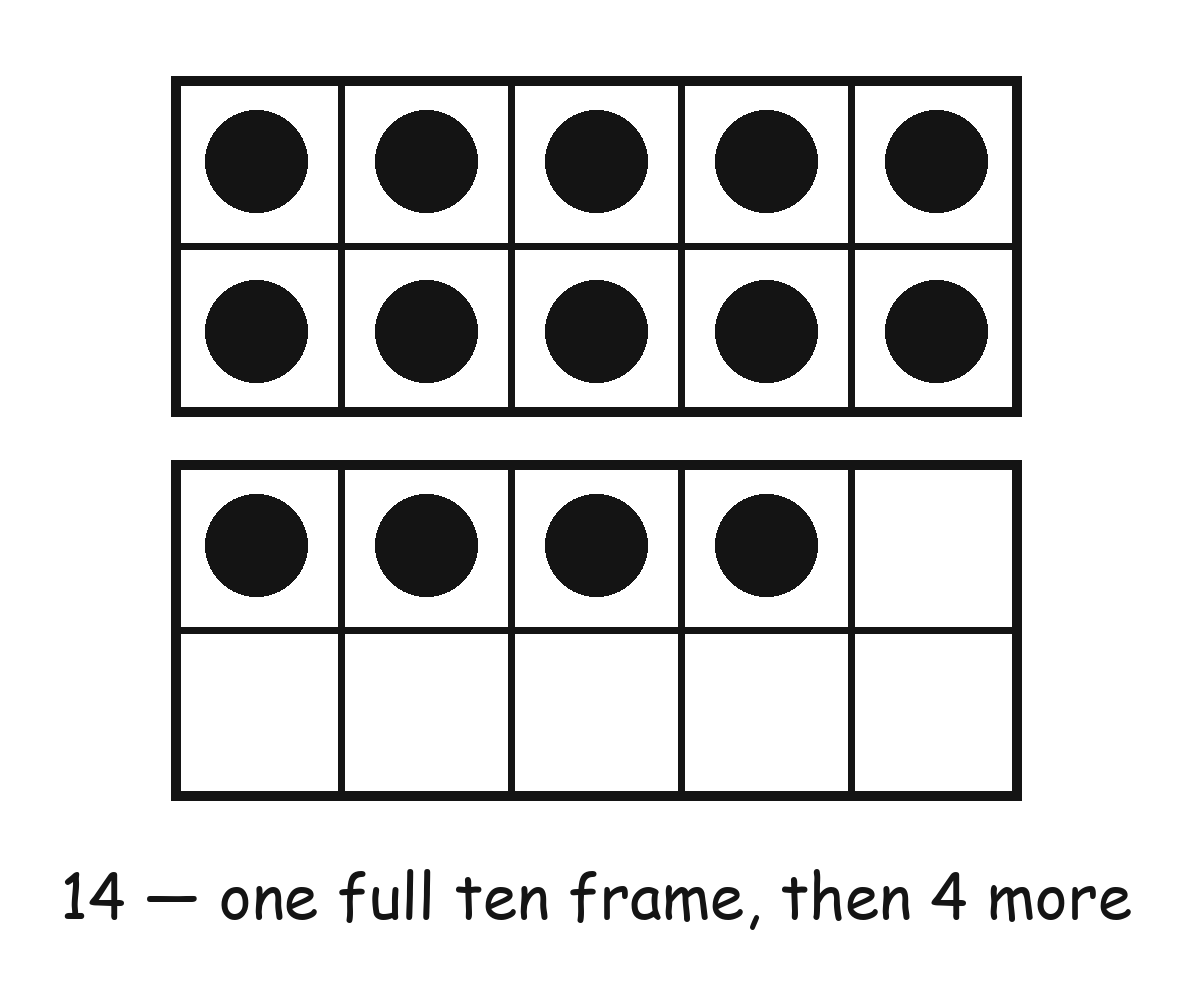
I am fussy about that. A double frame that splits 14 as seven and seven, or fills the bottom frame first, is arithmetically true and pedagogically useless — it hides the ten. Writing 14 as 10 and 4 is the thing the pages are for, and it is the same sentence a child will need again for 24 and 104.
The same rule sets the addition pages. On page 11, where the sums cross ten, no addend is larger than 9, so neither frame ever arrives already full and the child always has to work out how many it takes to finish one.
Answer key
Items are numbered down each page, left column first. Pages 3, 4 and 9 are not listed because the number is already printed above each frame on the page itself, and page 12 is blank on purpose.
| Page | 1 | 2 | 3 | 4 | 5 | 6 |
|---|---|---|---|---|---|---|
| Page 1 — count and write, 1 to 5 | 1 | 2 | 3 | 5 | 4 | 2 |
| Page 2 — count and write, 6 to 10 | 9 | 7 | 6 | 8 | 10 | 7 |
| Page 5 — how many more make 10 | 8 shown → 2 | 6 shown → 4 | 2 shown → 8 | 1 shown → 9 | 4 shown → 6 | 9 shown → 1 |
| Page 6 — how many more make 10 | 9 shown → 1 | 8 shown → 2 | 1 shown → 9 | 3 shown → 7 | 6 shown → 4 | 7 shown → 3 |
| Page 7 — teen numbers 11 to 15 | 12 | 13 | 14 | 11 | — | — |
| Page 8 — teen numbers 16 to 20 | 18 | 17 | 20 | 16 | — | — |
| Page 10 — addition, sums to 10 | 5 + 4 = 9 | 5 + 5 = 10 | 4 + 3 = 7 | 3 + 3 = 6 | — | — |
| Page 11 — addition, sums past 10 | 8 + 4 = 12 | 8 + 5 = 13 | 7 + 7 = 14 | 8 + 7 = 15 | — | — |
On pages 5 and 6 the first figure is how many dots are printed and the bold figure is the answer the child writes, because those two are easy to mix up when you are marking.
How to print these
Print at US Letter, actual size. Nothing a child writes on sits closer than half an inch to the paper edge, so “fit to page” or “shrink to fit” is not needed and will only shrink the squares. Each square in a frame is 0.57 inches across and each answer box is a 0.53 inch square, which is what those settings would eat into — a five-year-old writing a 7 needs that space. Black and white is fine: there is no color anywhere in the set, so grayscale or draft mode costs nothing but toner.
The blank page and the draw-the-dots pages are the ones worth putting in a sleeve with a dry-erase marker rather than reprinting, since they get used over and over with different numbers.
Ten frame worksheets: questions parents and teachers ask
What age are ten frame worksheets for?
Ten frames are a kindergarten and first-grade tool. In US classrooms, counting out and showing numbers to 20 is a kindergarten expectation (Common Core K.CC.B.4), making ten from a smaller number sits in the same year (K.OA.A.4), and reading a teen number as ten plus some more is a first-grade one (1.NBT.B.2). This set follows that order: pages 1 to 6 stay inside 1 to 10, pages 7 to 9 move to the teen numbers, and pages 10 and 11 add. Children move through that at their own pace, and how a particular child is developing is a question for their teacher rather than a worksheet page.
How do ten frames help a child learn to count?
A ten frame replaces counting one at a time with recognizing a shape. Because the dots always fill the top row first, a full top row means five without counting, and seven looks like a full row plus two. That is the whole point of the tool: the child stops counting 1, 2, 3, 4, 5, 6, 7 and starts seeing five-and-two. It also makes the gap to ten visible, which is what pages 5 and 6 are built on. If you are working on counting further than the frame goes, the guide on how to teach kids to count to 100 covers the stretch past 20.
Do these ten frame worksheets cover addition?
Yes, on pages 10 and 11. Each problem there prints two ten frames side by side with dots already in them, plus the equation underneath and a box for the total. Page 10 keeps every sum at 10 or under. Page 11 crosses 10, with sums from 12 to 15, and no addend is bigger than 9 — that is deliberate, because if one frame arrived already full the child would never have to work out how many it takes to finish it. For addition practice with color instead of frames, the math printables section has color-by-number addition pages.
Is there a blank ten frame in this set?
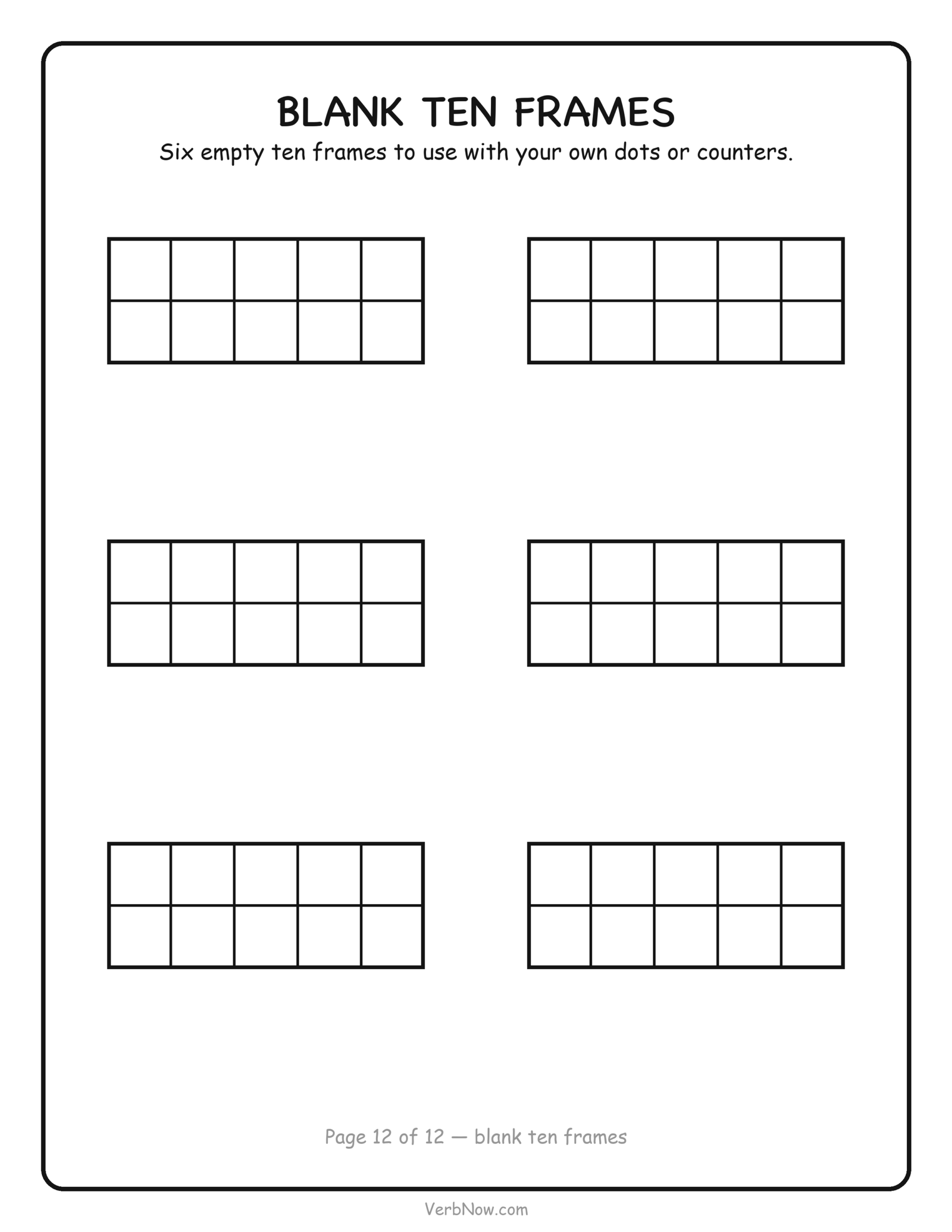
Yes, page 12 is six blank ten frames with nothing printed in them — no numbers, no dots, no answer boxes. It is there for counters, buttons, cereal or a dry-erase marker, and for any number you want to work on that is not on the other eleven pages. Pages 3, 4 and 9 also print empty frames, but those come with a number assigned to each frame.
Are there math coloring worksheets too?
Yes, and they are a separate set. These ten frame pages are worksheets: thin grid lines, solid dots, boxes to write in. If what you want is math a child colors rather than fills in, use the math coloring worksheets instead, or the number coloring pages for numerals to color.
More free math printables
Everything here lives in the math section: browse the rest of the math printables for the other number pages. For a younger child who is still counting objects rather than reading frames, the counting worksheets cover 1 to 10 in the same US Letter black and white layout, and the number tracing worksheets cover writing the numerals themselves. For numerals to color rather than count, there are the number coloring pages.