
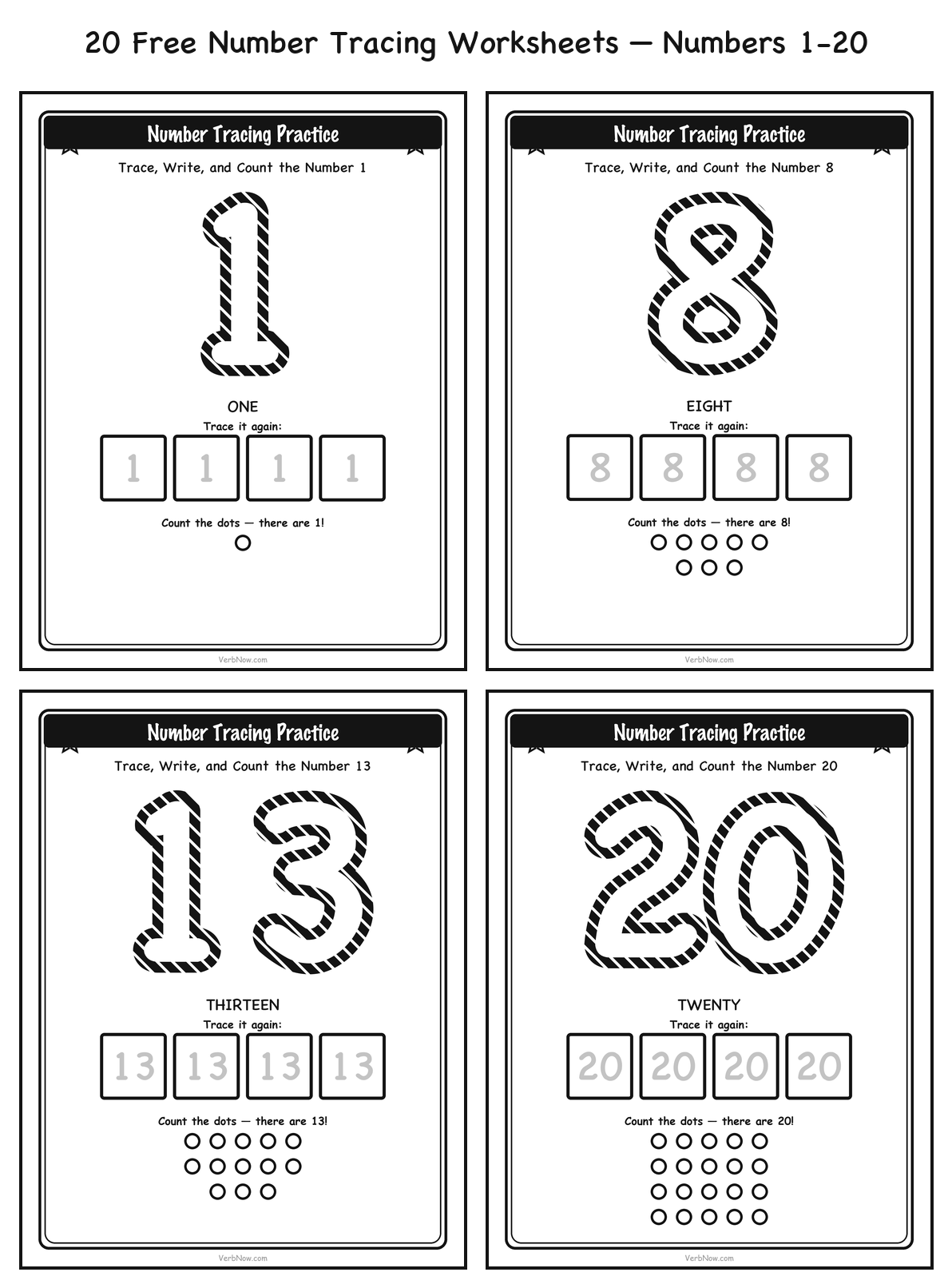
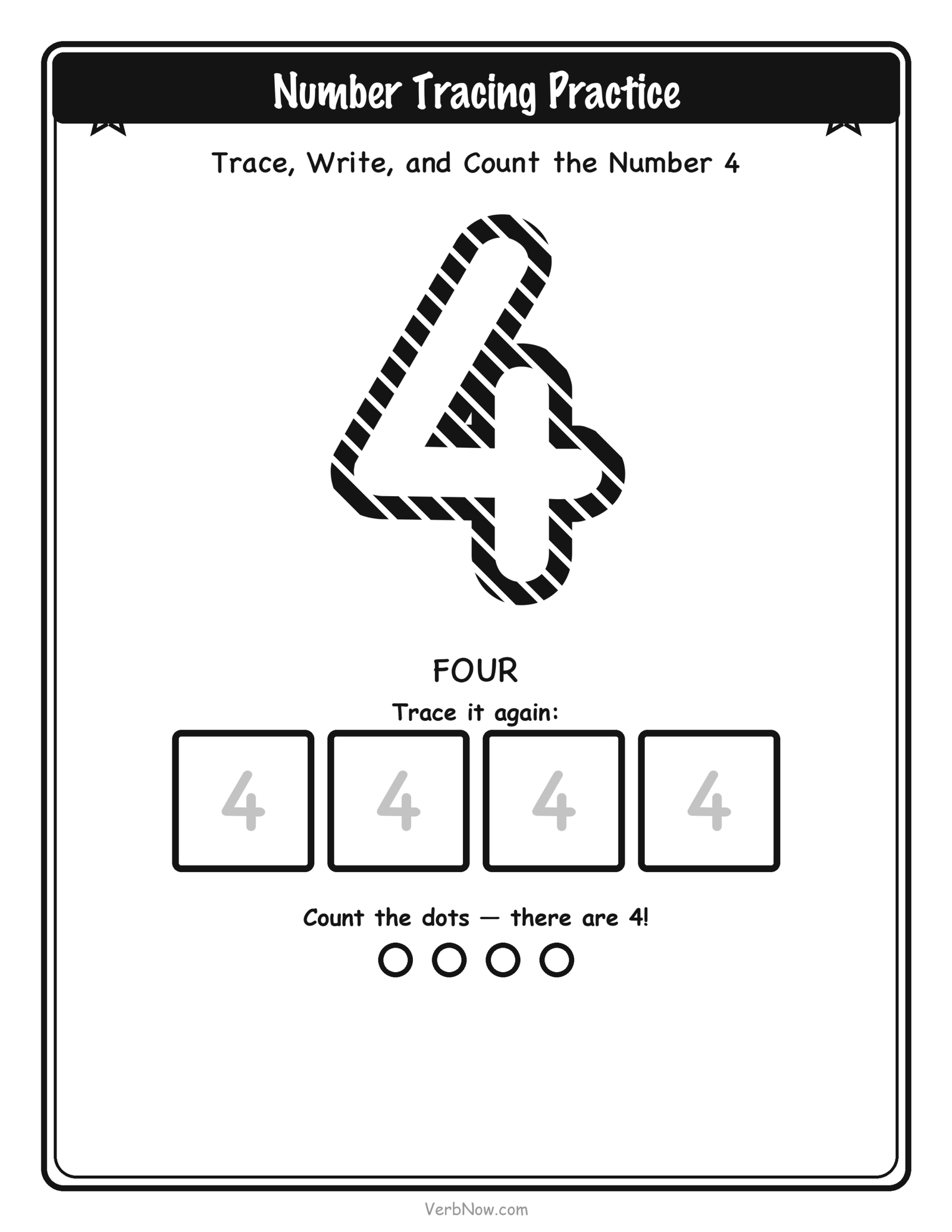
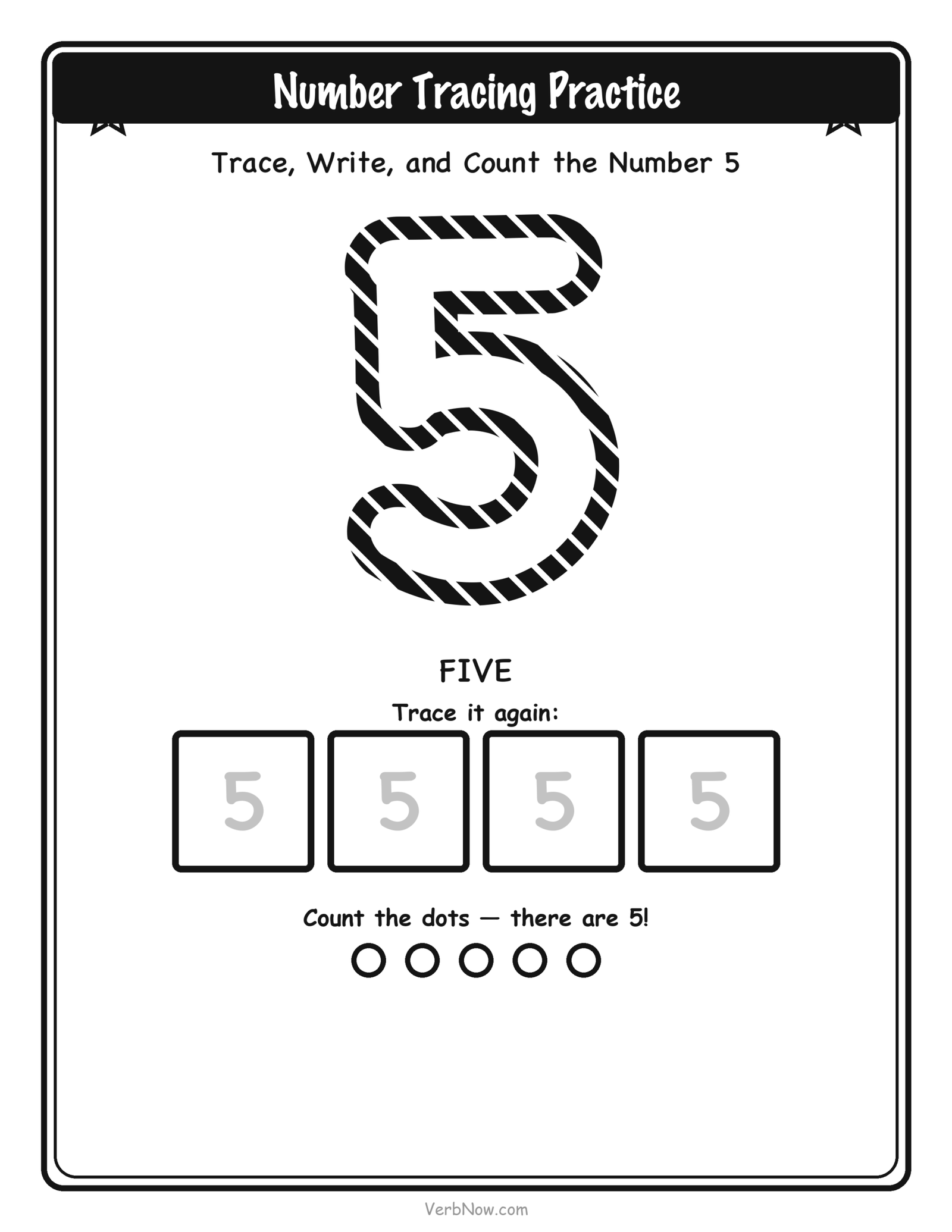
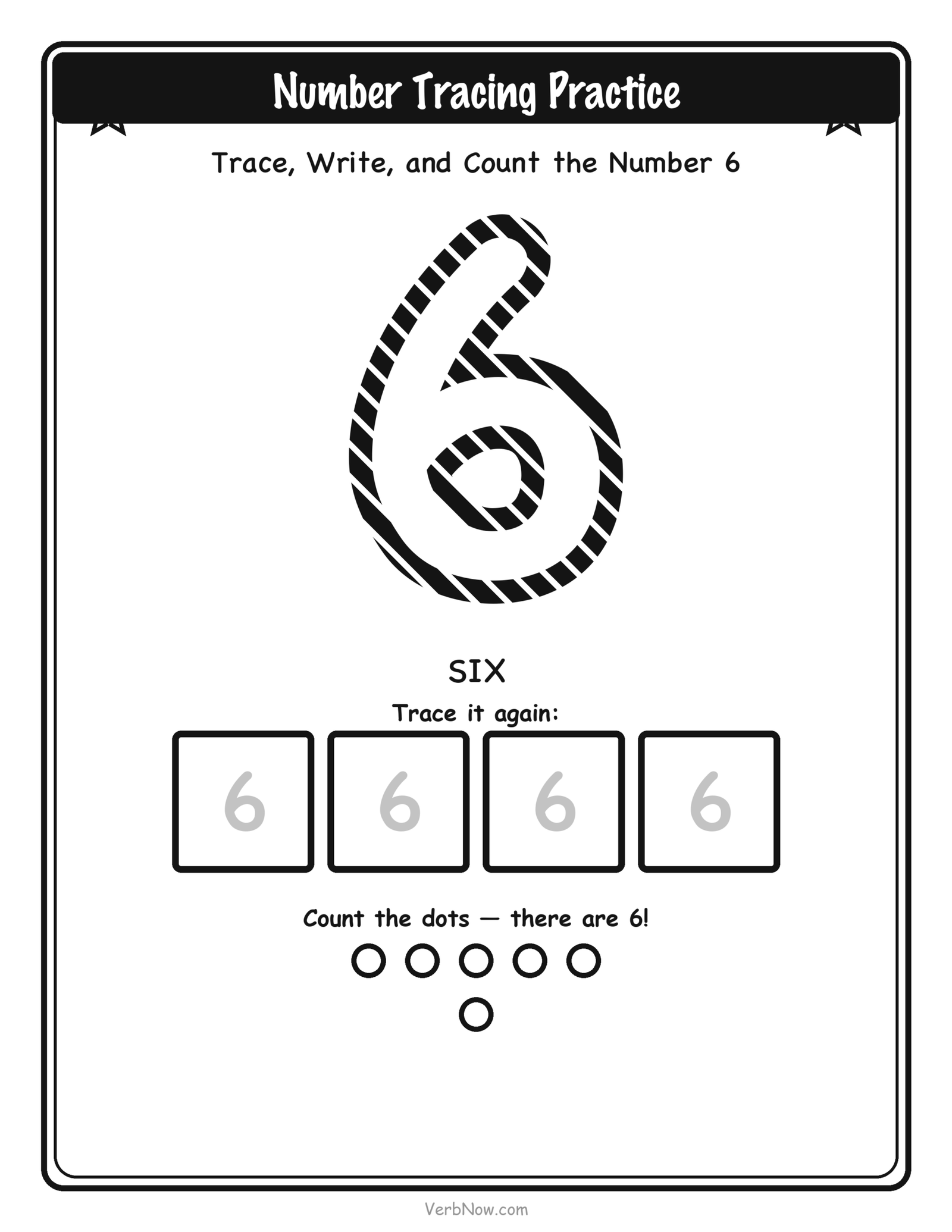
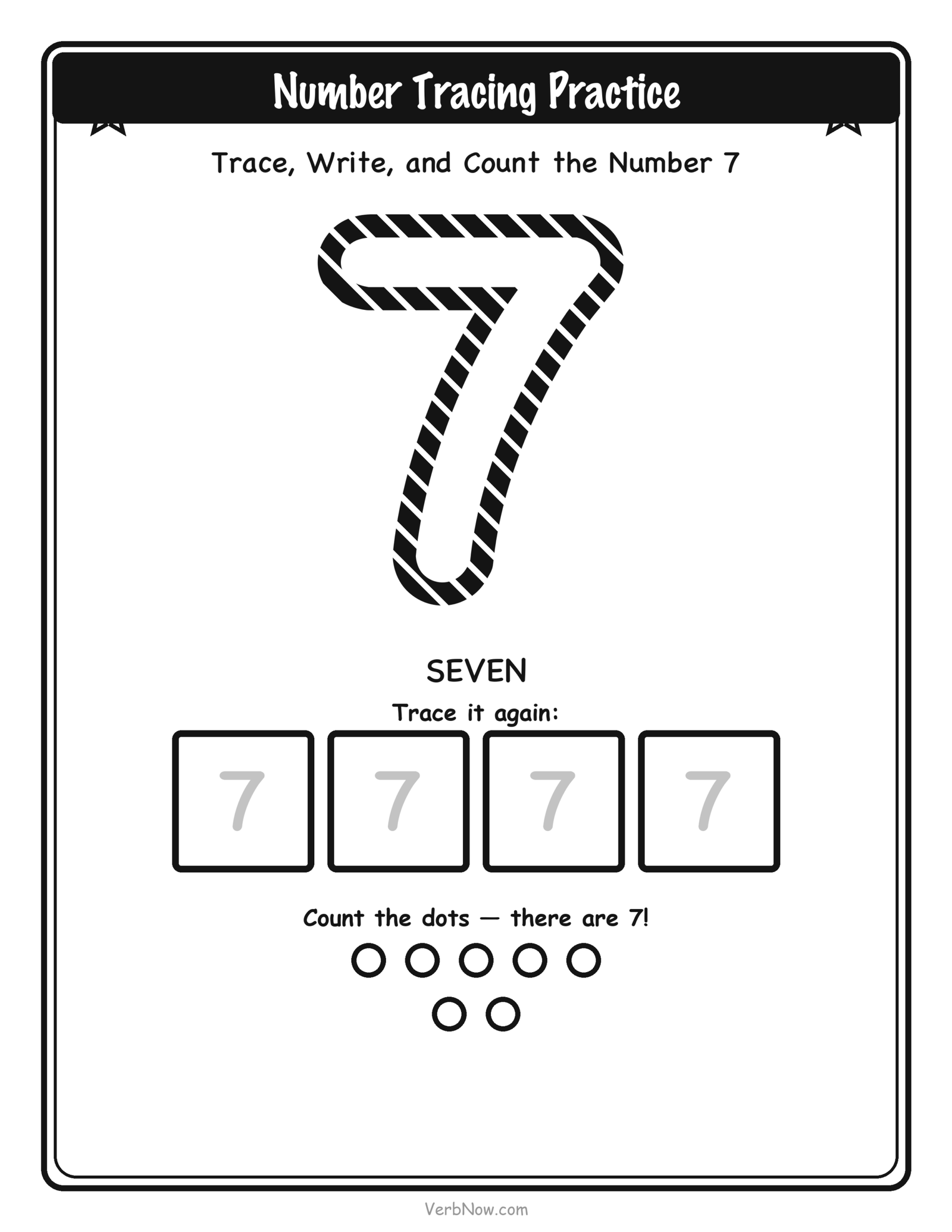
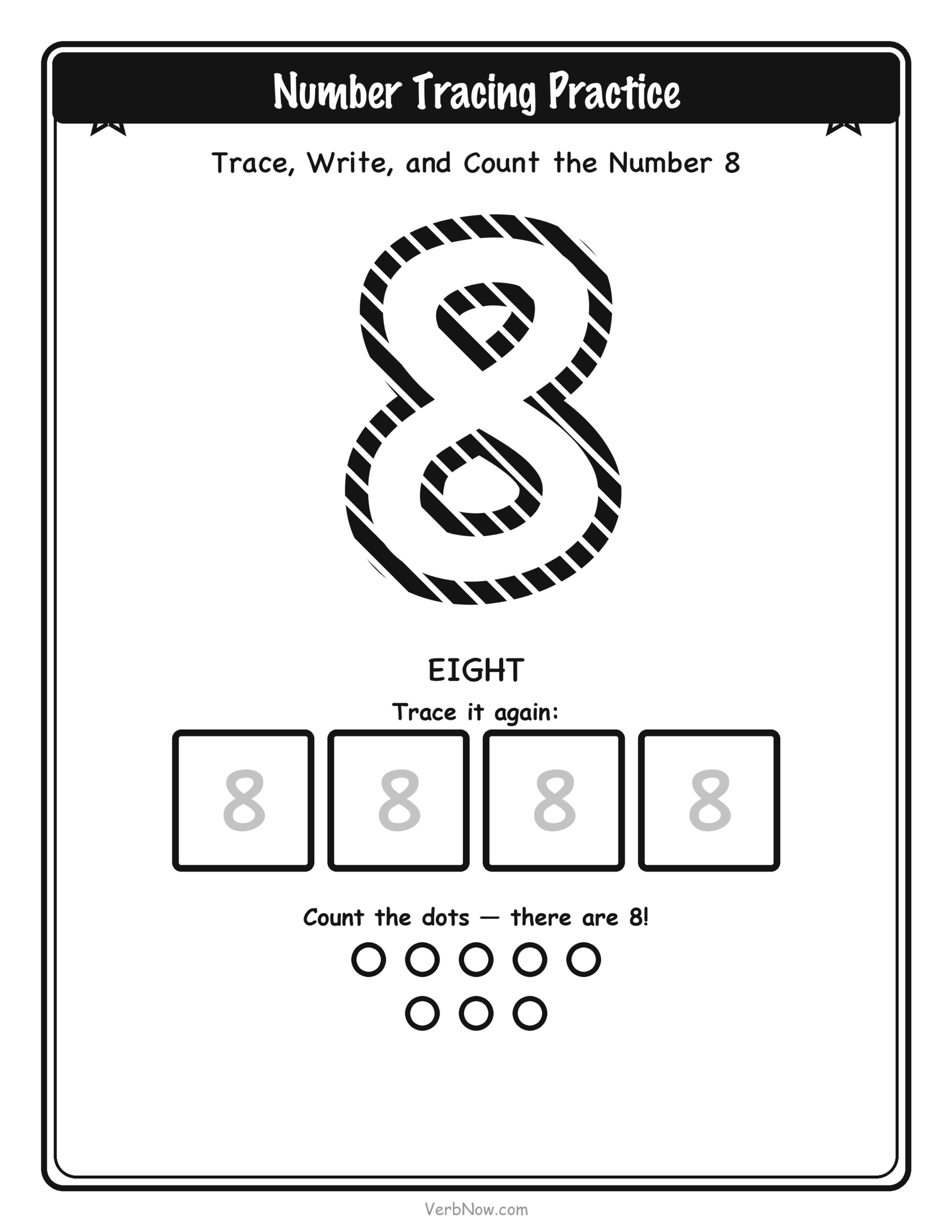
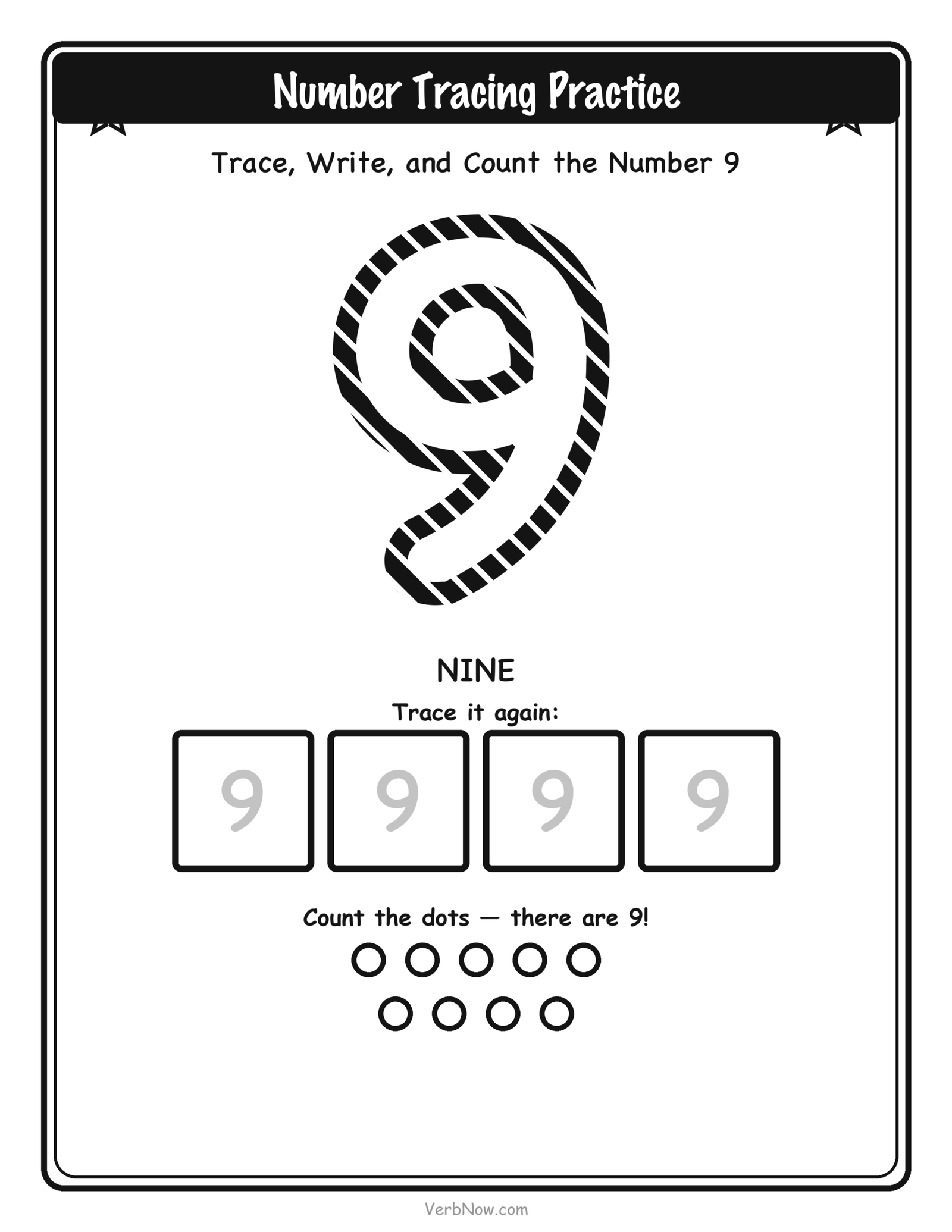
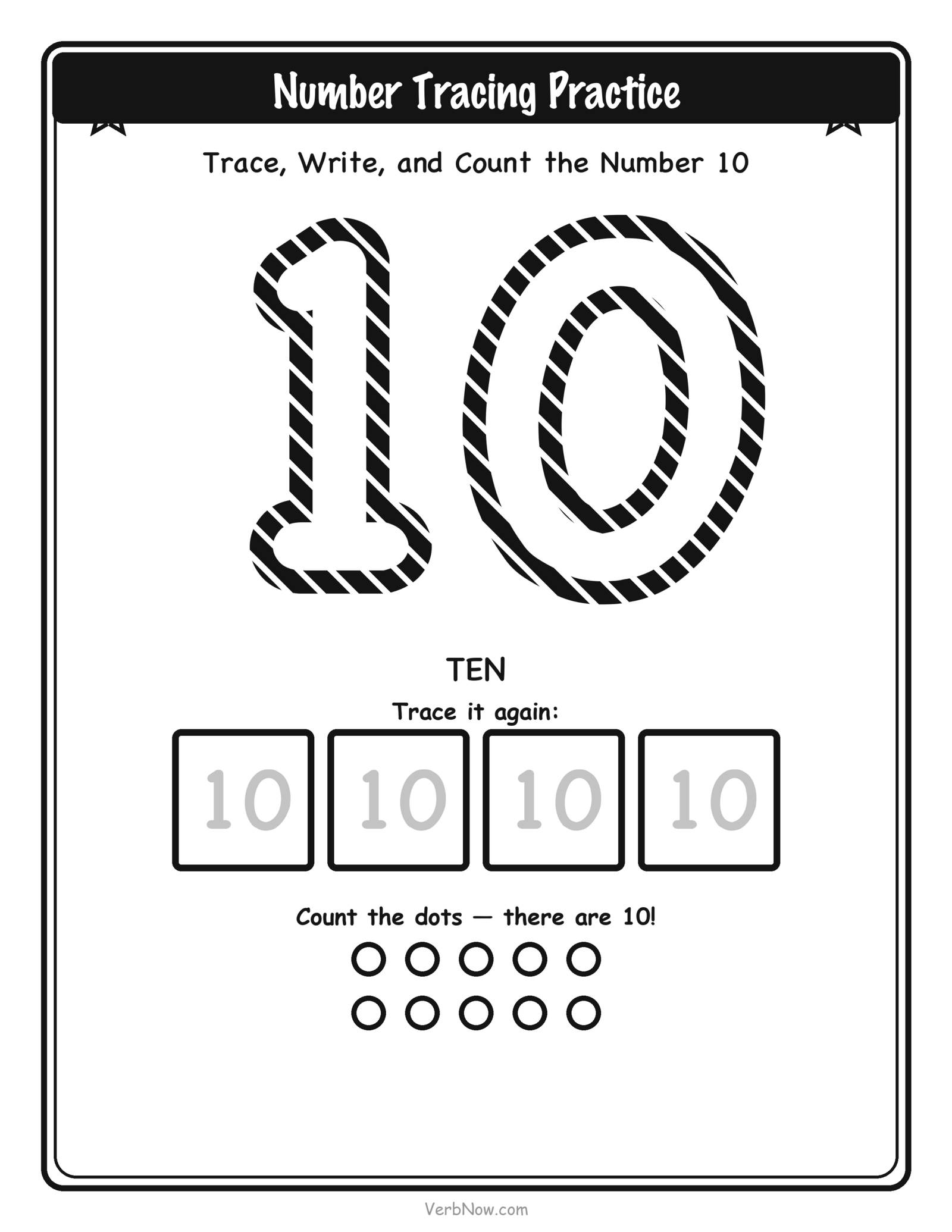
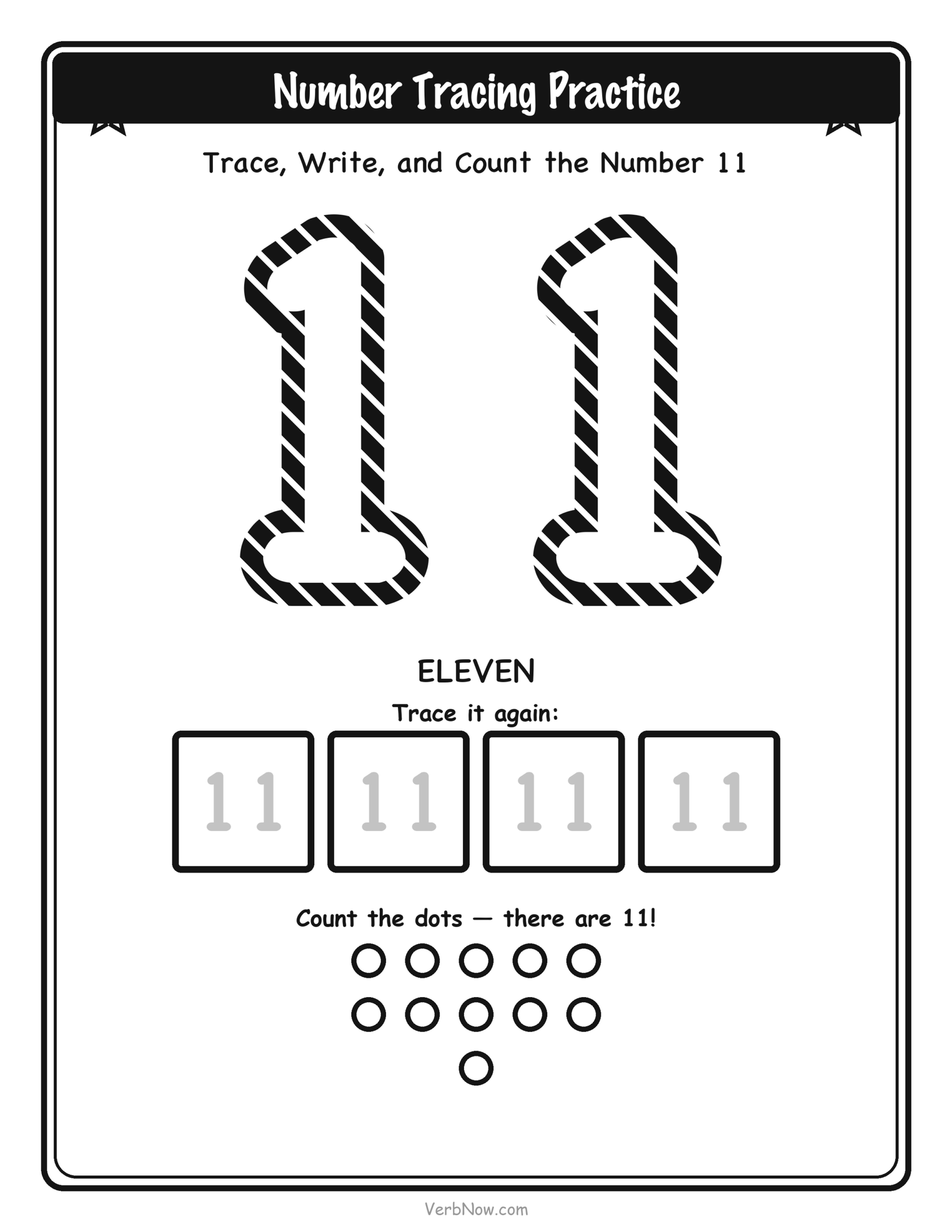
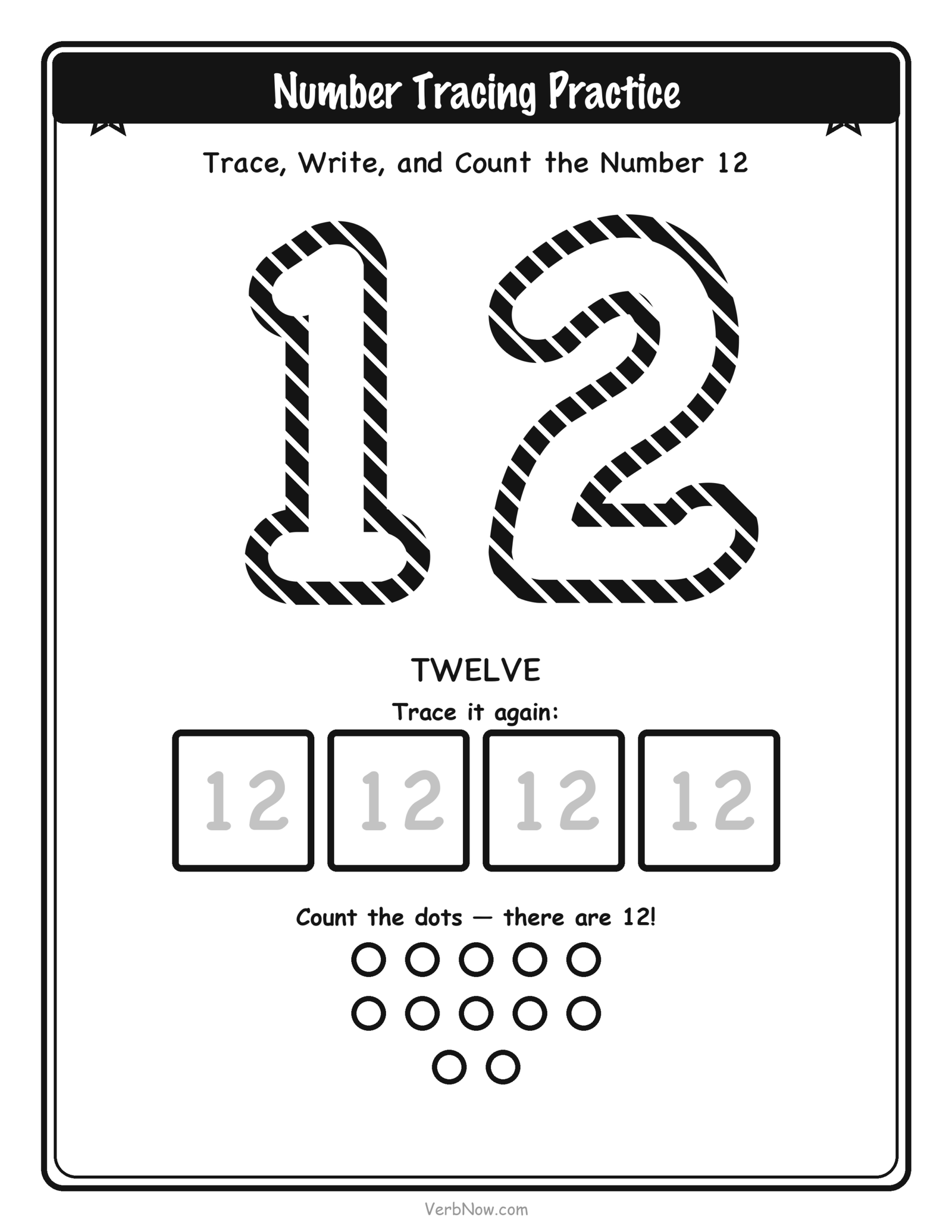
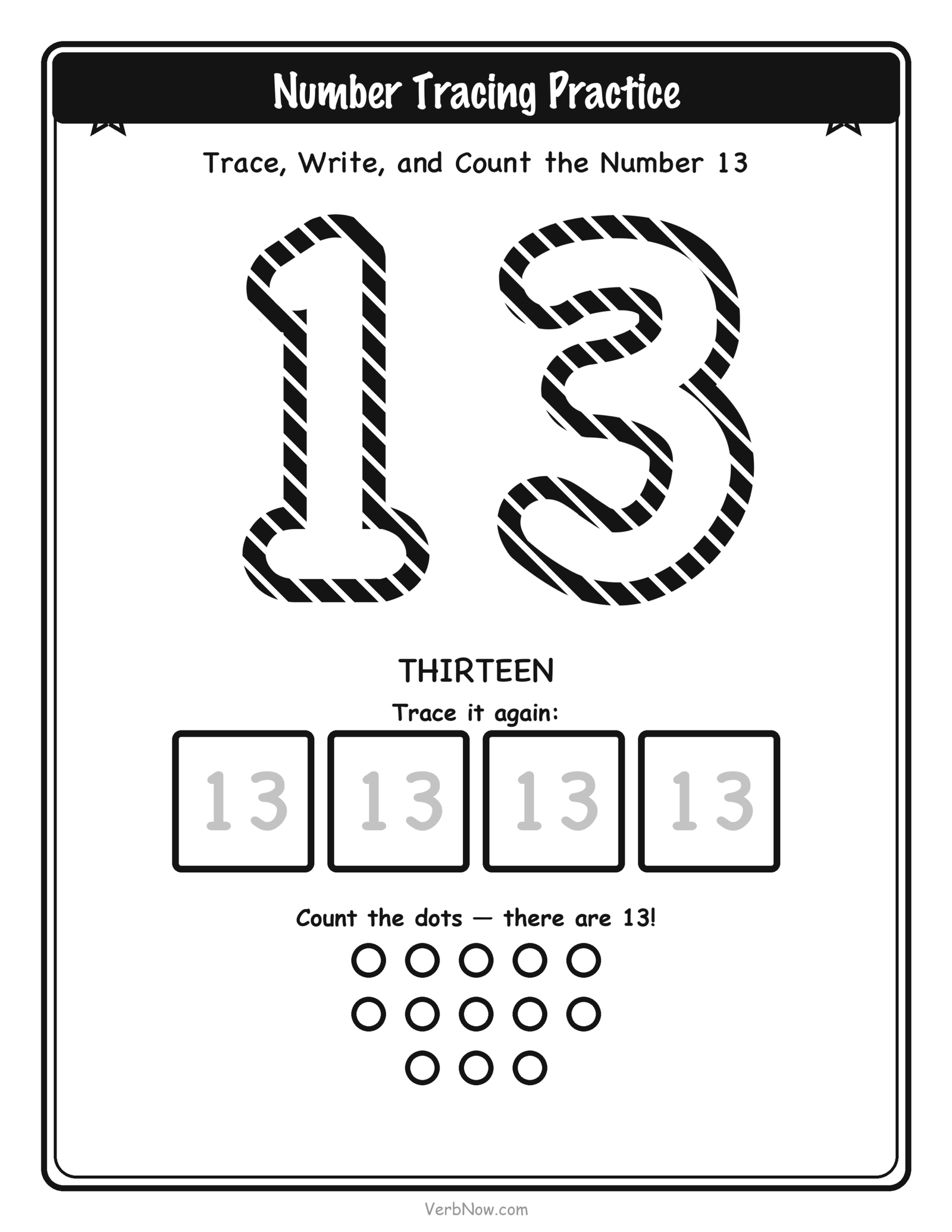
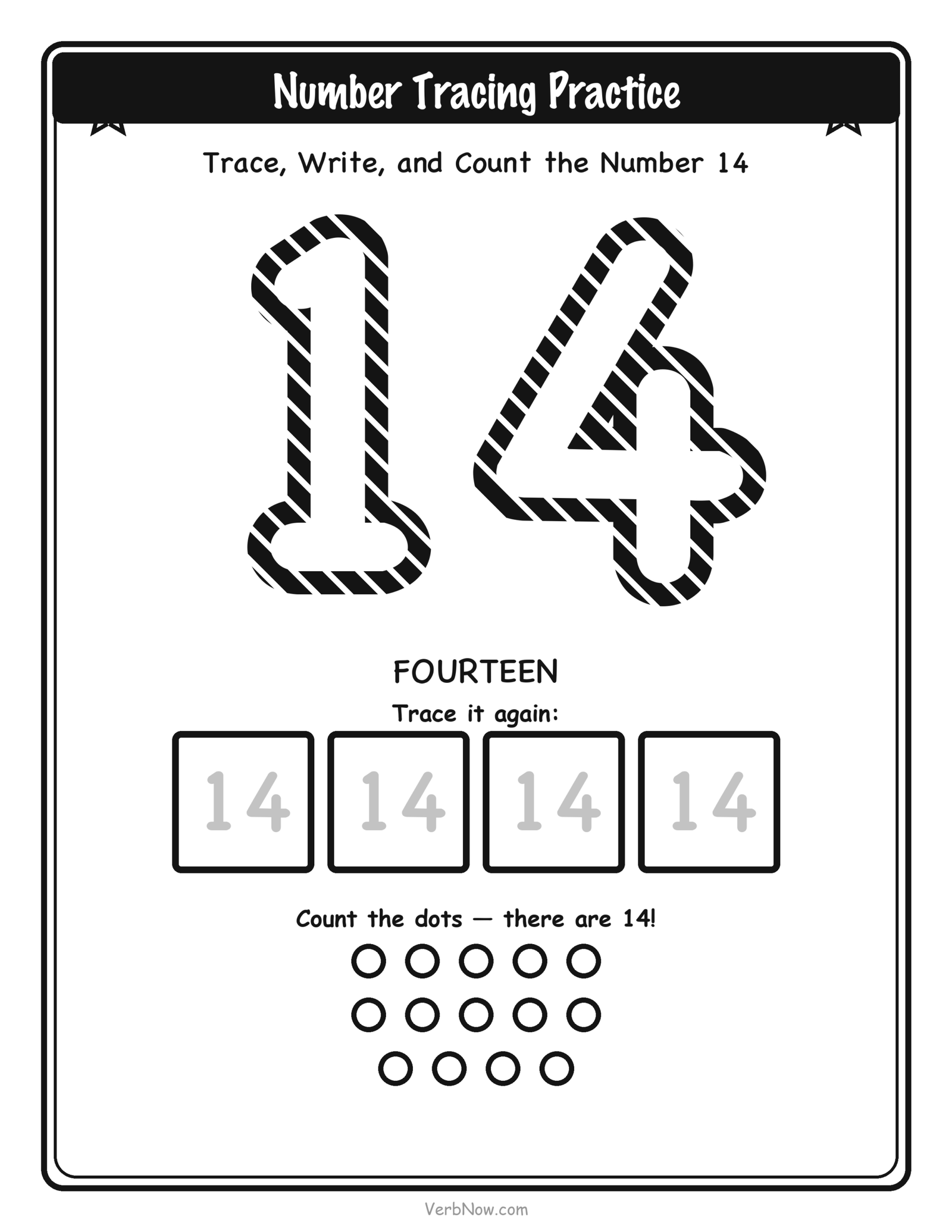
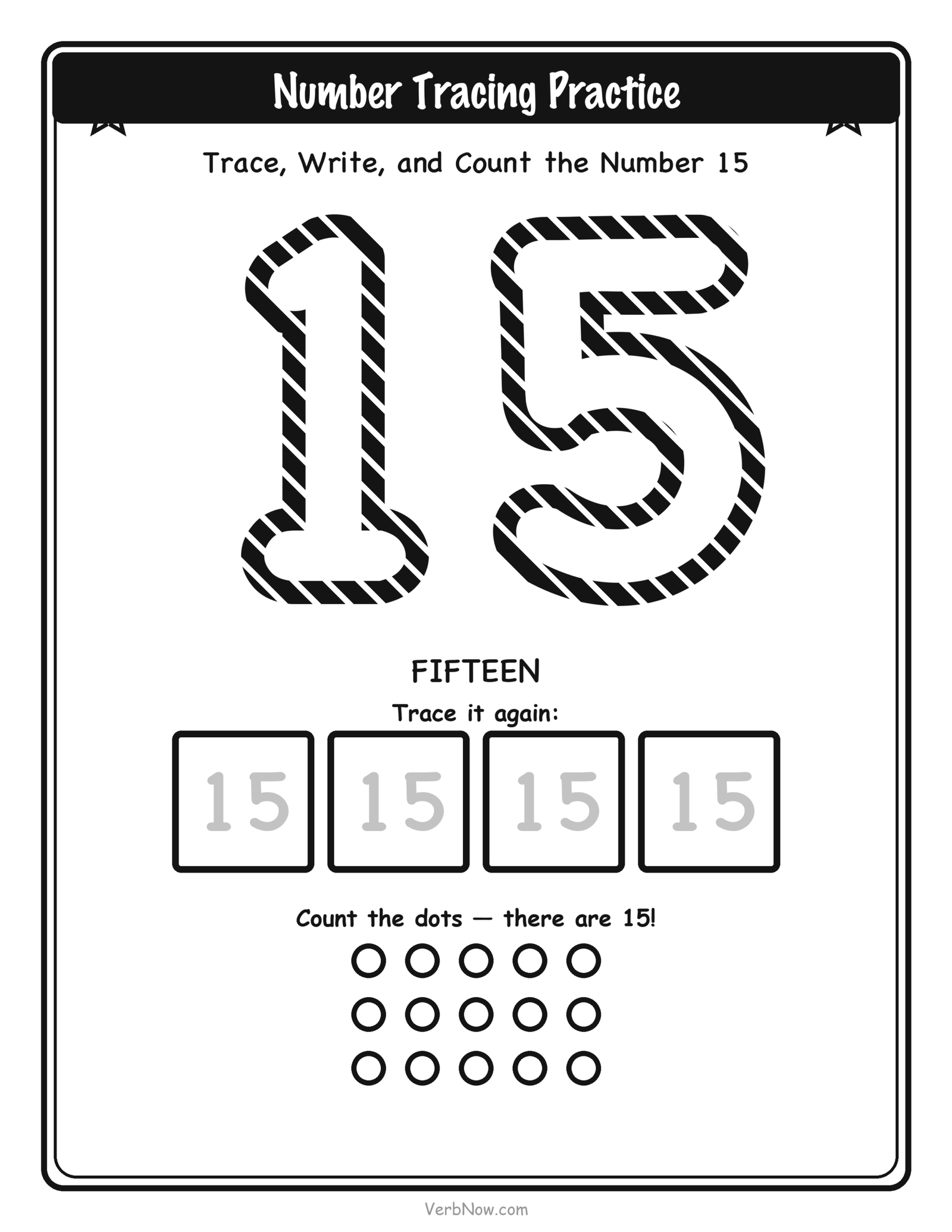
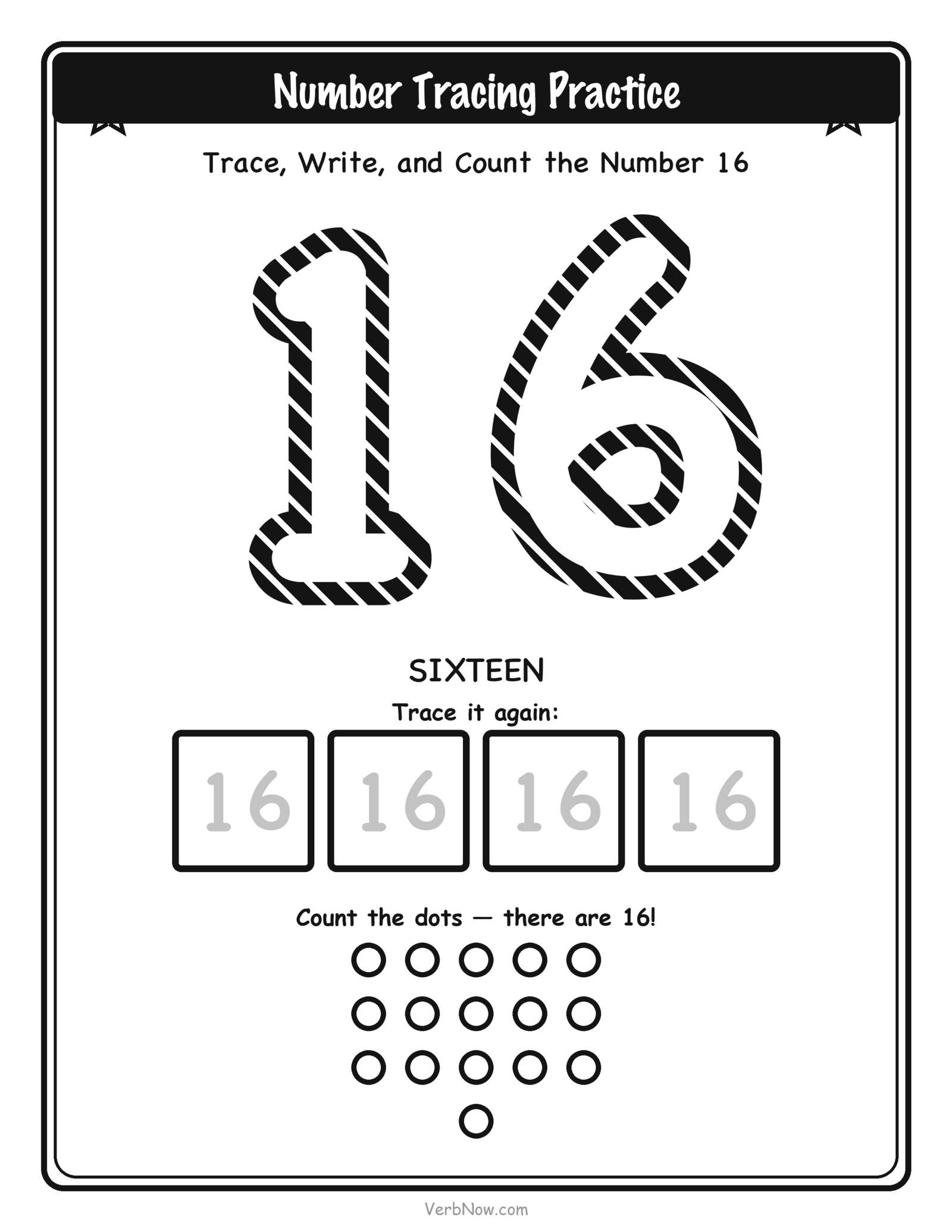
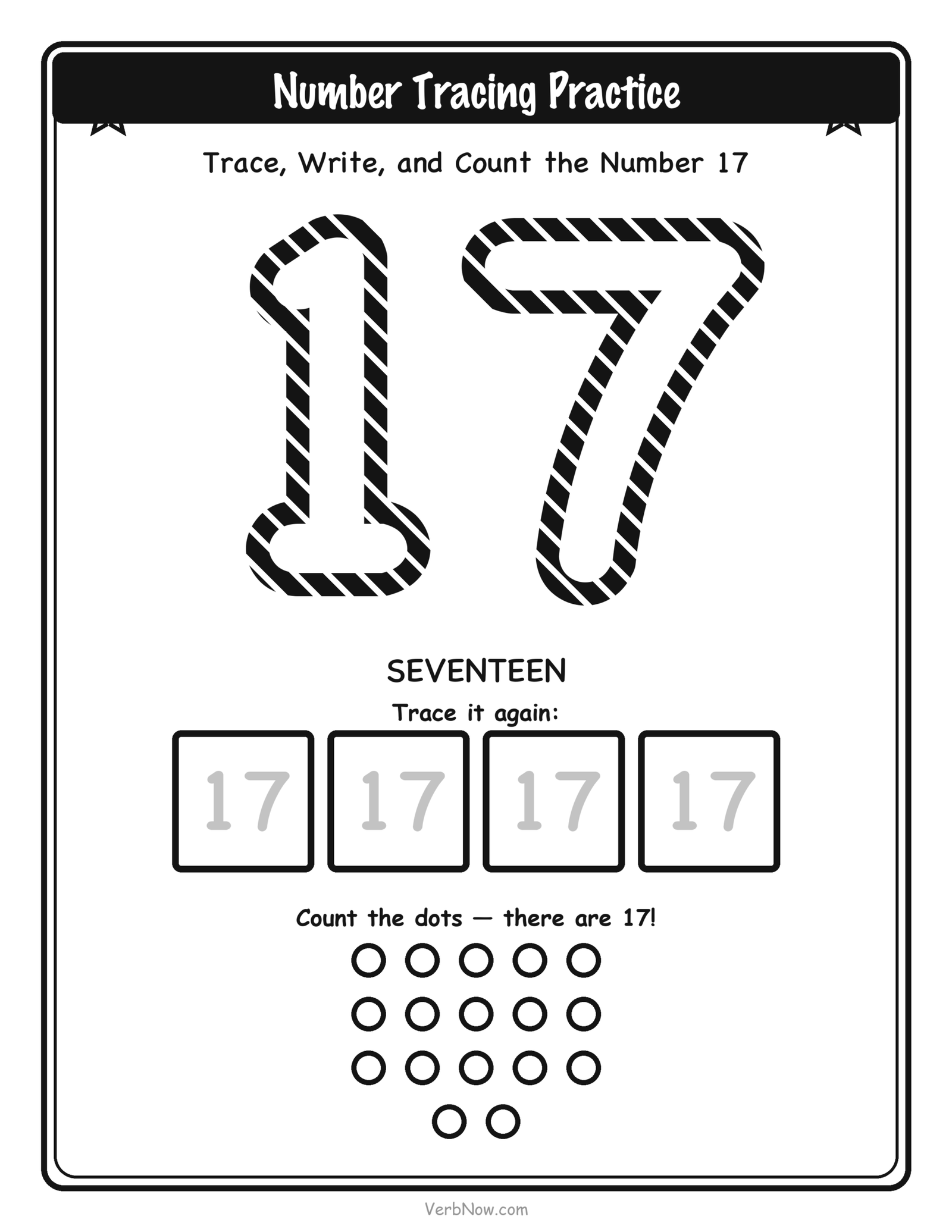
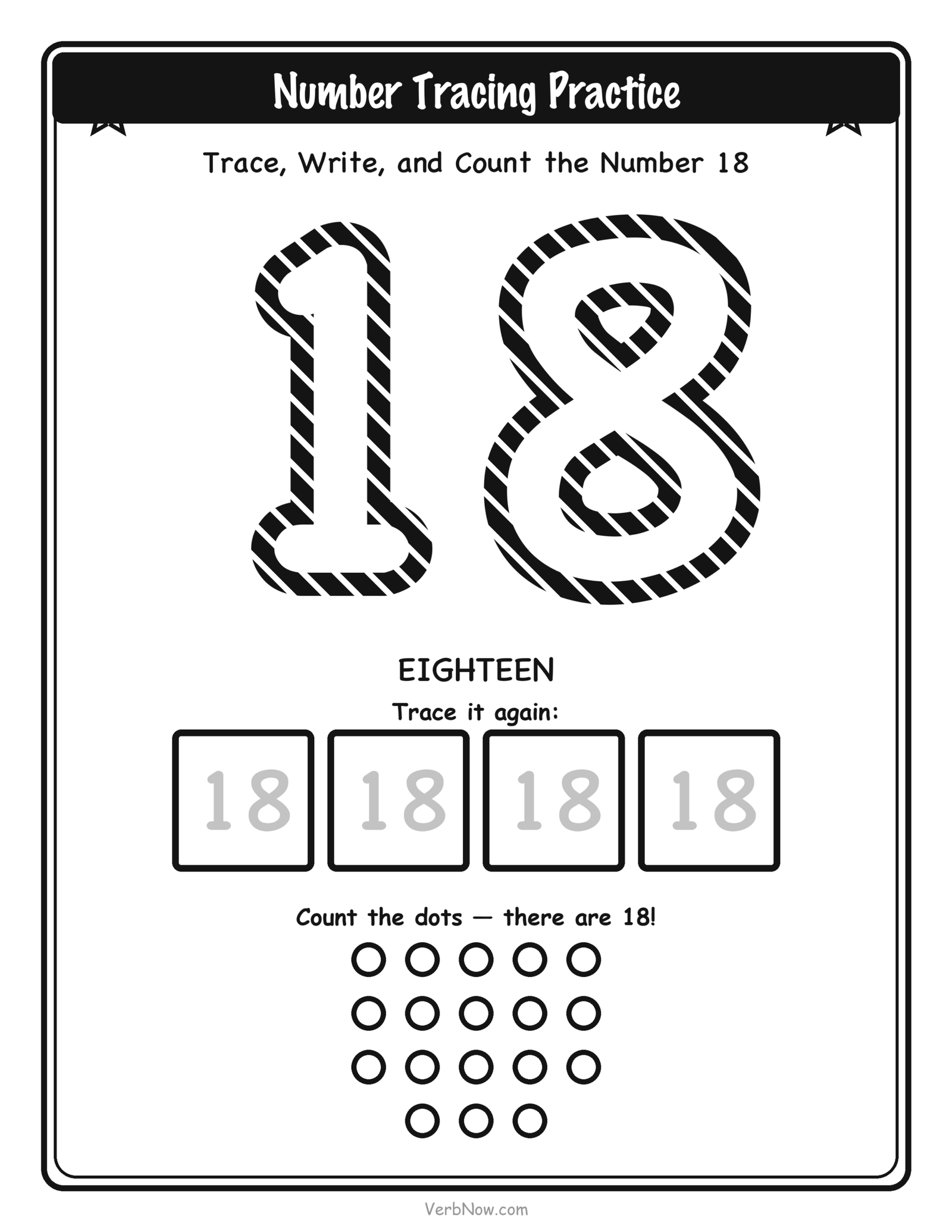
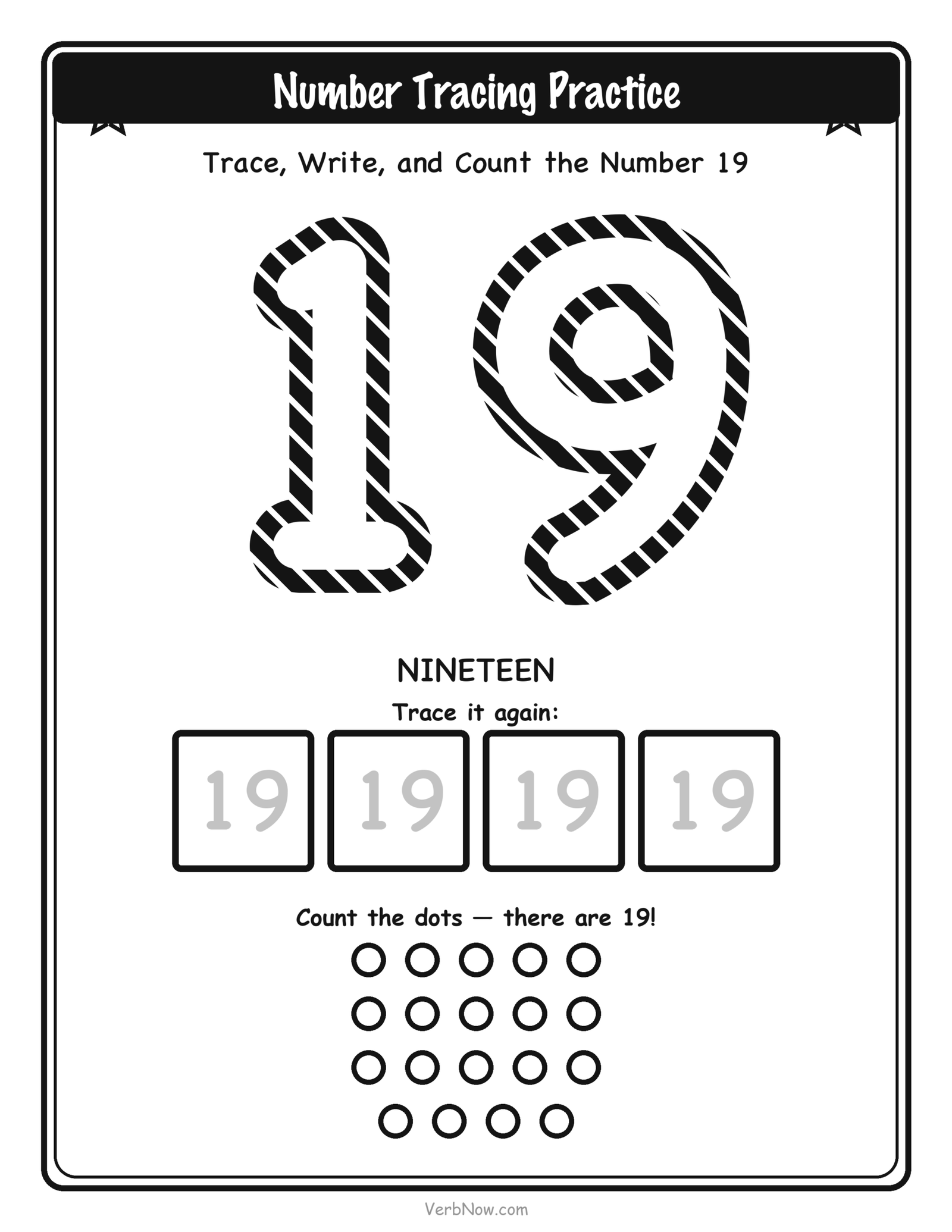
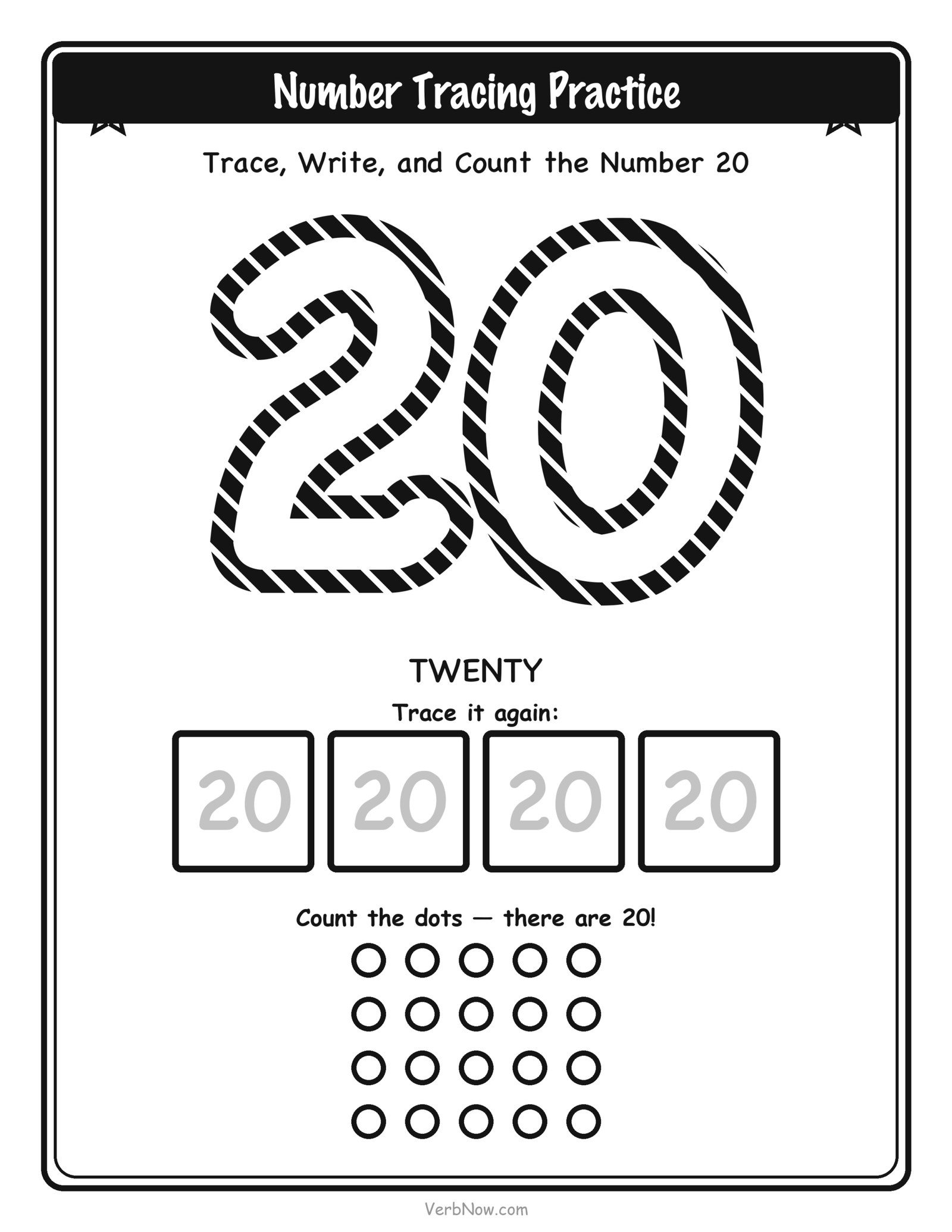
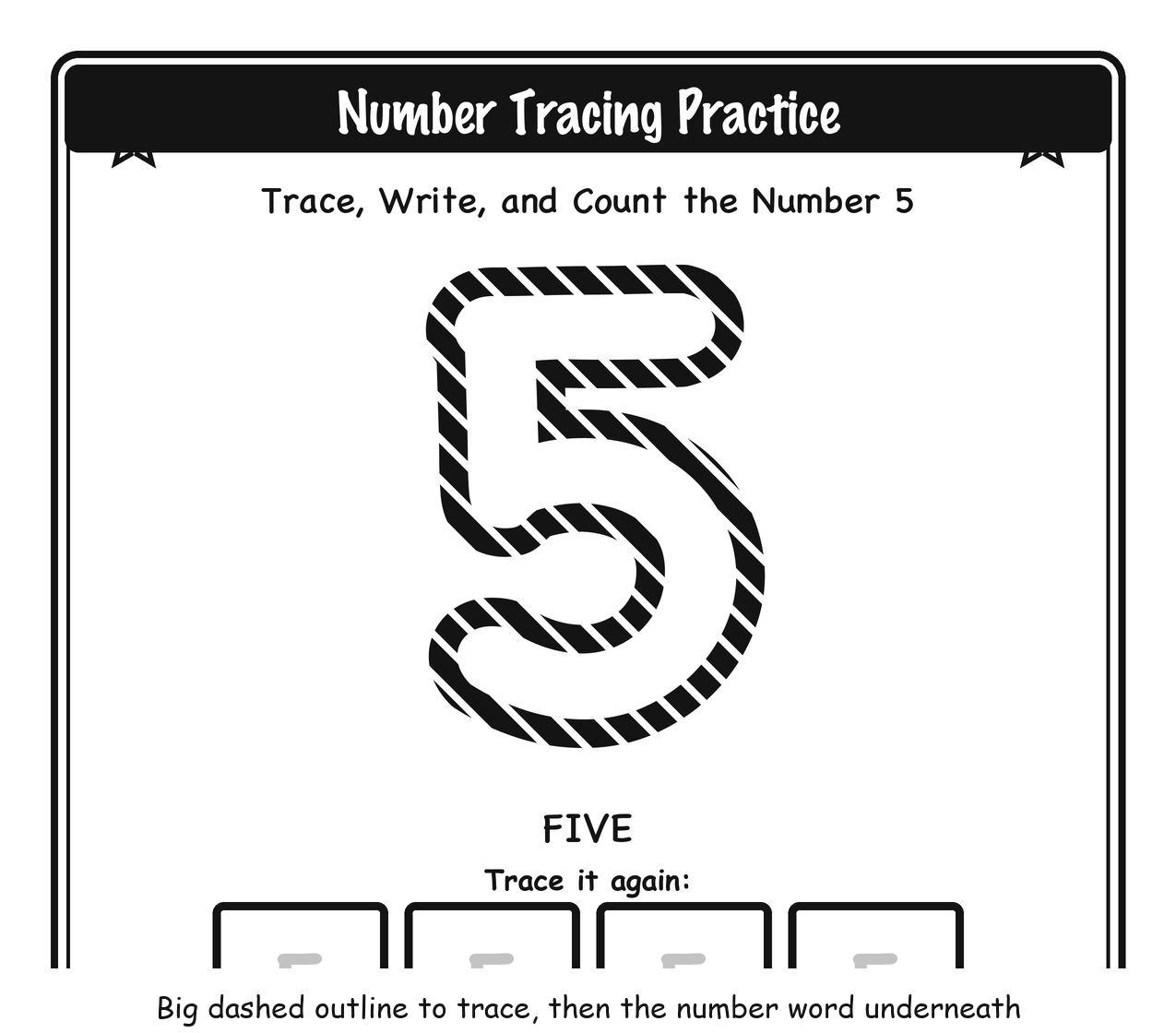
This collection has 20 free number tracing worksheets — one page for every number from 1 to 20. Each page has three parts: a large dashed outline number to trace, a row of 4 smaller boxes with a faded number to write in on their own, and a row of dot counters that matches the page’s number. Every page is black and white on US Letter, downloads as a free PDF, and needs no signup.
The dashed outline on the big number is thick enough for a preschool pencil grip, and the same layout repeats on all 20 pages — only the number, the number word, and the dot count change — so a page for 14 looks and works exactly like the page for 4.
What’s on each page
Every page in this set combines three things on purpose: the big dashed number for tracing with a whole arm or hand, the 4 small boxes for writing the number again at a more normal size, and the dot row for connecting that number to a quantity you can count. Tracing first, writing second, counting third — each step uses a different skill, and putting all three on one page means a page never needs to be reprinted for a different exercise.
How to use these with a preschooler
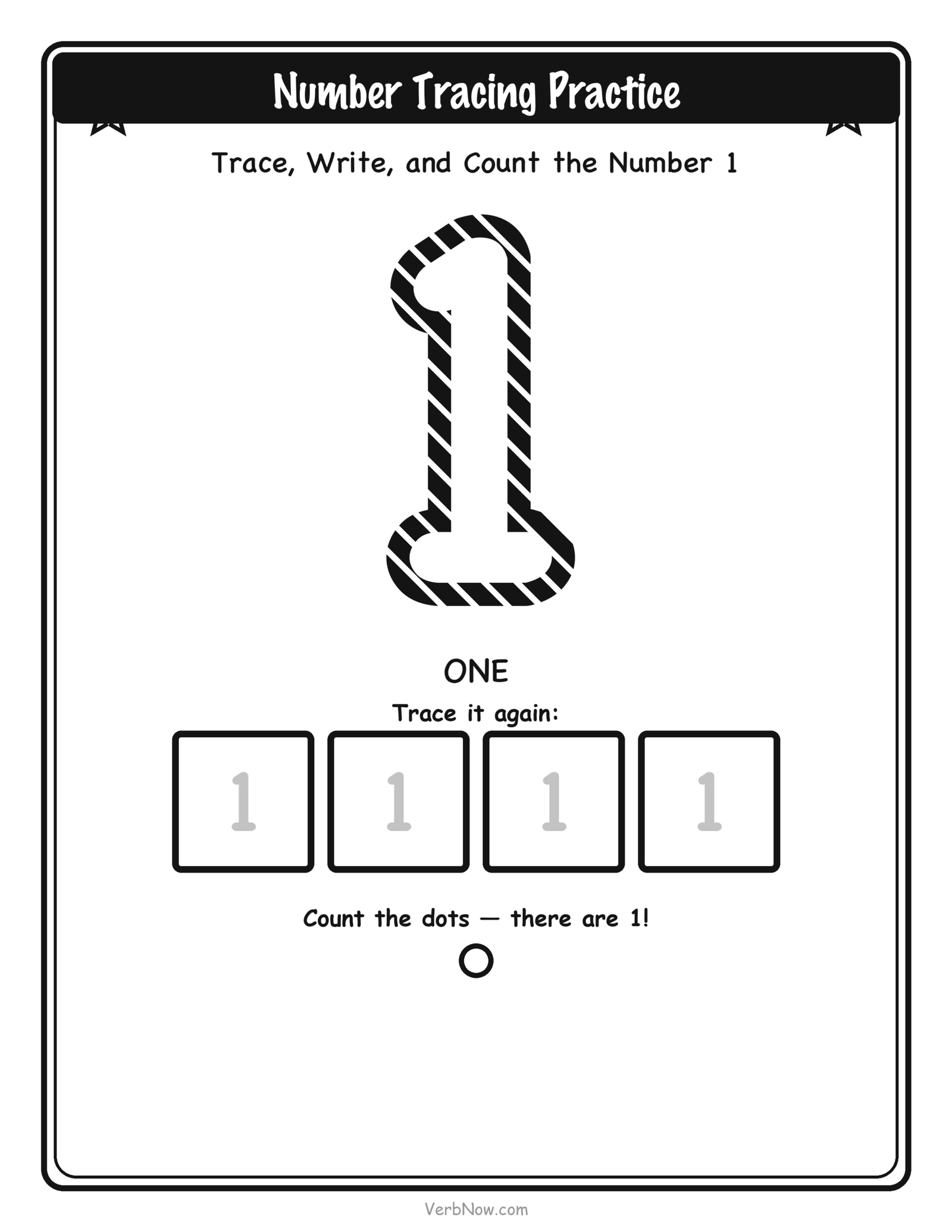
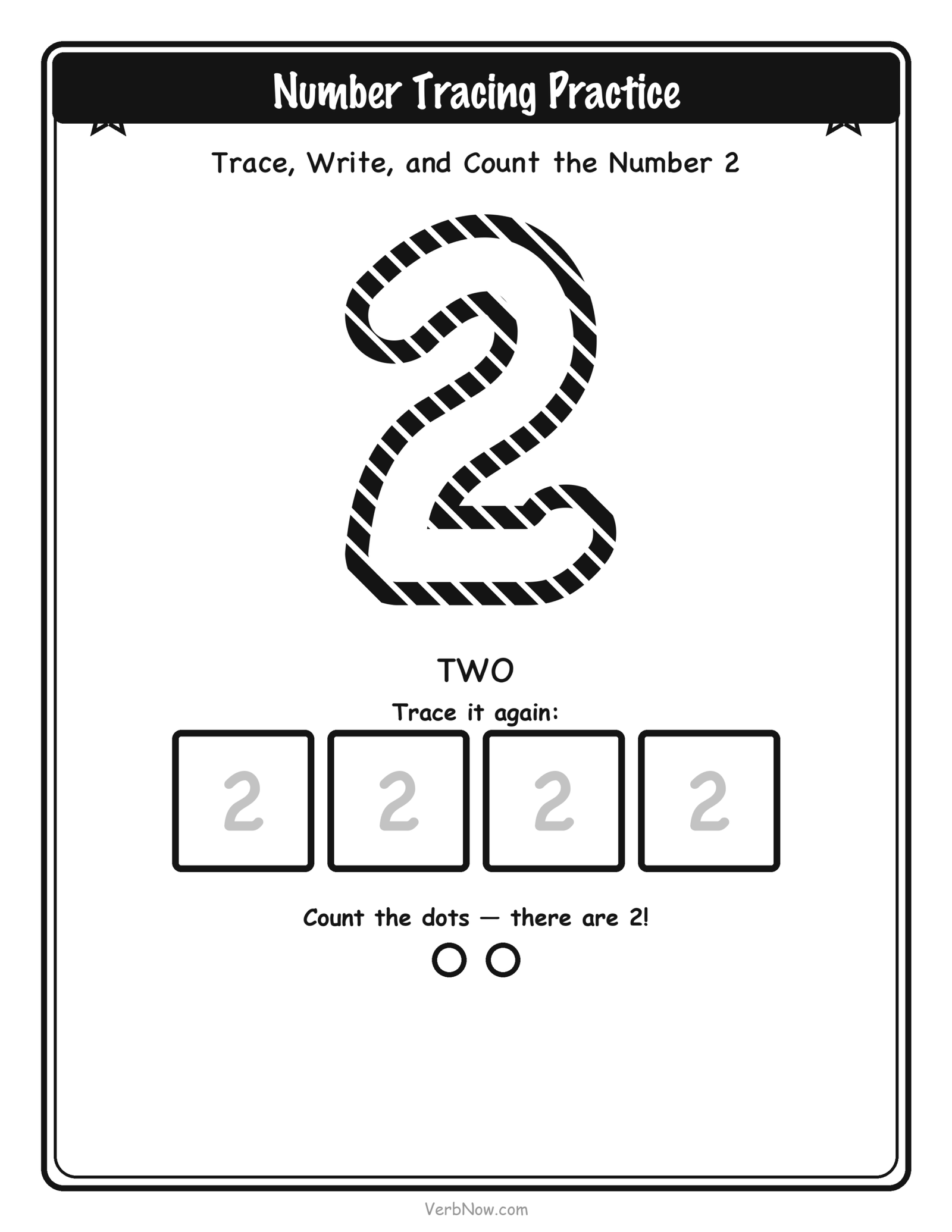
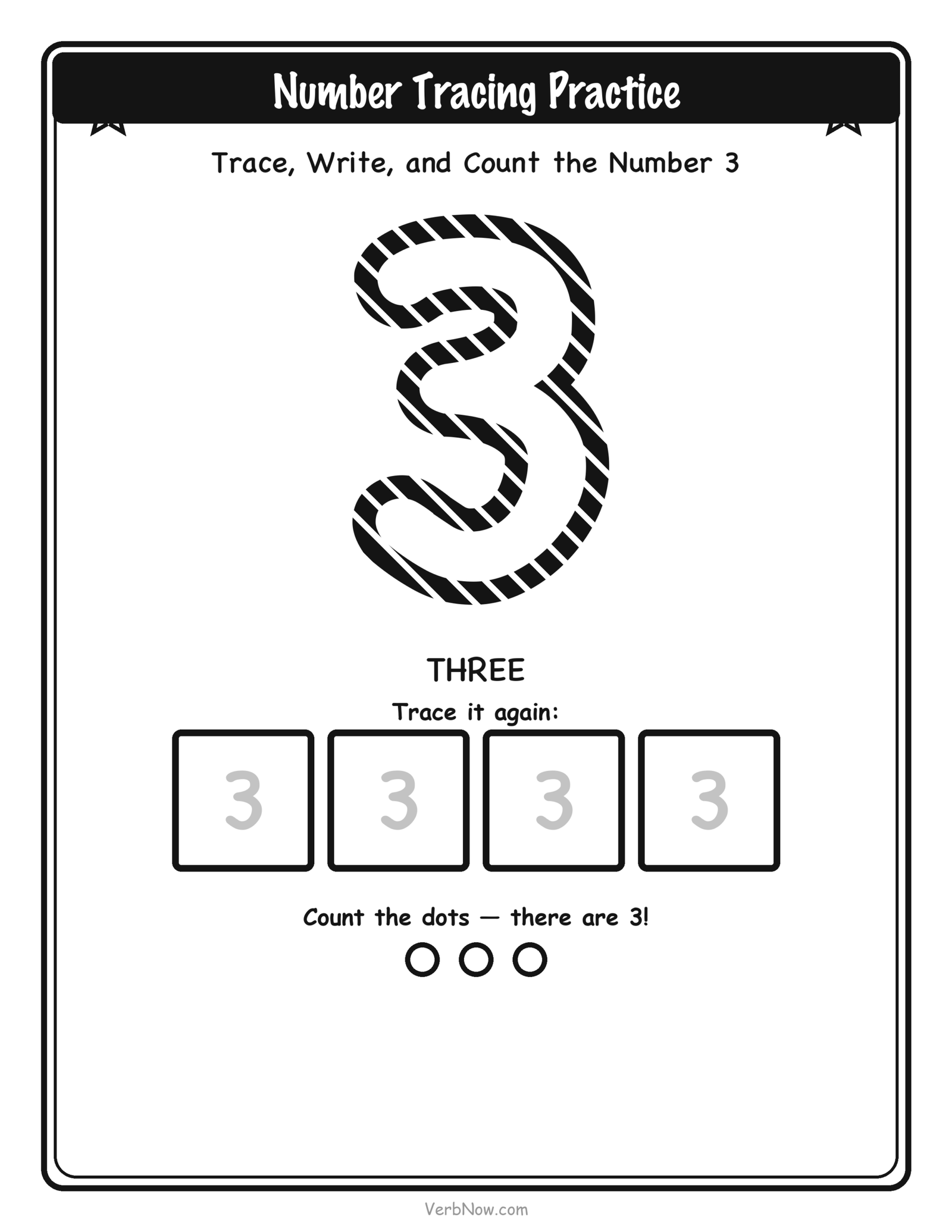
Start with the dashed number — tracing a large shape uses bigger arm and shoulder movement, which is easier for a preschooler than small, precise strokes. Once the big number feels comfortable, move to the 4 write-it-again boxes, which are sized closer to normal handwriting. Finish with the dot row: point at each dot while counting out loud, then check the count against the number word printed above it. That order (big trace, then write, then count) is a design choice built into the page, not a claim about how any specific child will respond to it.
These pair naturally with the name tracing worksheets in this same “tracing” family — one practices writing a name, the other practices writing numbers, and both use the same trace-then-write structure.
How to print these
Every page is US Letter (8.5 × 11 in), pure black and white, with the practice area inside a 0.5 in margin. Plain copy paper works for all 20 — nothing on the page depends on photo paper or color ink.
FAQ
What age are number tracing worksheets 1-20 for?
These are sized for preschool and pre-k hands — the dashed number is large and the stroke is thick, which suits a first-time pencil grip. Numbers up through 20 also make the set useful for kindergarten review once a child has moved past the numbers below 10.
Why does each page have a big dashed number AND small write-in boxes?
They target two different motor skills. The big dashed number uses larger arm movement, which is easier to control first. The 4 small boxes are closer to the size a number is actually written at, so they are the bridge between “tracing a shape” and “writing a number” on the page.
What do the dots on each page mean?
The dot row shows the number’s value as a count, arranged 5 to a row. Counting the dots and checking that total against the number and the number word is what ties the written symbol to an actual quantity.
Do I need to print all 20 pages at once?
No. Each page in the grid above downloads separately, so you can print one number at a time or print a few in the order a child is learning them.
What paper and printer settings work best?
Standard US Letter copy paper and a black-and-white or draft print setting are enough — every page is pure black and white with no shading or photo elements.
For a hub of every worksheet in this silo, see Math Worksheets. For the same trace-then-write structure applied to writing a name, see the name tracing worksheets.