
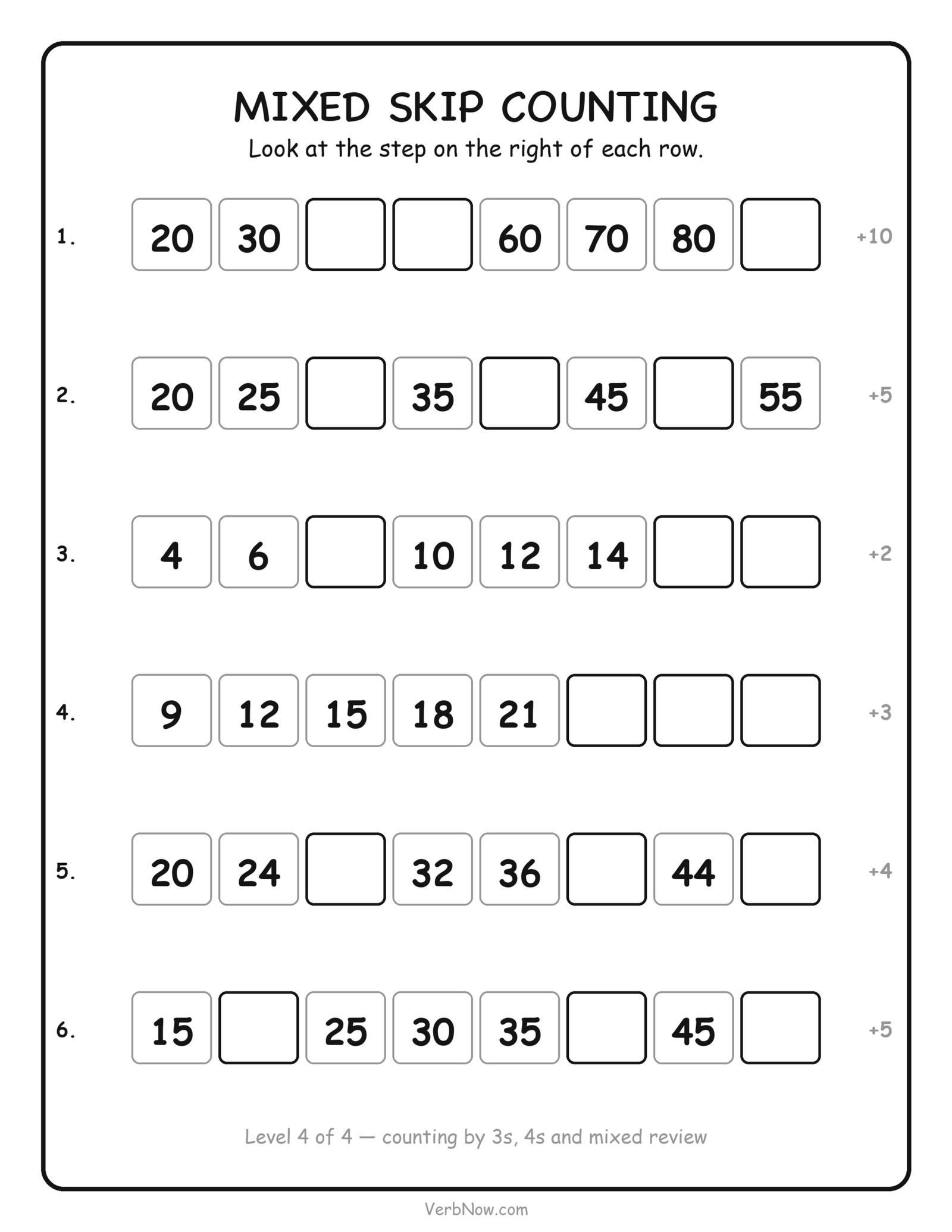
This set has 12 skip counting worksheets covering five step sizes — 2s, 3s, 4s, 5s and 10s — in six exercise formats: fill in the missing numbers, color a hundred chart, fill the gaps on a number line, count groups of objects, join a dot to dot, and one mixed review page. Across the set there are 120 boxes to write a number into, 4 full 1-to-100 charts, 126 objects to count in groups and a 20-dot puzzle. The pages run in four levels, easiest first, and every one is US Letter, black and white, and printable as it is.
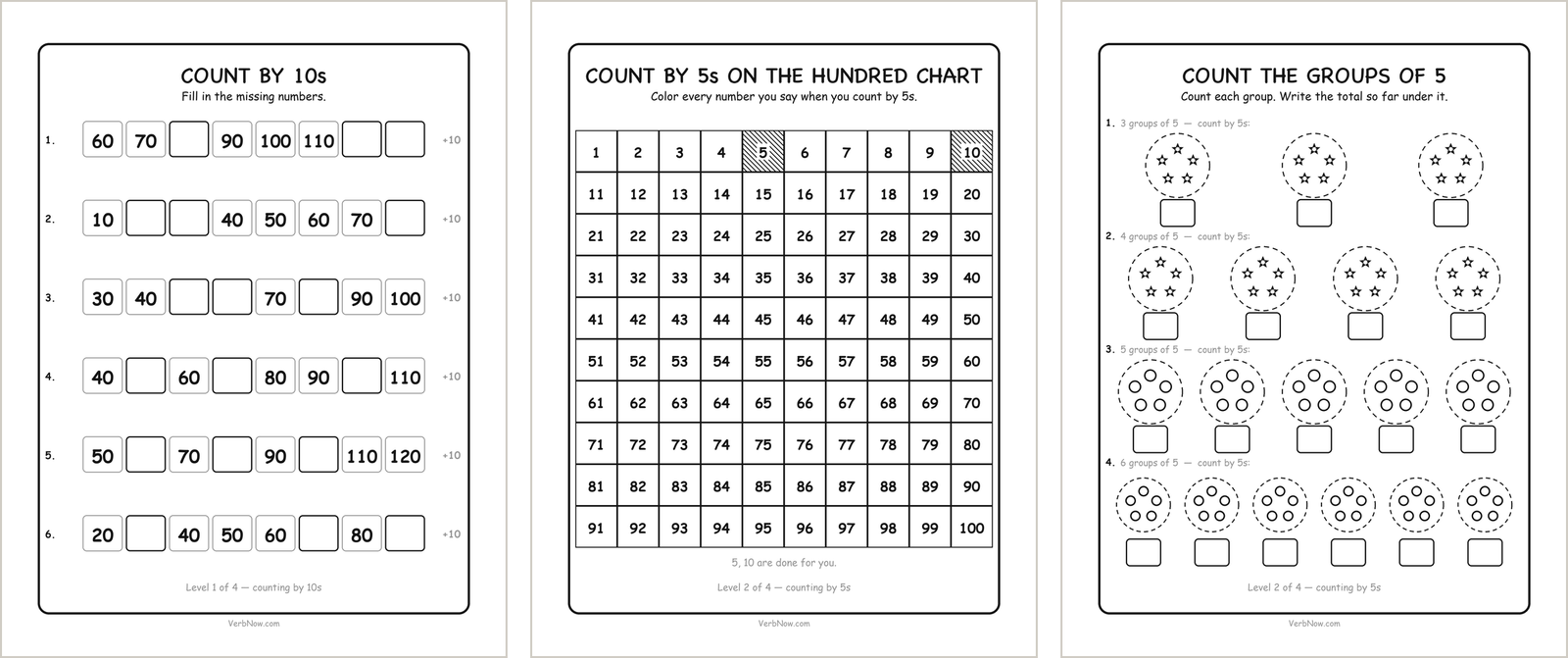
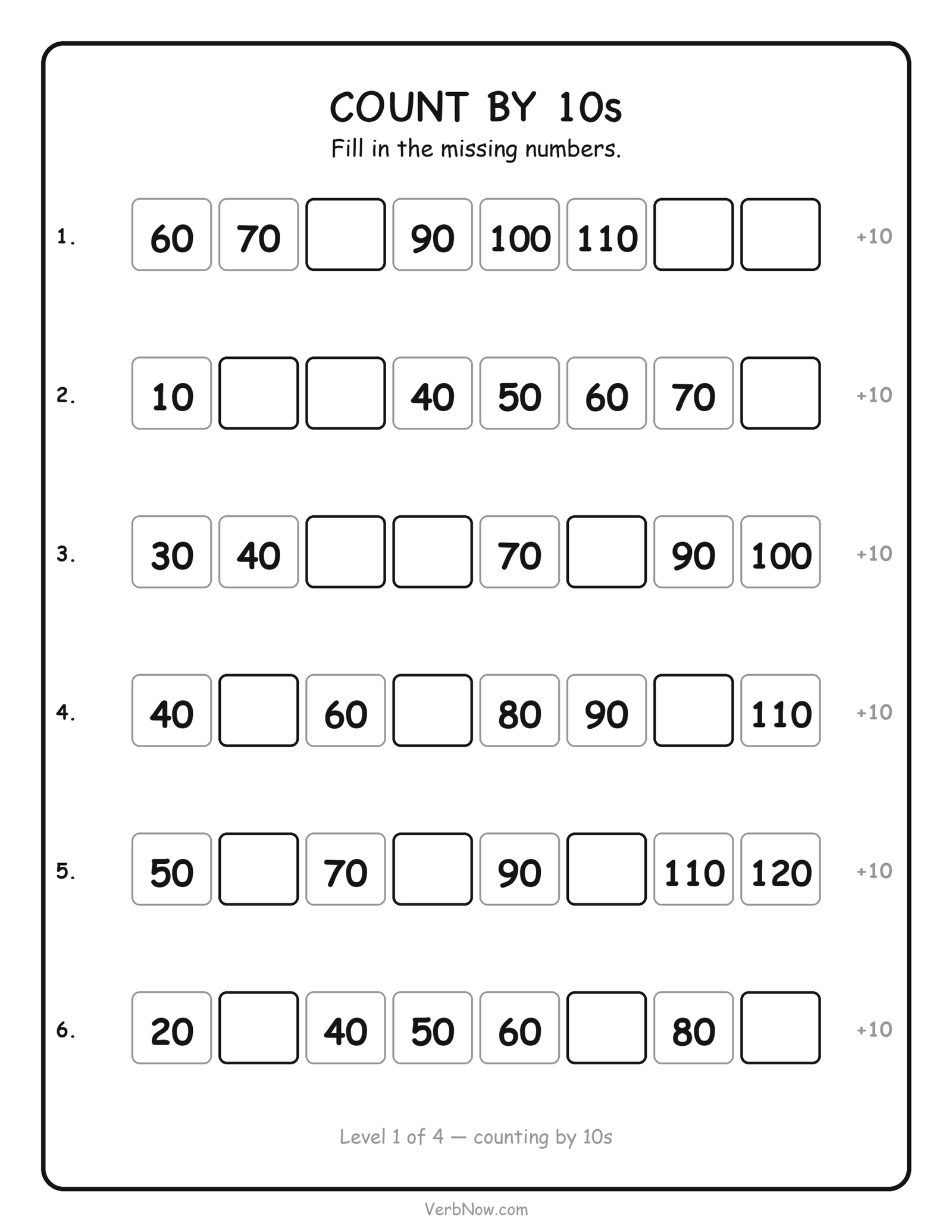
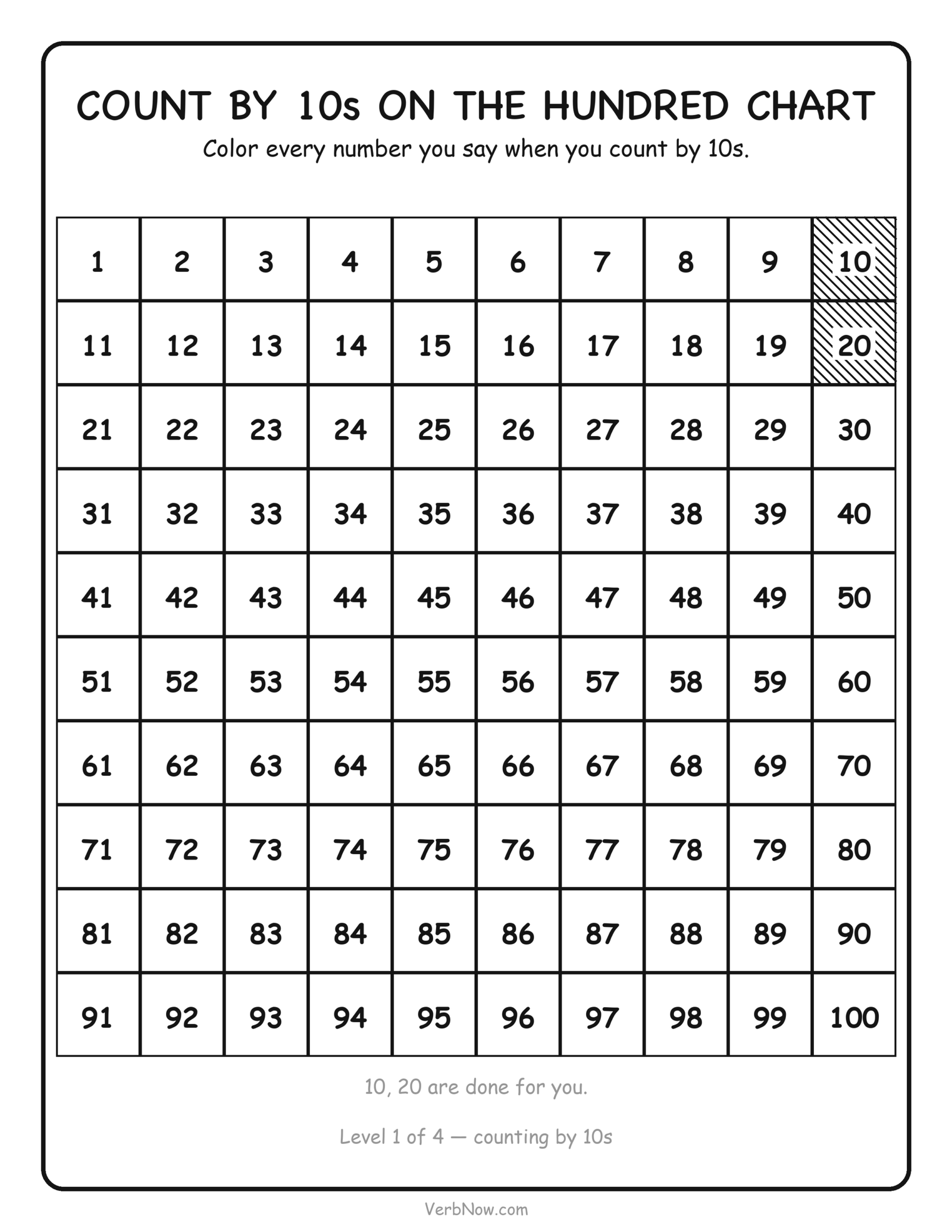
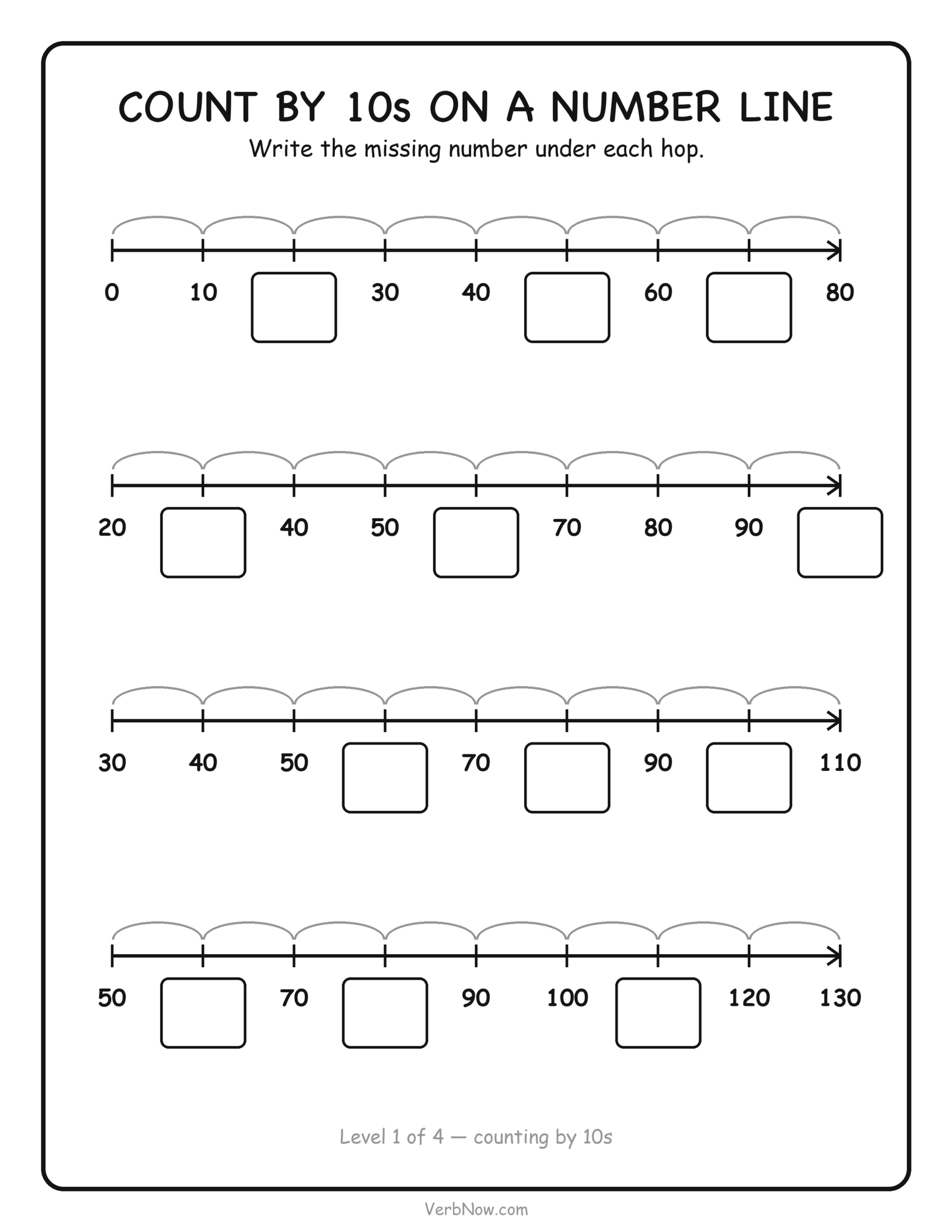
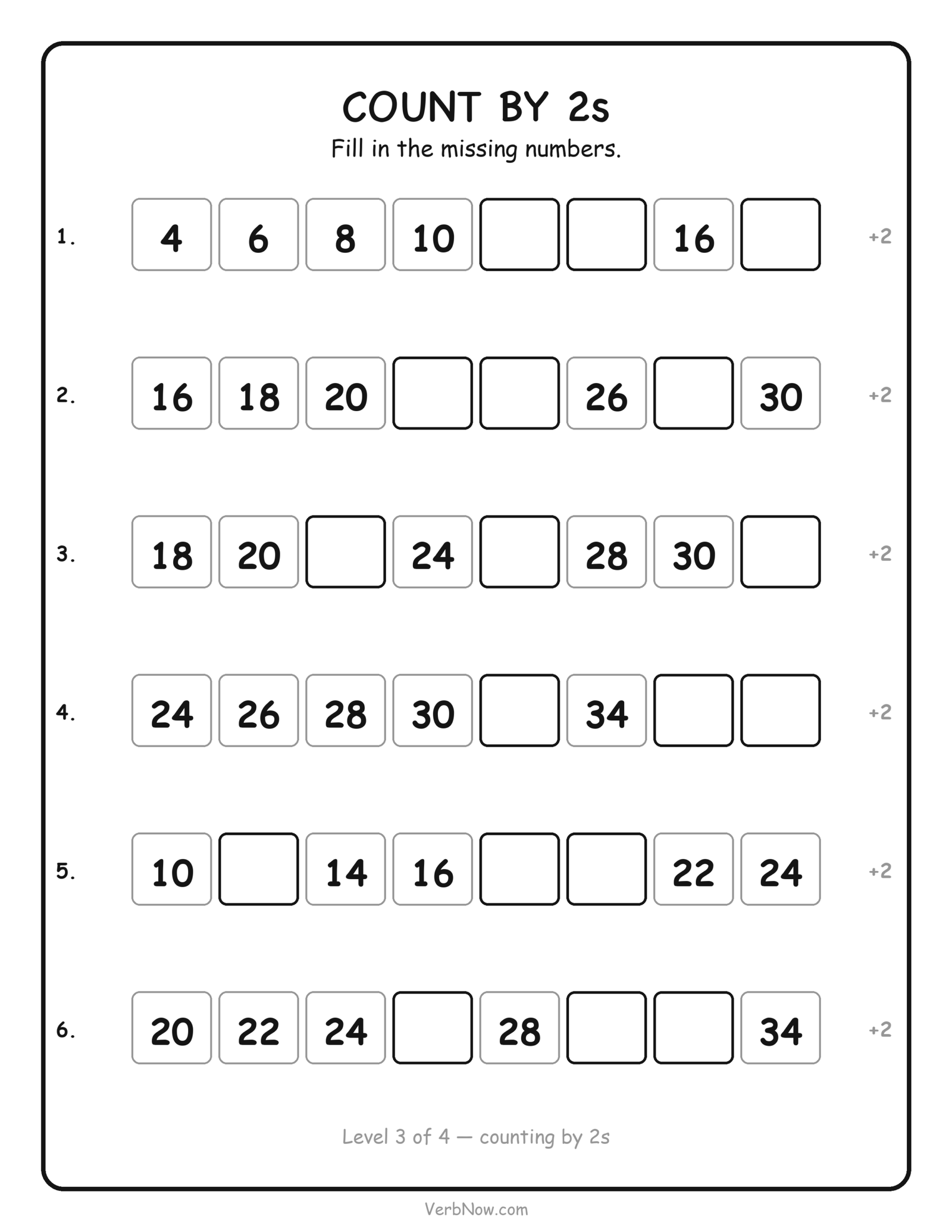
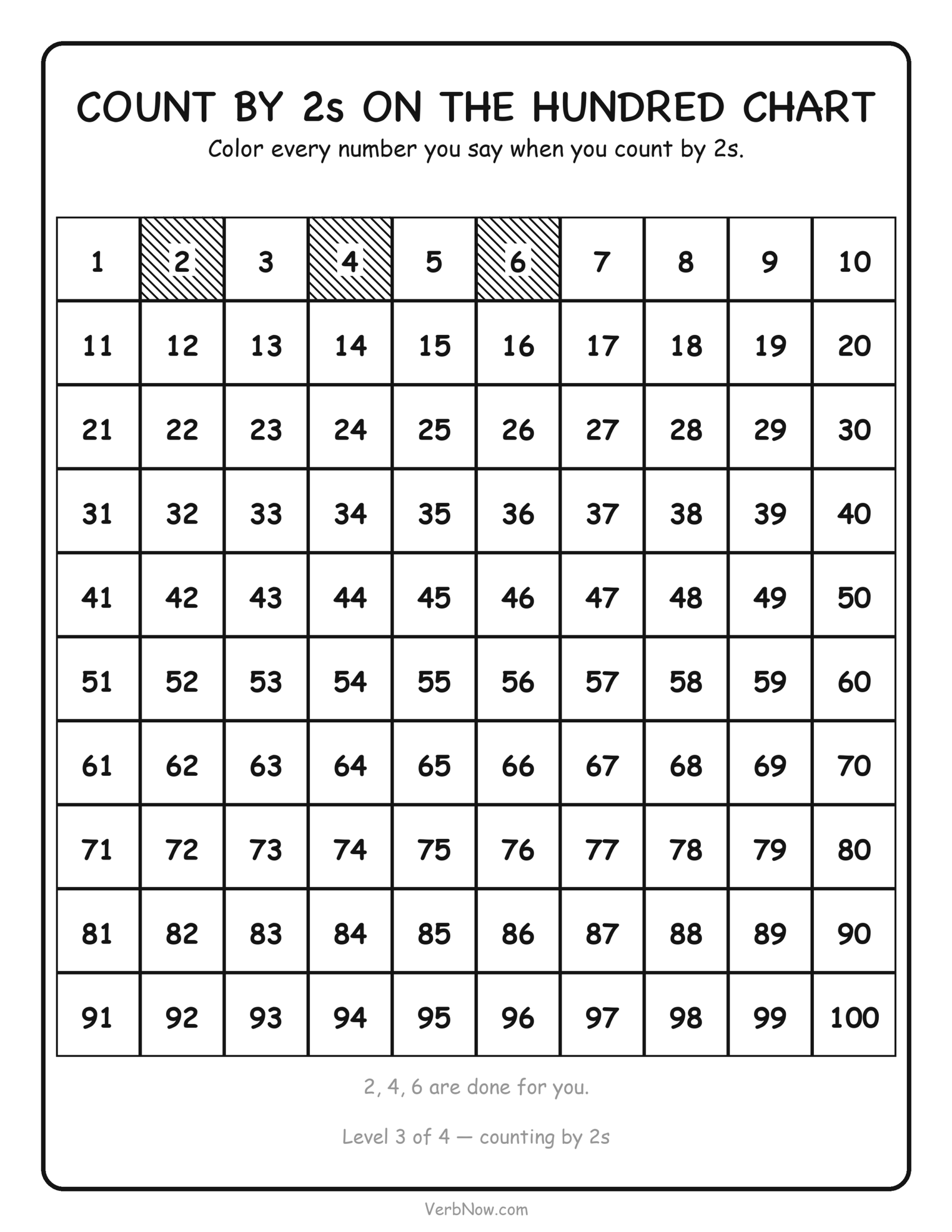
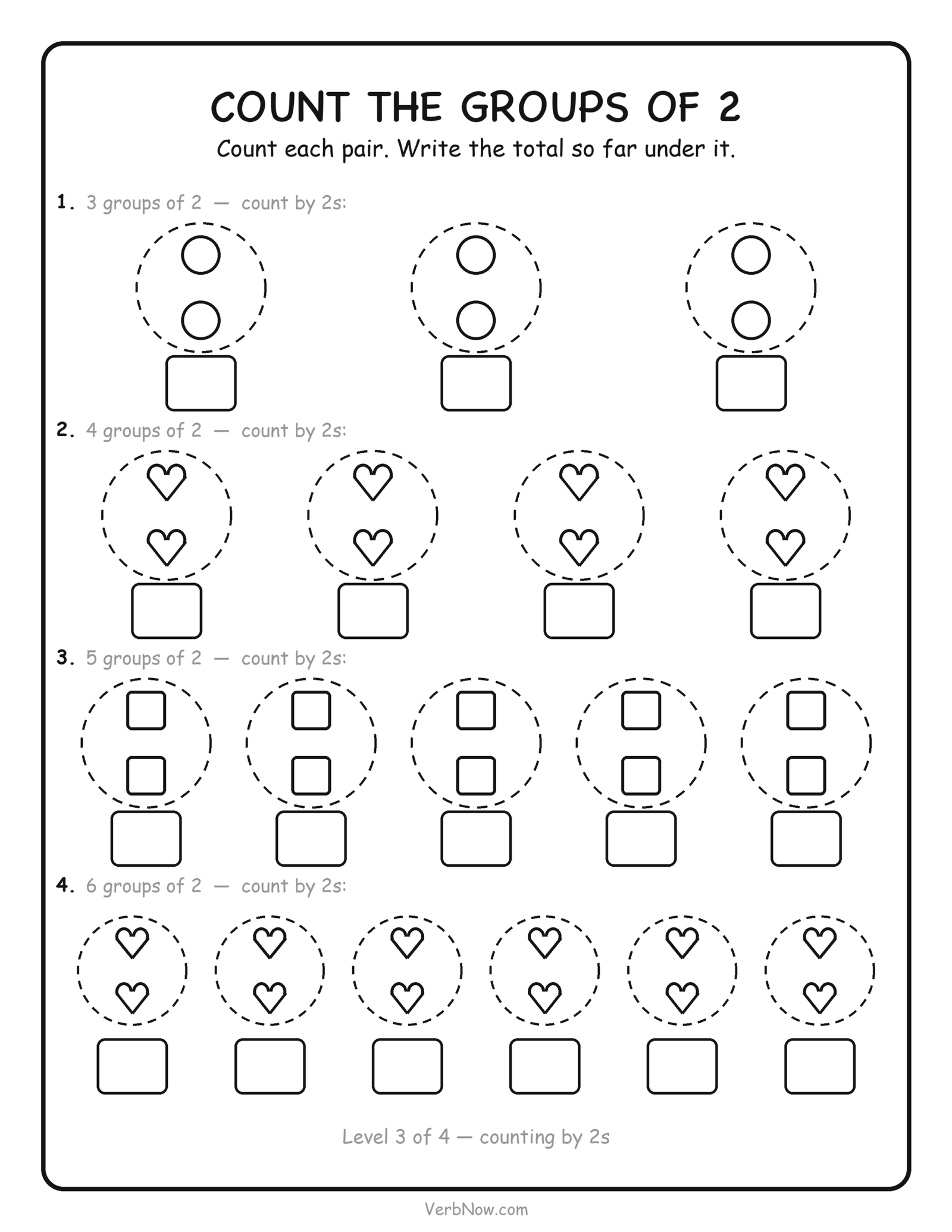
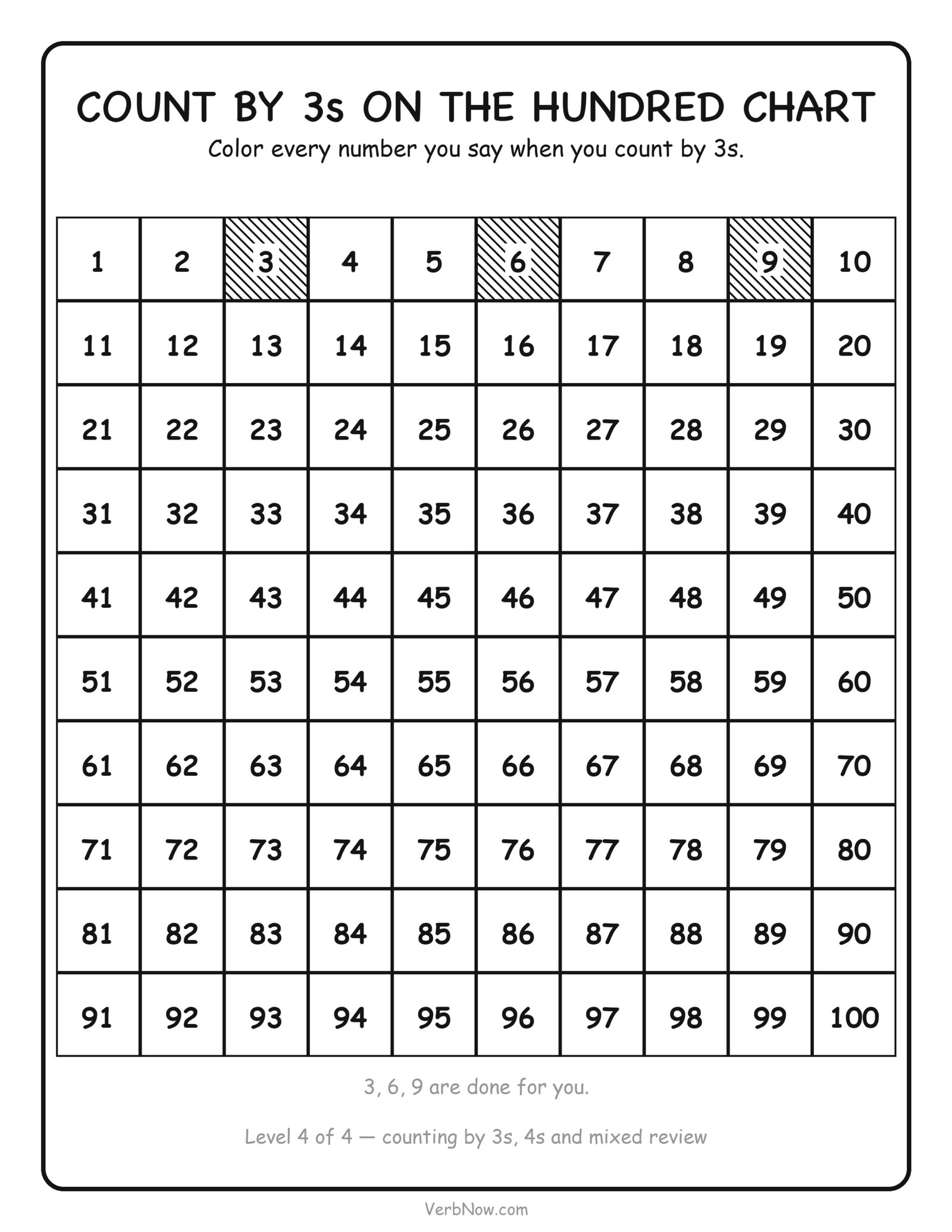
What is on the 12 pages
The pages are grouped into four levels, printed along the bottom edge of each sheet so a loose stack can be sorted back into order. The level sets the step size; the exercise format changes within a level so the same count is practised more than one way.
| Level | Counting by | Pages | Formats |
|---|---|---|---|
| 1 | 10s | Pages 1, 2, 3 | Missing numbers, hundred chart, number line |
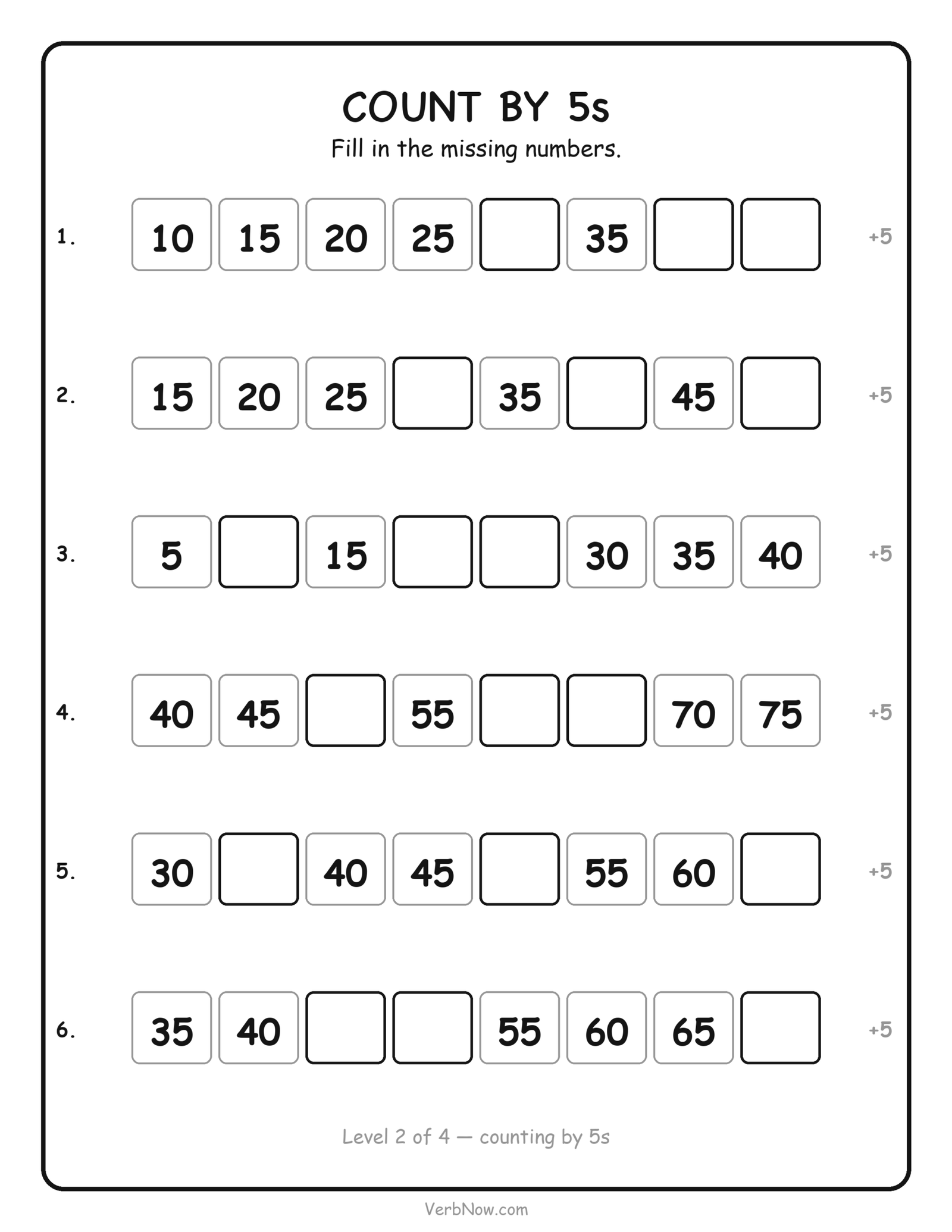
| 2 | 5s | Pages 4, 5, 6, 7 | Missing numbers, hundred chart, count the groups, dot to dot |
| 3 | 2s | Pages 8, 9, 10 | Missing numbers, hundred chart, count the groups |
| 4 | 3s, 4s, mixed | Pages 11, 12 | Hundred chart, then a mixed page with all five step sizes |
The write-in boxes measure 0.72 by 0.65 inches on the four sequence pages, 0.77 by 0.63 inches under the number line, and 0.63 by 0.5 inches under each group circle, where the gap between circles is what sets the limit. The hundred chart squares are 0.75 inches. I keep the sequence boxes near three quarters of an inch wide on purpose: that is about where a two-digit number written by a five- or six-year-old still lands inside the line rather than over it, and a page marked wrong for handwriting teaches nothing about counting.
The order these are taught, and why 10s come before 2s
Counting by 10s is first because it is the only one where the child does not have to compute anything: 10, 20, 30, 40 changes one digit and leaves the other alone. Counting by 5s is next because the ending alternates between 5 and 0 and nothing else, and because it is already attached to things a child has seen — the minute marks on a clock face, a five-cent coin, a hand. Counting by 2s comes third: the pattern is the even numbers, which is easy to say but has no single-digit tell the way 5s and 10s do.
Then 3s and 4s, and they are genuinely harder, not just later. There is no pattern in the last digit at all — 3, 6, 9, 12, 15, 18 ends in six different digits before it repeats. A child cannot get through those by looking at endings; they either add each step or they have started remembering the sequence. That is why level 4 is where the mixed review page sits as well, and why 4s appear only on that page rather than getting a sheet of their own.
The matching classroom sequence is Common Core 2.NBT.A.2 for counting within 1000 by 5s, 10s and 100s, with even numbers and equal groups in 2.OA.C.3 and 2.OA.C.4. Counting by 3s and 4s is not named in those standards, which is part of why it tends to get skipped until the times tables arrive and it is suddenly assumed.
Why the hundred chart pages do something the fill-in pages cannot
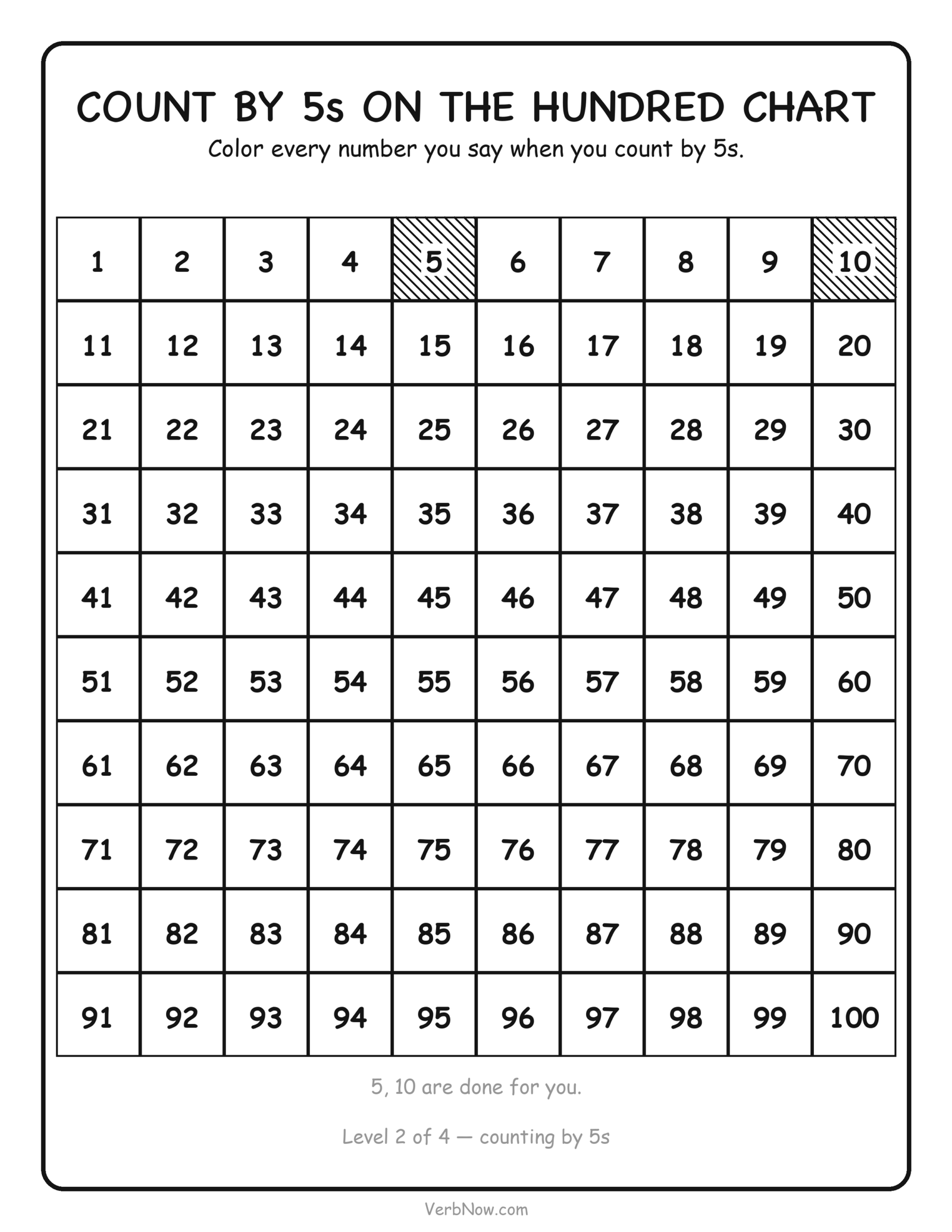
A fill-in-the-blank sequence proves a child can continue a pattern. A hundred chart shows them what the pattern is. Once the multiples are colored in, each step size makes a different shape on the grid, and the shape is the explanation.
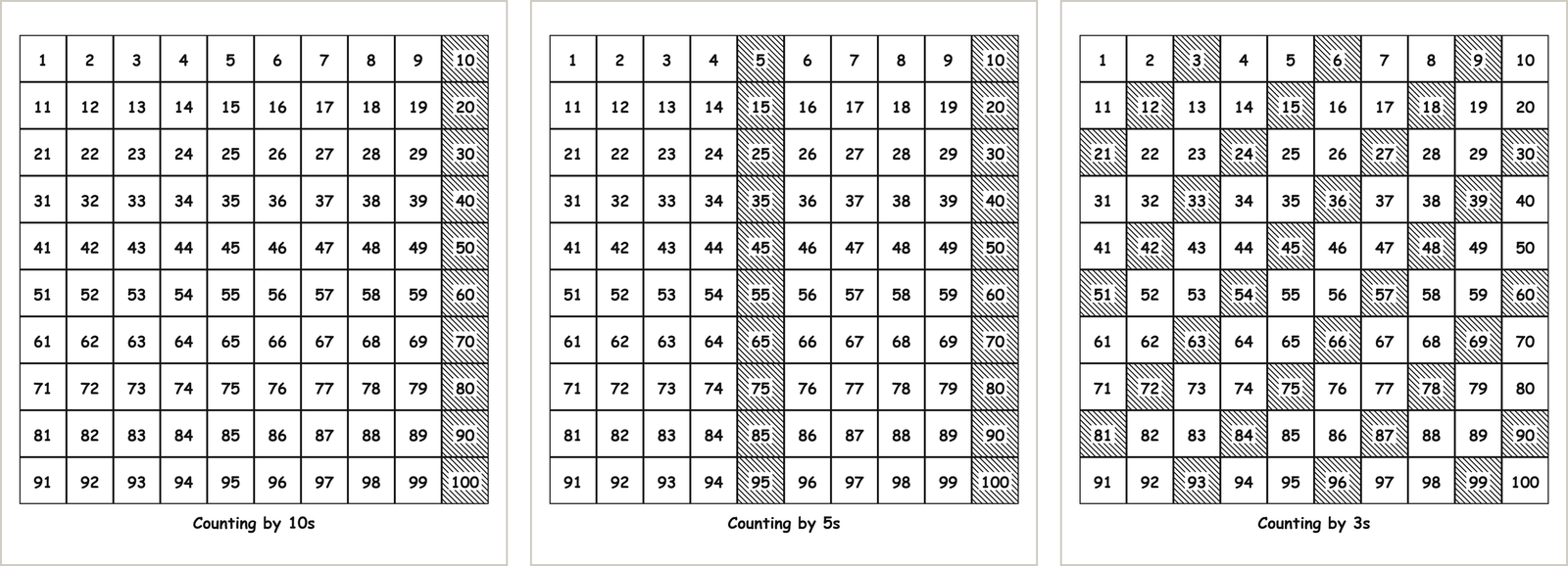
Counting by 10s colors a single column down the right-hand edge, which is the visible reason the tens digit is the only thing that changes. Counting by 5s adds a second column in the middle, so the 5-then-0 ending stops being a rule to remember and becomes two stripes. Counting by 2s fills five alternating columns — the even numbers, as a comb. Counting by 3s breaks the column pattern completely and runs on a diagonal, which is exactly why 3s are hard. All 400 squares across the 4 charts are numbered, so a child who loses the thread can go back to counting one square at a time and pick it up again.
I put the first two or three multiples in as a hatched worked example on each chart rather than leaving the grid blank. A blank grid with an instruction above it gets started in the wrong place often enough to be worth the two squares.
Counting groups is where skip counting turns into multiplication
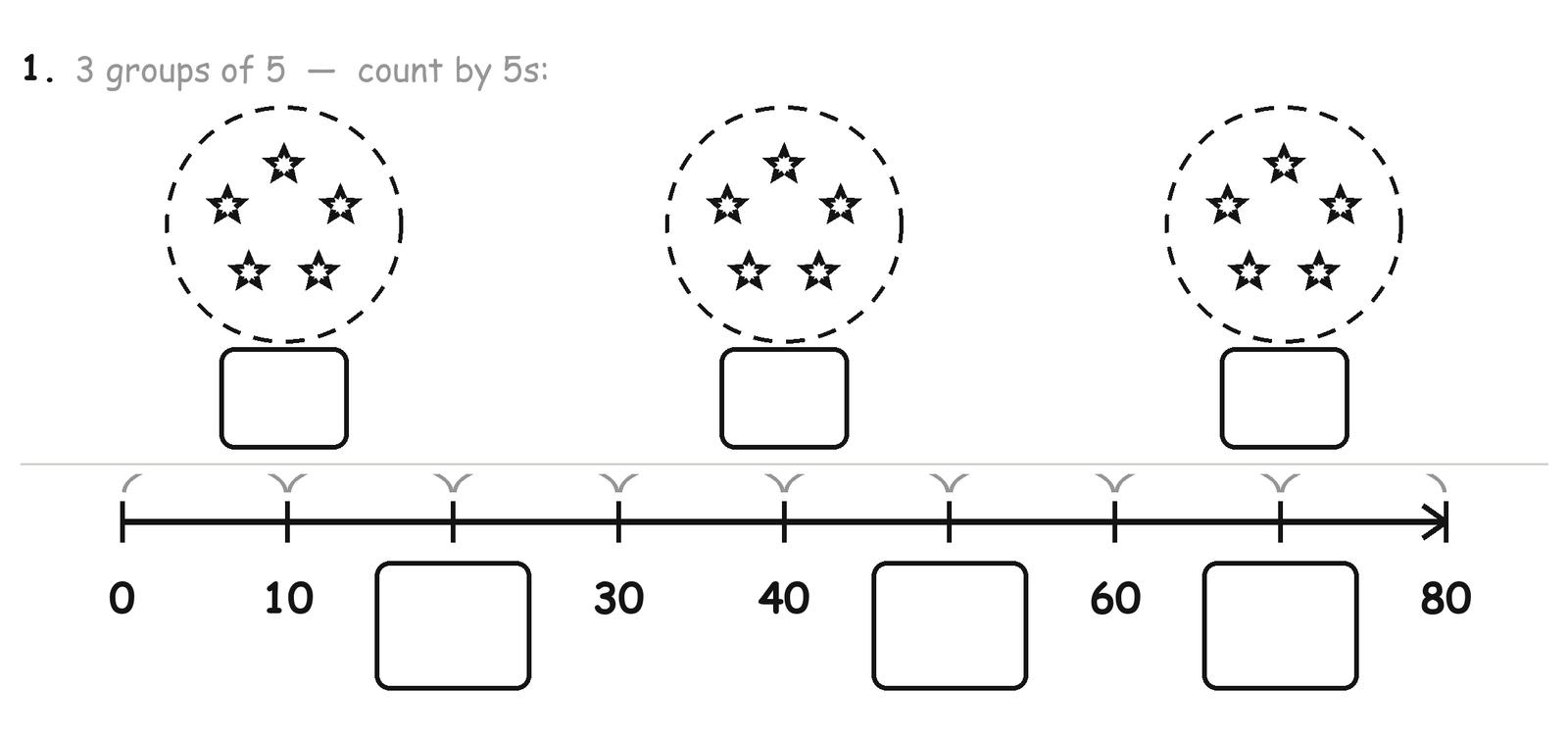
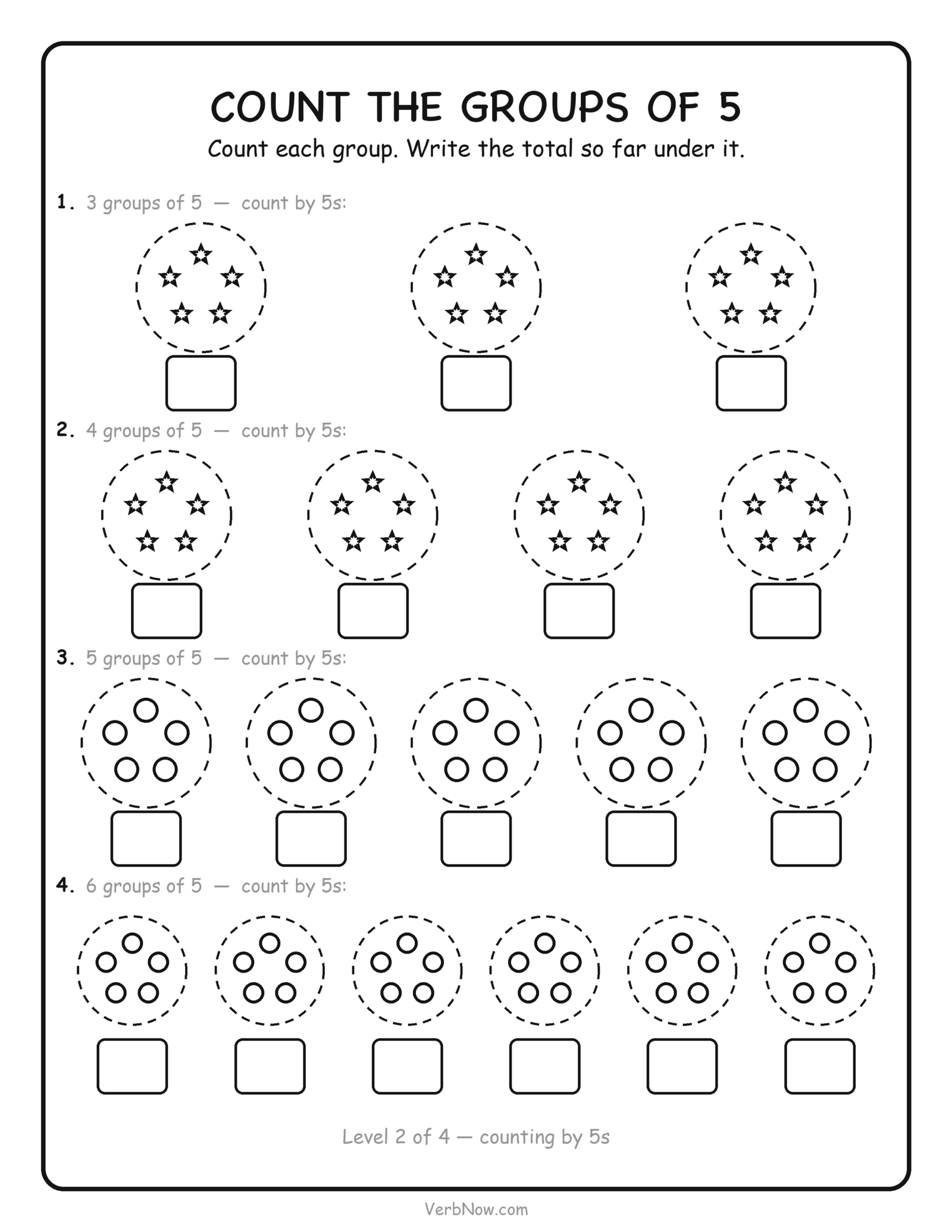
On the two count-the-groups pages, the objects are drawn inside dashed circles and there is one box under each circle, not one box at the end. The child writes 5, then 10, then 15, then 20 — the running total after each group, not just the answer. Four groups of five and 4 × 5 are then the same picture, which is the whole reason the format exists. There are 126 objects to count across those two pages, laid out as three, four, five and six groups at a time.
The number line page does the same count a third way. Each hop is the same width, the ticks are evenly spaced, and some labels are missing, so the child has to work out where the count has got to rather than read it off. Groups show skip counting as repeated addition; the number line shows it as equal distance. Both are worth having before the times tables show up as facts to memorise.
Answer key
Answers are listed left to right, in the order the empty boxes appear on the row. The 4 hundred charts are not listed here, because the answer is every multiple of the step size from the first one up to 100, and it is already printed in each square.
| Where | Step | Missing numbers |
|---|---|---|
| Page 1, row 1 | +10 | 80, 120, 130 |
| Page 1, row 2 | +10 | 20, 30, 80 |
| Page 1, row 3 | +10 | 50, 60, 80 |
| Page 1, row 4 | +10 | 50, 70, 100 |
| Page 1, row 5 | +10 | 60, 80, 100 |
| Page 1, row 6 | +10 | 30, 70, 90 |
| Page 3, number line 1 | +10 | 20, 50, 70 |
| Page 3, number line 2 | +10 | 30, 60, 100 |
| Page 3, number line 3 | +10 | 60, 80, 100 |
| Page 3, number line 4 | +10 | 60, 80, 110 |
| Page 4, row 1 | +5 | 30, 40, 45 |
| Page 4, row 2 | +5 | 30, 40, 50 |
| Page 4, row 3 | +5 | 10, 20, 25 |
| Page 4, row 4 | +5 | 50, 60, 65 |
| Page 4, row 5 | +5 | 35, 50, 65 |
| Page 4, row 6 | +5 | 45, 50, 70 |
| Page 8, row 1 | +2 | 12, 14, 18 |
| Page 8, row 2 | +2 | 22, 24, 28 |
| Page 8, row 3 | +2 | 22, 26, 32 |
| Page 8, row 4 | +2 | 32, 36, 38 |
| Page 8, row 5 | +2 | 12, 18, 20 |
| Page 8, row 6 | +2 | 26, 30, 32 |
| Page 12, row 1 | +10 | 40, 50, 90 |
| Page 12, row 2 | +5 | 30, 40, 50 |
| Page 12, row 3 | +2 | 8, 16, 18 |
| Page 12, row 4 | +3 | 24, 27, 30 |
| Page 12, row 5 | +4 | 28, 40, 48 |
| Page 12, row 6 | +5 | 20, 40, 50 |
And the two count-the-groups pages, where each box holds the running total after that group:
| Where | Groups | Running totals |
|---|---|---|
| Page 6, exercise 1 | 3 groups of 5 | 5, 10, 15 |
| Page 6, exercise 2 | 4 groups of 5 | 5, 10, 15, 20 |
| Page 6, exercise 3 | 5 groups of 5 | 5, 10, 15, 20, 25 |
| Page 6, exercise 4 | 6 groups of 5 | 5, 10, 15, 20, 25, 30 |
| Page 10, exercise 1 | 3 groups of 2 | 2, 4, 6 |
| Page 10, exercise 2 | 4 groups of 2 | 2, 4, 6, 8 |
| Page 10, exercise 3 | 5 groups of 2 | 2, 4, 6, 8, 10 |
| Page 10, exercise 4 | 6 groups of 2 | 2, 4, 6, 8, 10, 12 |
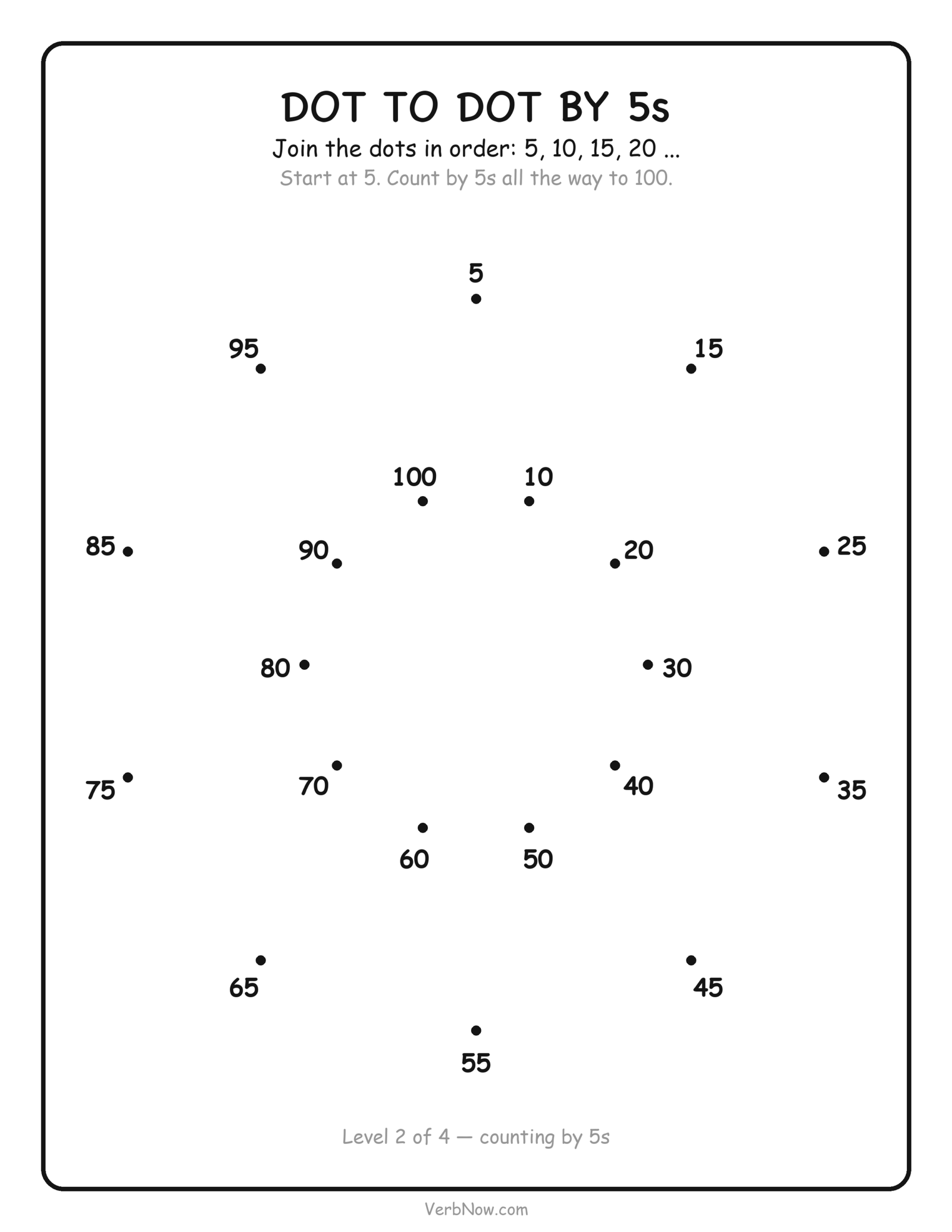
The dot to dot on page 7 runs 5, 10, 15 and on to 100 across 20 dots, and the finished line is a star.
How to print these
Print at US Letter, actual size. Nothing a child writes on comes closer than half an inch to the paper edge, so “fit to page” or “shrink to fit” is not needed and will only take the write-in boxes below the size they were drawn at. Black and white is fine — there is no color anywhere in the set, so grayscale or draft mode costs nothing but toner.
The four hundred charts are the ones worth putting in a sleeve with a dry-erase marker rather than reprinting, because the same grid gets colored a different way for every step size. The other eight pages are written on once.
Skip counting worksheets: questions parents and teachers ask
Is there a printable hundred chart in this set?
Yes — 4 of the 12 pages are full 1 to 100 charts, one each for 10s, 5s, 2s and 3s. Every square from 1 to 100 is printed, so any of them doubles as a plain hundred chart if you ignore the instruction line at the top. The only marks already on the grid are the first two or three multiples, hatched in as a worked example, and they sit in a different place on each of the four pages.
Does skip counting help with multiplication?
It is the step directly before it. Counting 5, 10, 15, 20 out loud is the same operation as 4 × 5, said in a form a child can reach without knowing any multiplication facts. That is why the count-the-groups pages in this set print the groups as separate circles with a running total under each one: the child writes 5, 10, 15, 20, and the last box is the product. The 5s, 10s, 2s, 3s and 4s covered here are also the five times tables most curricula teach first, for the same reason. If you want the teaching sequence for multiplication itself rather than the pages, that is covered in how to teach kids multiplication.
What grade is skip counting taught in?
In US classrooms, counting by 2s, 5s and 10s starts in kindergarten and first grade, and counting within 1000 by 5s, 10s and 100s is a second-grade expectation (Common Core 2.NBT.A.2). Recognising even and odd numbers and adding equal groups sit in second grade too (2.OA.C.3 and 2.OA.C.4). Counting by 3s and 4s is not pinned to a grade in that standard; it usually turns up alongside the three and four times tables. That is the order the four levels here follow. Where a particular child sits in that sequence is a question for their teacher, not for a worksheet page.
My child skips numbers when counting — is that the same thing?
No, and they are worth keeping apart. Skip counting is deliberate: the child leaves out the same amount every time and knows they are doing it. Dropping numbers while counting one by one — saying 1, 2, 3, 5, 6 — is a gap in the count sequence, and doing skip counting pages will not close it. Counting one at a time comes first. If that is where you are, the guide to counting to 100 and the counting worksheets for numbers 1 to 10 are the earlier step.
Are there color-by-number math pages too?
Yes, in a separate set. These pages are worksheets — number boxes, grids and number lines sized for writing in, not for coloring. The one exception is the four hundred charts, where coloring is the exercise. For pages where the coloring is the point and the arithmetic decides the color, use the math coloring pages instead.
More math printables
Everything here lives in the math section: browse the rest of the math printables for the other number pages. For a younger child who is still counting one at a time, the counting worksheets cover numbers 1 to 10. Counting by 5s is also how a clock face is read, which is what the telling time worksheets practise. And for more number order work in puzzle form, there are the dot to dot printables.