
VerbNow is an Amazon Associate. If you buy through a link on this page we may earn a commission, at no extra cost to you. See our disclaimer for the full picture.
For most kids coloring printable pages, a triangular barrel with a soft core beats a round barrel with a hard one — the grip stays put and the color actually shows up. Four sets cover almost every situation: Faber-Castell Jumbo Grip for the youngest fists, Faber-Castell Triangular EcoPencils once the grip matures, Crayola 50-count when you need color range on a budget, and Prismacolor Scholar for an older kid who has started caring how the finished page looks.
What this list is, and what it isn’t. I haven’t held every one of these sets. What I have done is draw the pages they get used on — so this is written from two things I can actually check: the specs each manufacturer publishes, and how a pencil behaves against the line weight and fill areas I draw into VerbNow printables. Where a spec isn’t published, I say so instead of guessing.
What actually matters on a coloring page
Three things change how a coloring session goes, and only one of them is color count.
Core softness. A soft core lays down pigment with light pressure. A hard core needs the child to push. That matters because a four-year-old pressing hard is a four-year-old who tears paper, and a nine-year-old pressing hard gets shiny wax buildup that won’t take another layer. Soft cores also break more often — that’s the trade, and no brand escapes it.
Barrel shape. A triangular barrel does two jobs: it seats the three-finger grip without the child thinking about it, and it doesn’t roll off the table. A round barrel does neither. For a kid still forming a pencil grip, this matters more than the pigment.
Barrel width. A wide jumbo barrel suits a fist grip — roughly ages 3 to 5. After that, a jumbo barrel gets in the way of the fine control a standard barrel allows.
The fill areas in VerbNow printables are drawn wide on purpose, with heavy outlines, precisely so a thick jumbo core can stay inside the lines. On a page with fine detail, that same thick core is a problem. Match the pencil to the page, not just to the child.
Four barrel shapes, side by side
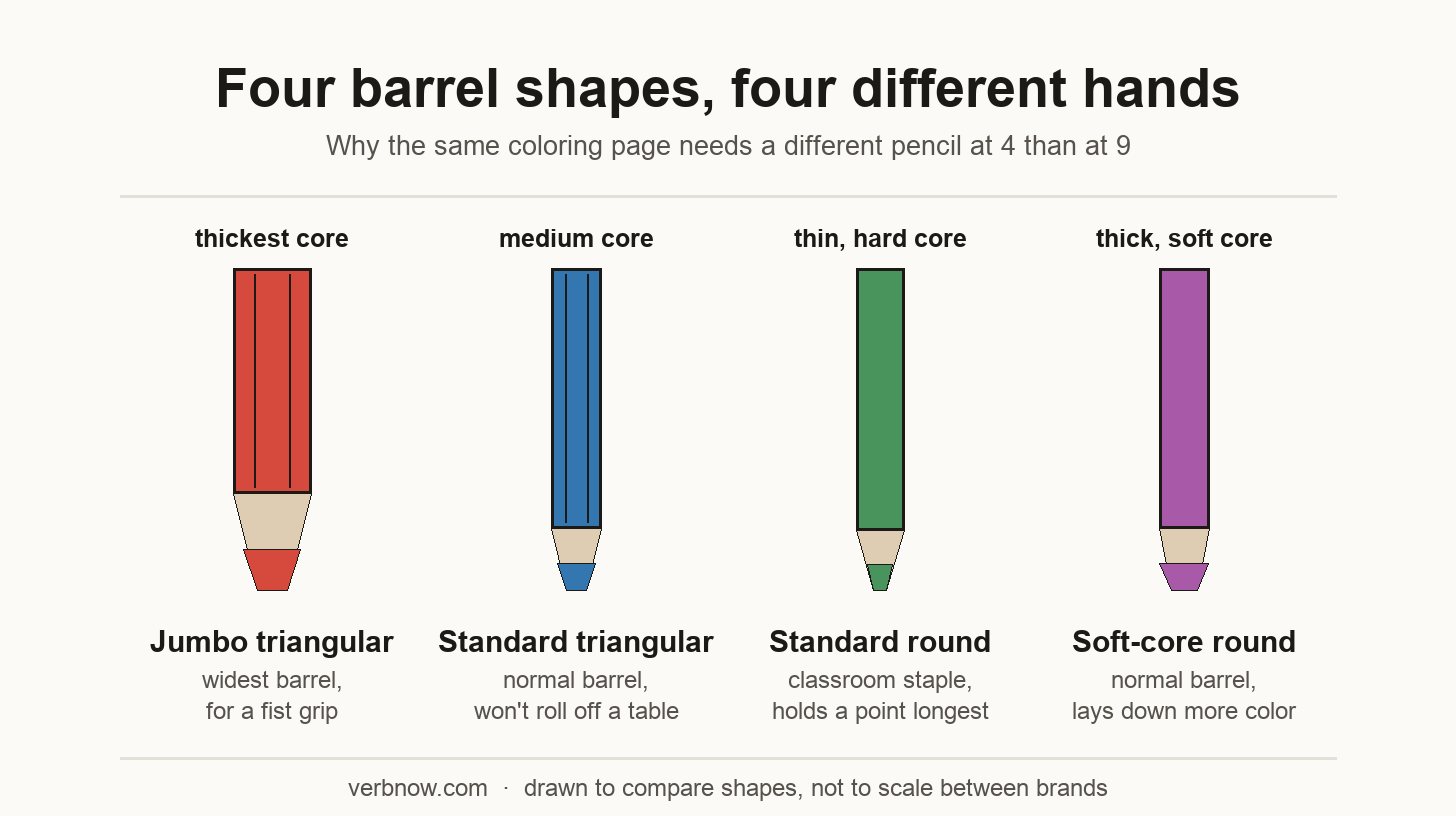
Manufacturers rarely publish core diameter. Crayola is the exception — they state a 3.3 mm core. For the others, the illustration above compares relative thickness rather than inventing numbers nobody published.
Faber-Castell Jumbo Grip — for the youngest fists
Best for roughly ages 3 to 5, where the hand still wraps the pencil rather than pinching it. The barrel is triangular and jumbo-width, with grip dots along the shaft, and the pigment is water-soluble — a wet brush turns the same drawing into a watercolor, which effectively doubles what one page can do.
Faber-Castell glues the core into the wood along its full length, which is the design reason these survive drops better than pencils where the core sits loose. At the time of writing the set carries 4.7 stars across roughly 3,900 ratings on Amazon.
Known limits: 12 colors is a narrow range, and the jumbo barrel outgrows its usefulness around kindergarten. It also needs a jumbo-size sharpener — a standard school sharpener won’t fit the barrel.
A note on availability: in the US this set usually ships from third-party sellers importing the European edition rather than from Amazon’s own stock, so it moves in and out of stock and costs more per pencil than the US-market Faber-Castell sets below. If it isn’t in stock when you look, the Triangular EcoPencils match it on barrel shape but not on barrel width — and for a fist grip the jumbo width is the whole point, so it is worth waiting rather than substituting.
Check the Jumbo Grip set on Amazon
Faber-Castell Triangular EcoPencils — the step up
Best from about age 5, once the grip has matured past a fist. Standard barrel width, still triangular, and pre-sharpened out of the box. Faber-Castell rates this set 5+, and the same full-length core bonding applies.
This is the set I’d point most parents to first if their child has aged past jumbo pencils but isn’t asking for artist supplies yet. At the time of writing it holds 4.6 stars across about 700 ratings.
Known limits: the 12-count is genuinely limiting once a child starts wanting specific shades — a 24-count version exists for that reason.
Check the Triangular EcoPencils on Amazon
Crayola 50-count — range on a budget
Best when several kids color at once, or when the box needs to survive a classroom. Fifty pre-sharpened, nontoxic pencils is a lot of color range for the price, and the hard 3.3 mm core holds a point far longer than a soft one.
That hard core cuts both ways. It resists smudging — genuinely useful with young kids and a stack of finished pages — but it also lays down lighter color than a soft core does, so a child who wants a saturated page has to press. At the time of writing this set has 4.7 stars across more than 10,000 ratings, which is the largest sample of any set here.
Known limits: round barrels roll off tables and don’t guide a grip. Color comes out lighter than the same shade in a soft-core pencil.
Check the Crayola 50-count on Amazon
Prismacolor Scholar — for the kid who cares how it looks
Best from roughly age 8 up, when a child starts blending and layering instead of filling. Scholar is Prismacolor’s student line: soft wax-based cores, 60 colors, and enough pigment that light pressure gives full color. Blending two colors into a gradient is realistic with these in a way it isn’t with a hard-core pencil.
At the time of writing it carries 4.7 stars across roughly 13,000 ratings and an Amazon’s Choice badge in its category.
Known limits: soft cores break — this is the direct cost of the blending ability, not a defect. Round barrels, so the same rolling and grip caveats as Crayola. Overkill for a five-year-old who is going to press hard and snap them.
Check the Prismacolor Scholar set on Amazon
Which set for which age
- Ages 3-5, fist grip: Faber-Castell Jumbo Grip — triangular, jumbo barrel, water-soluble.
- Ages 5-8, developing grip: Faber-Castell Triangular EcoPencils — standard barrel, still triangular.
- Multiple kids or a classroom: Crayola 50-count — most colors per dollar, hardest core.
- Ages 8+, blending and shading: Prismacolor Scholar — soft core, 60 colors.
What I can’t tell you
I haven’t run these through a durability test, so I can’t tell you which set survives longest in a backpack, how many sharpenings each pencil gives, or how the pigments compare side by side on the same paper. Those claims show up in a lot of roundups without anyone having measured them. When I have real numbers from real use, this page gets updated and says so.
What’s above comes from published specs and from knowing how these pencils behave against the line weight in a VerbNow coloring page.
FAQ
Are expensive colored pencils worth it for a young child?
Not usually before about age 5. A four-year-old presses hard, and soft artist-grade cores snap under that pressure — you pay more and replace them faster. The upgrade that does pay off early is barrel shape, not pigment: a triangular barrel guides the grip regardless of what the core costs.
Why do my child’s colored pencils keep breaking?
Two common causes. Softer cores break more easily by design — that’s the trade for laying down color with light pressure. And a core that has been dropped can fracture inside the wood along its length, so it snaps at every sharpening even though the pencil looks fine. Pencils with the core glued along the full barrel, like the Faber-Castell sets here, are built to reduce the second problem.
How many colored pencils does a child actually need?
Twelve covers most coloring pages; the jump to 50 or 60 matters when a child starts wanting a specific shade rather than “a blue.” We wrote about this in more detail in how many colored pencils you should have.
What’s the difference between hard and soft colored pencils?
A soft core releases more pigment under less pressure and blends well, but wears down and breaks faster. A hard core holds a point, resists smudging, and lasts longer, but colors lighter. Neither is better in the abstract — see what soft pencils are and our guide to pencil types for the full breakdown.
Curious whether you can paint with them? Using water with colored pencils covers which ones are made for it.