
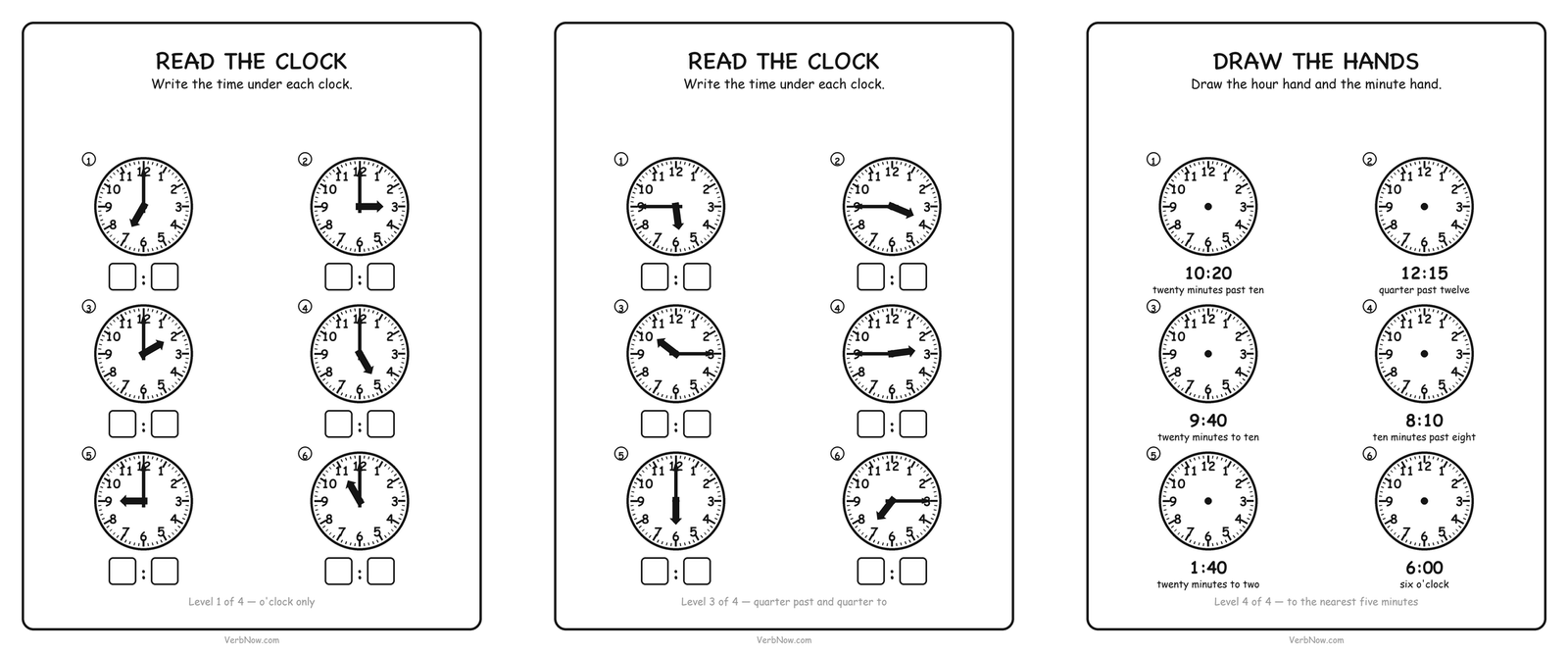
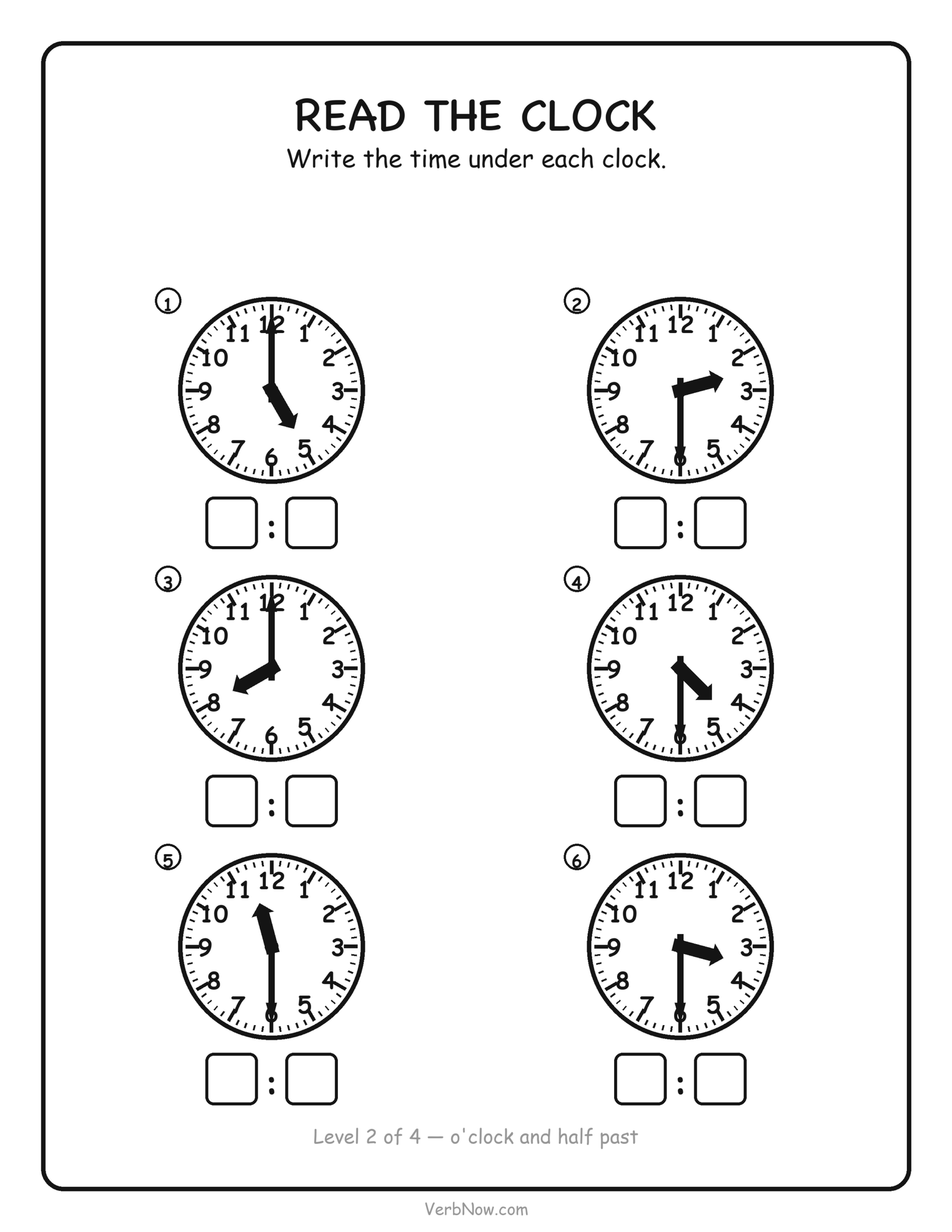
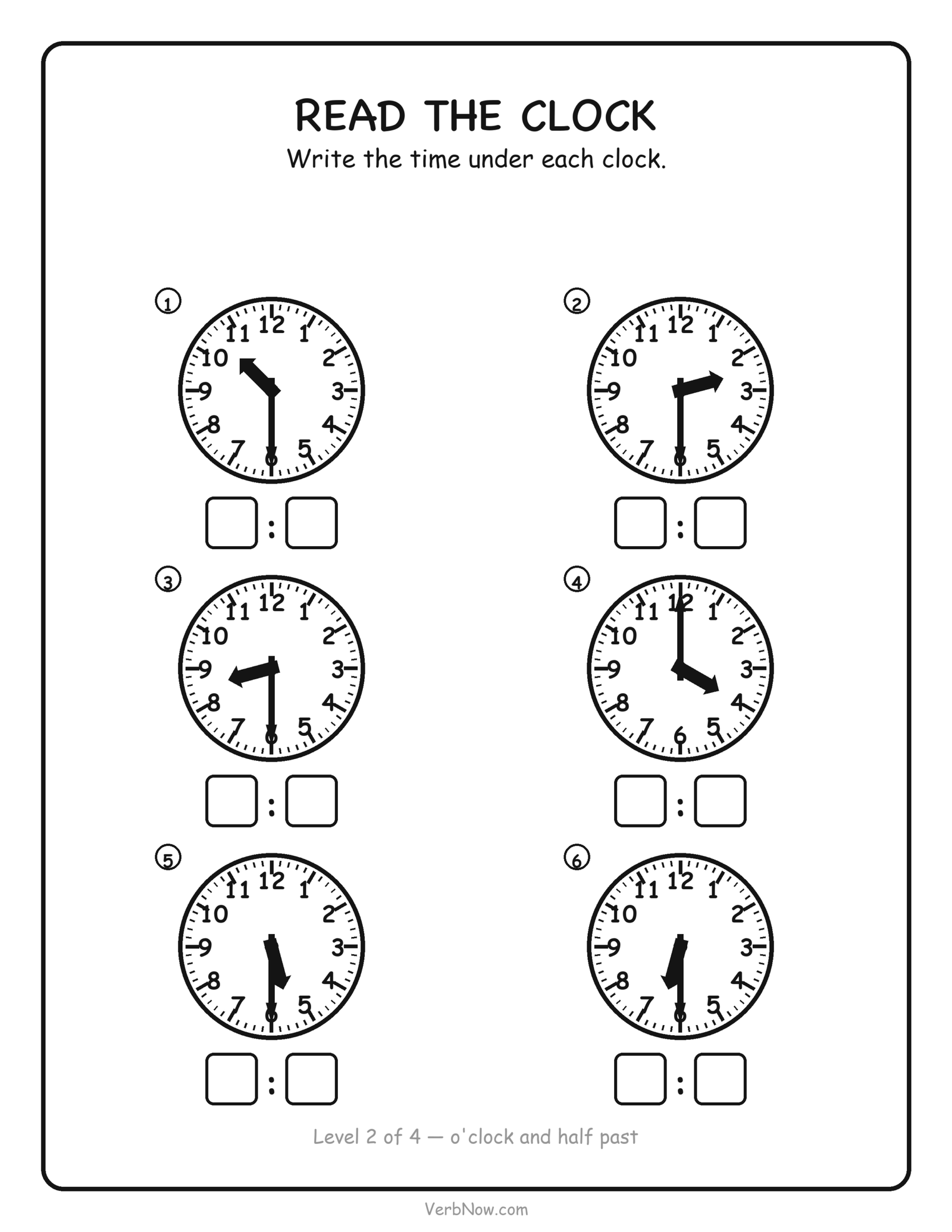
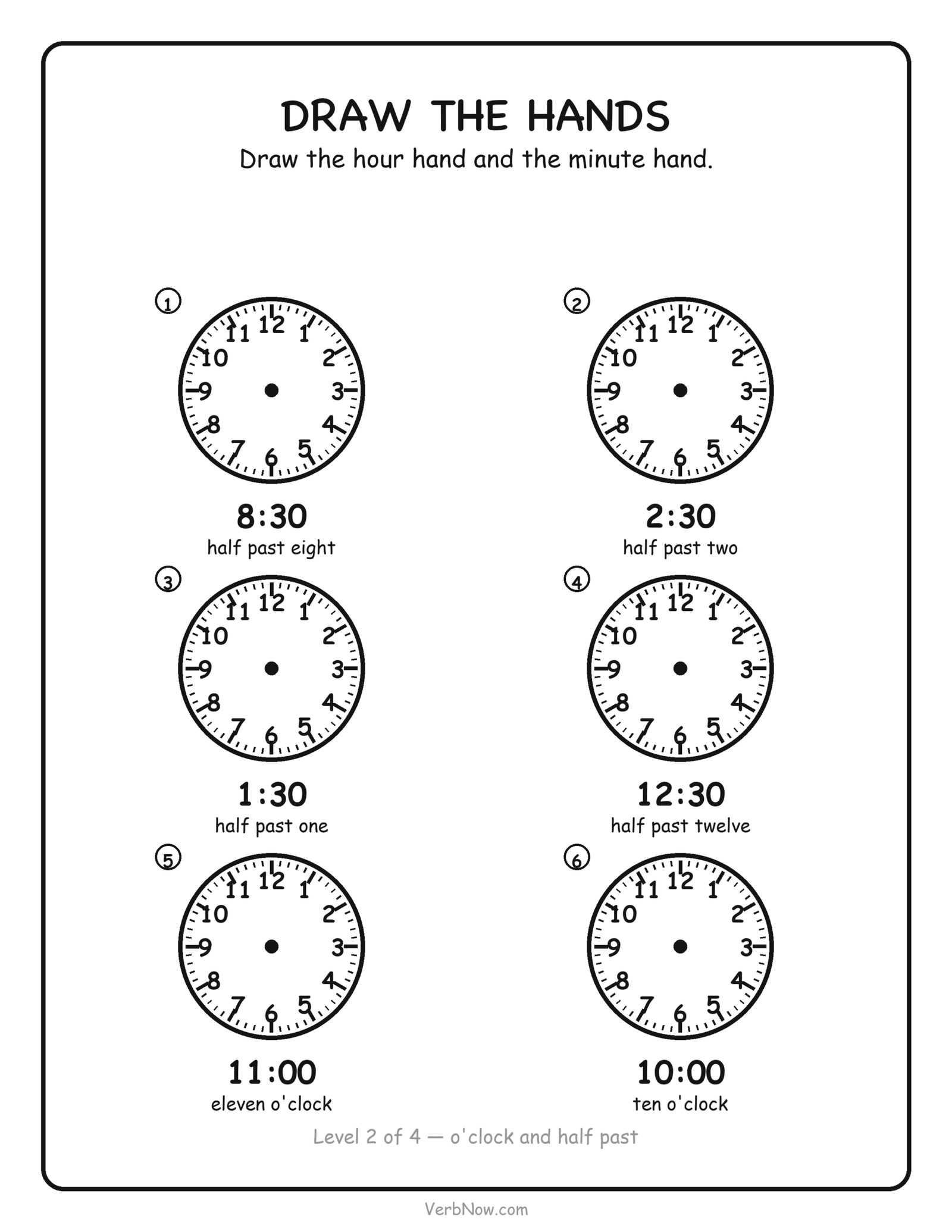
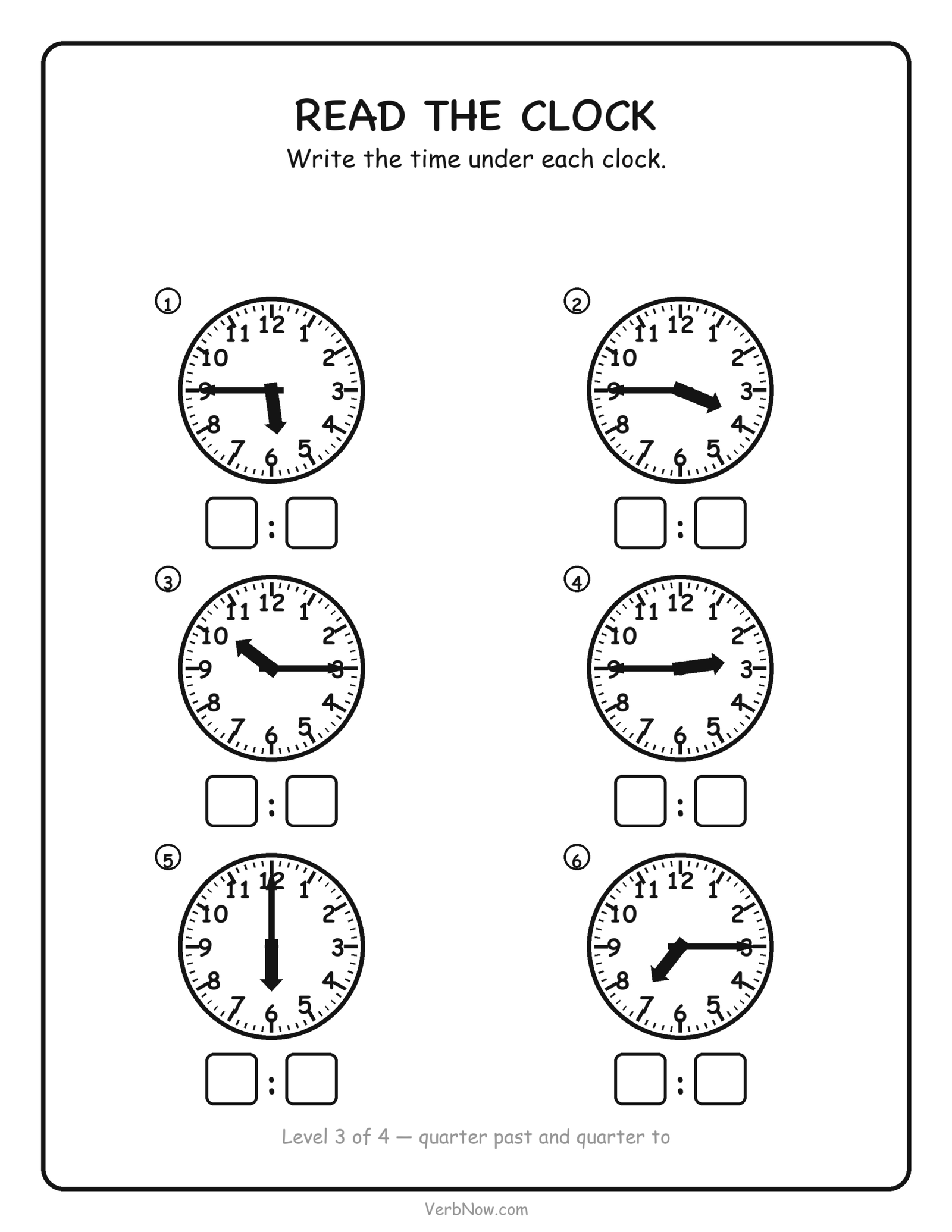
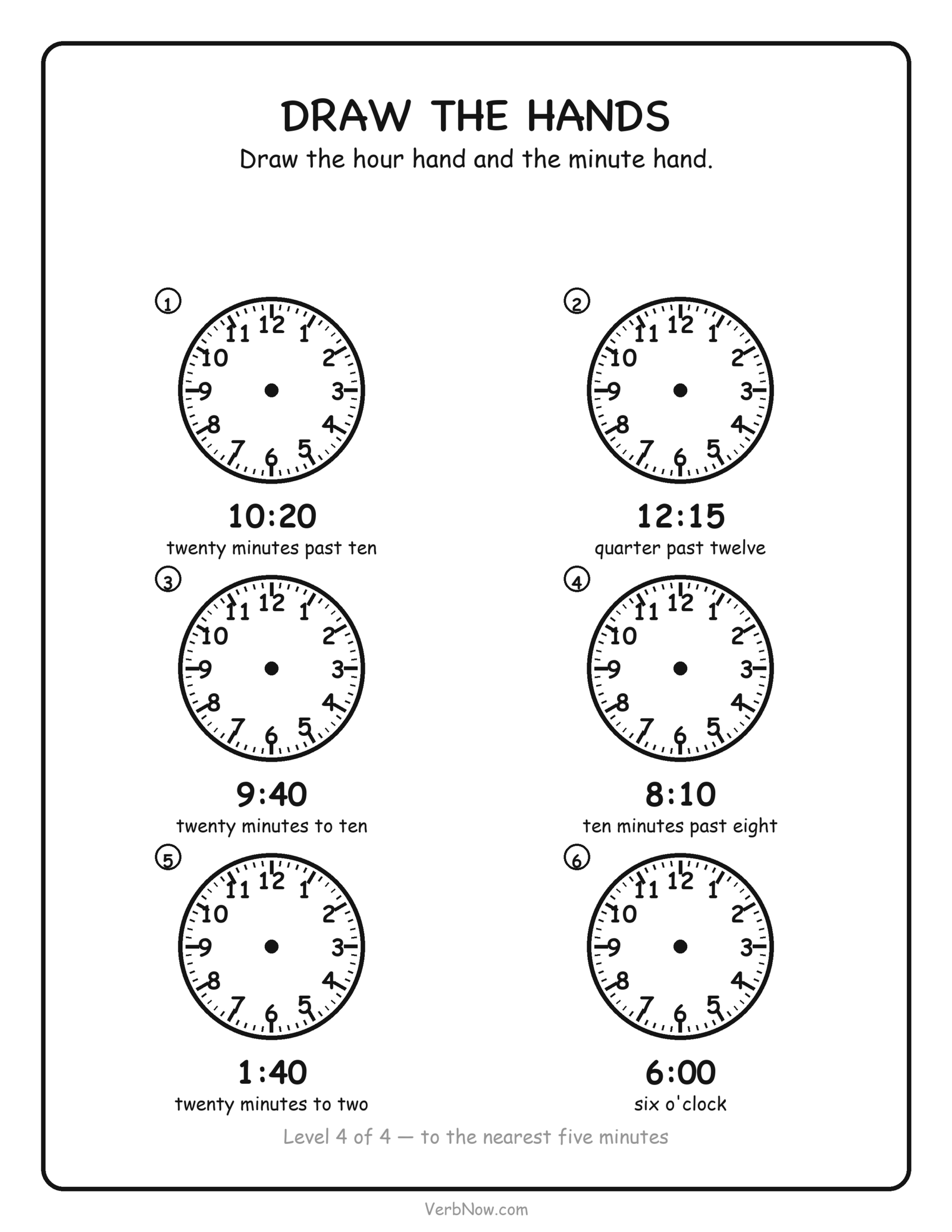
This set has 12 telling time worksheets holding 72 clock faces, split into four levels that follow the order clocks are normally taught: o’clock, half past, quarter past and quarter to, then times to the nearest five minutes. Eight pages ask a child to read an analog clock and write the time into an hour box and a minute box. The other four print the time in digits and in words and leave the clock face blank, so the child draws the hands. Every page is US Letter, black and white, and six clocks to a page.
What is on the 12 pages
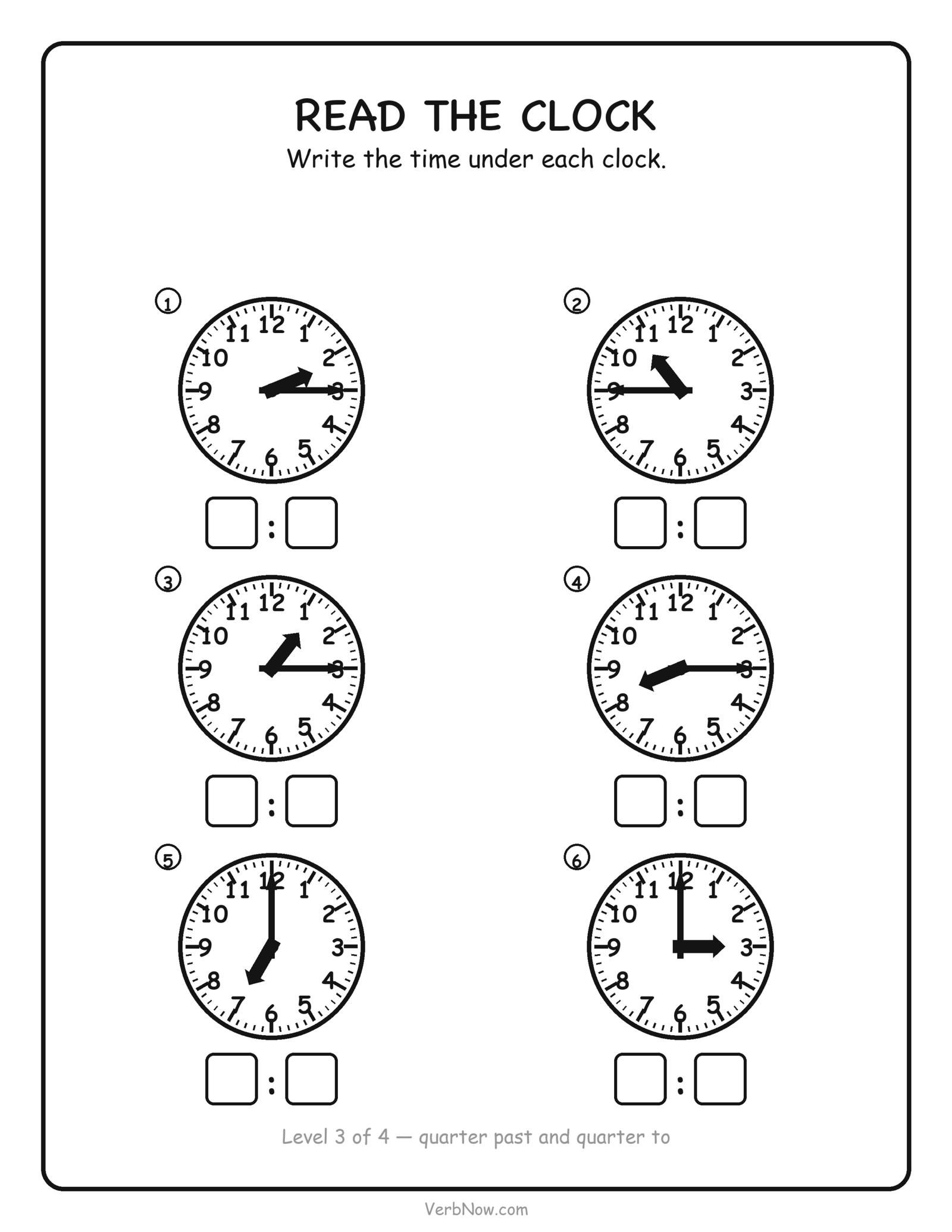
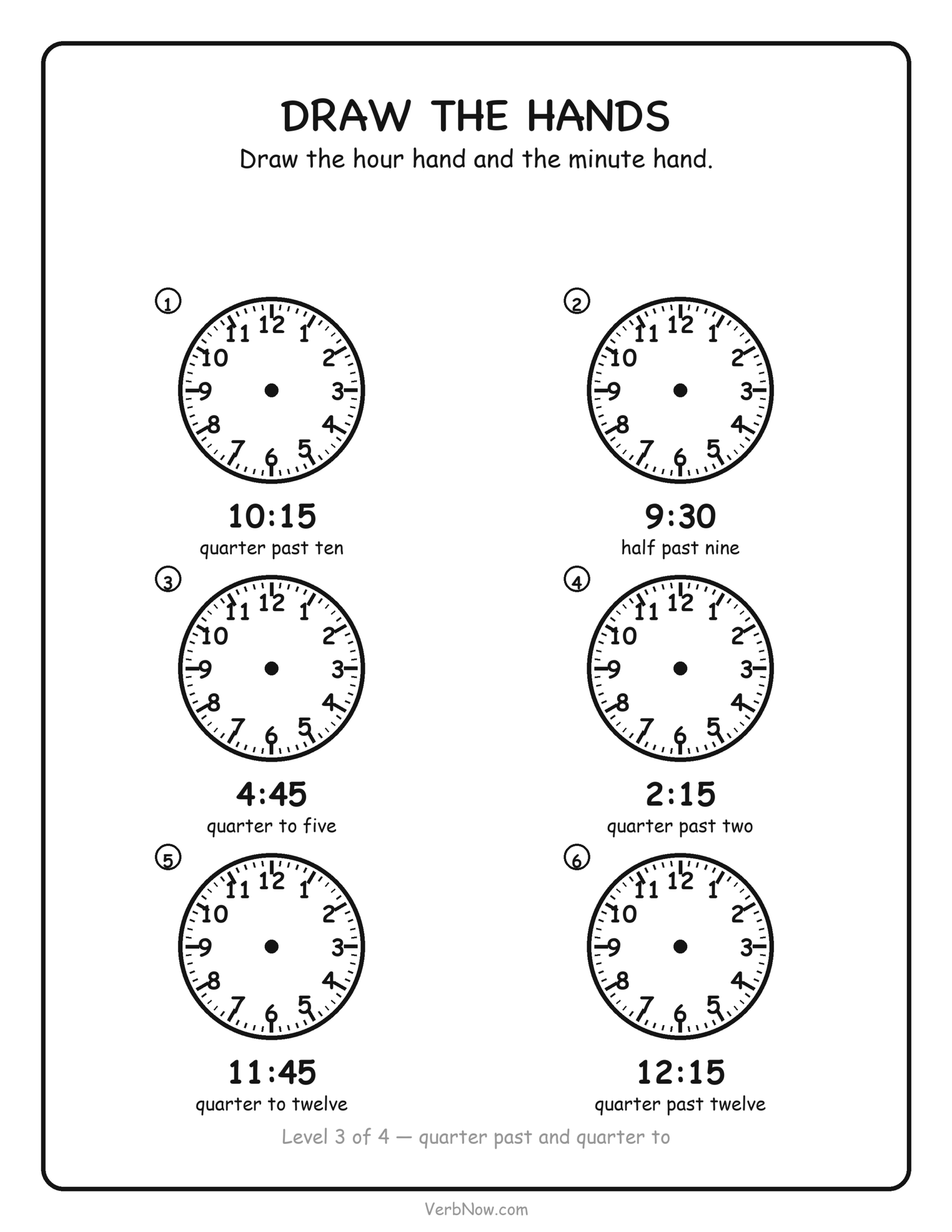
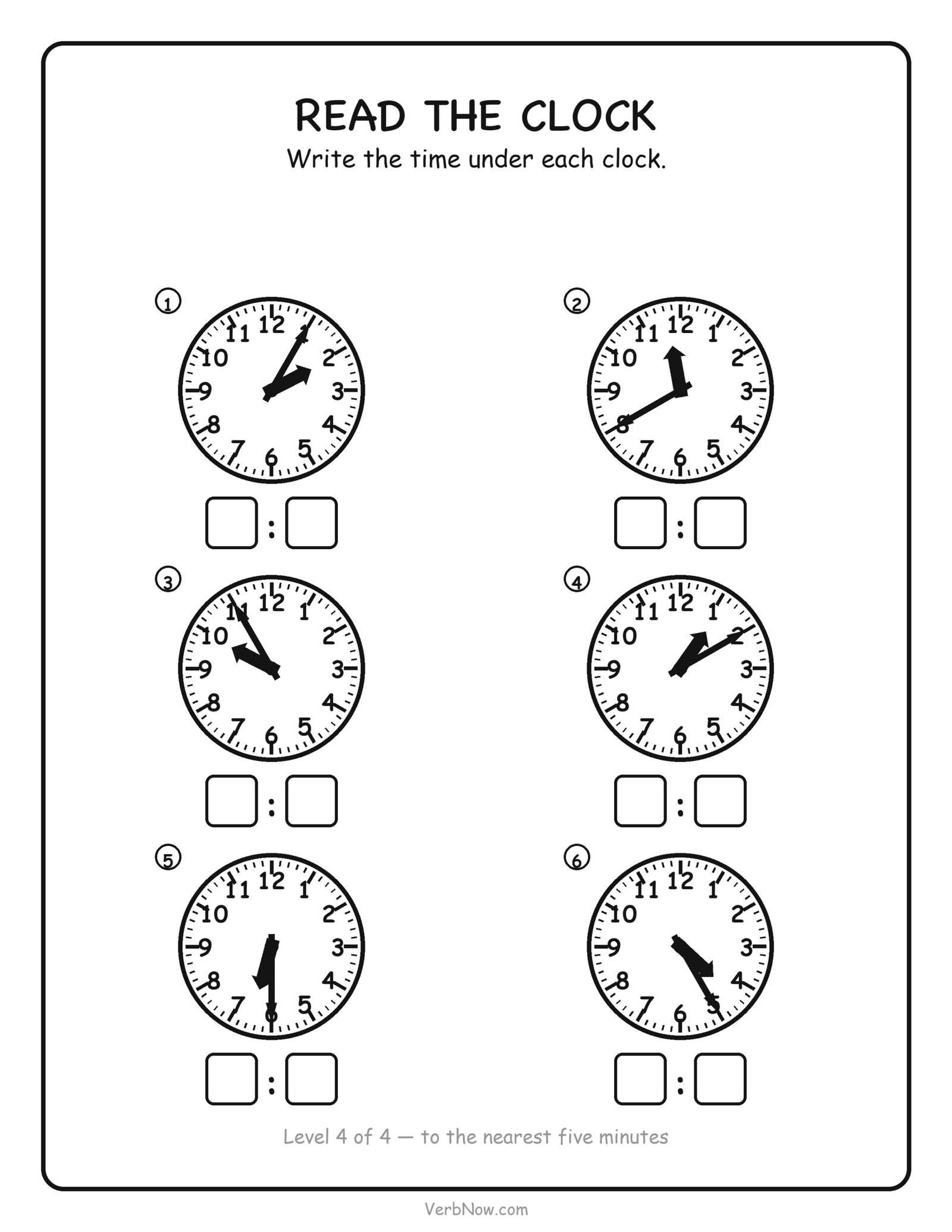
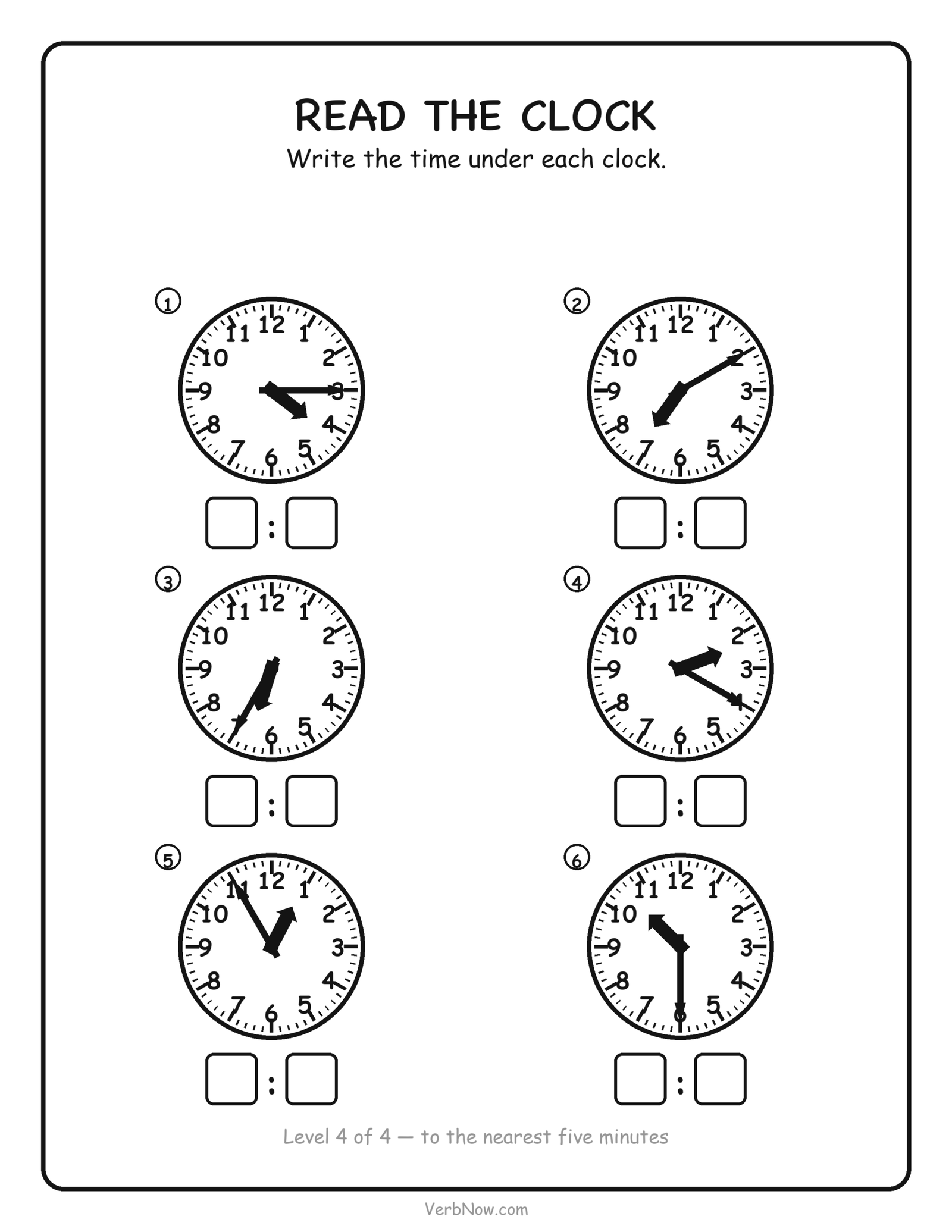
Each page carries six clocks in two columns, numbered 1 to 6, with the level printed along the bottom edge so a stack of loose pages can be sorted back into order. The difficulty is set by which minute values are allowed on that level, and nothing else about the layout changes.
| Level | Times used | Pages | What changes |
|---|---|---|---|
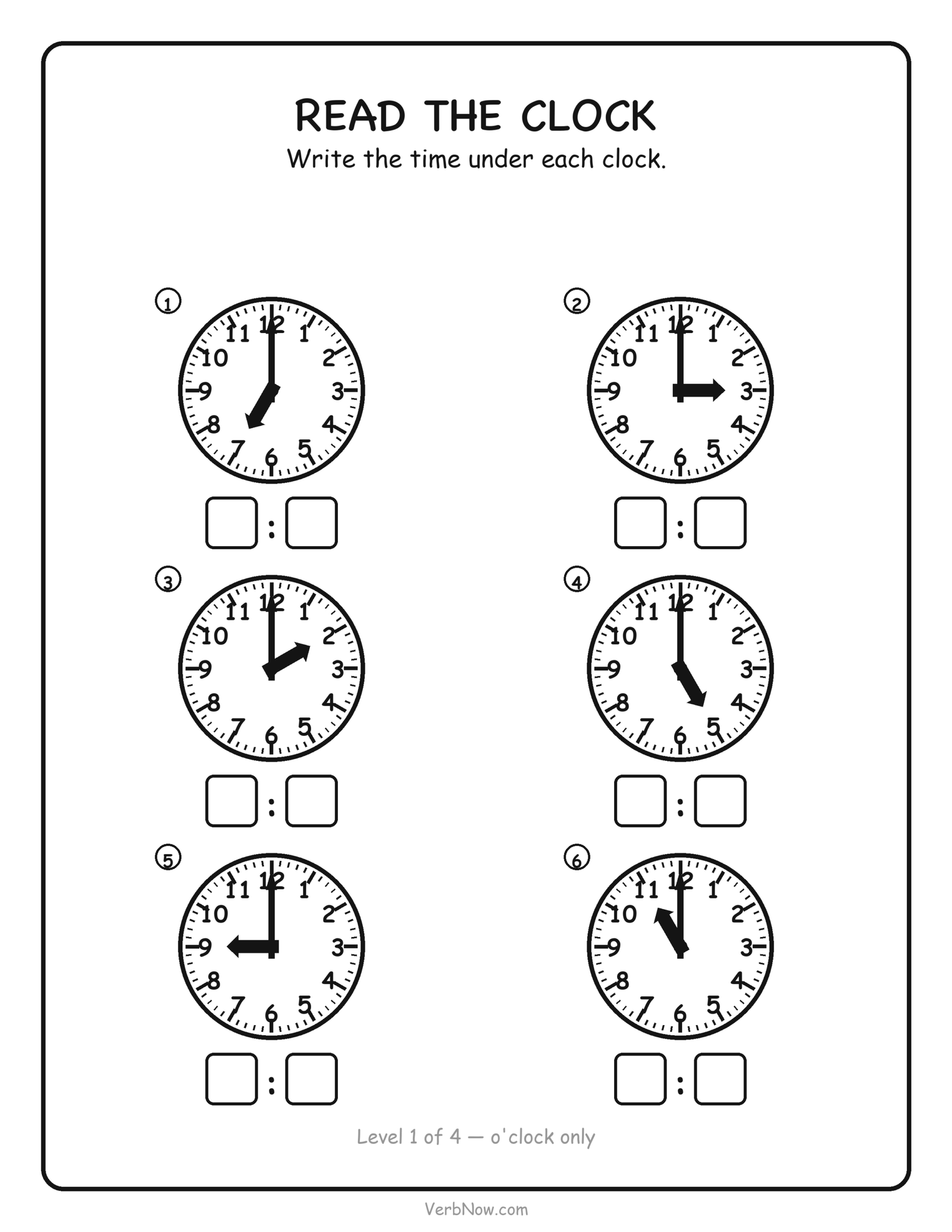
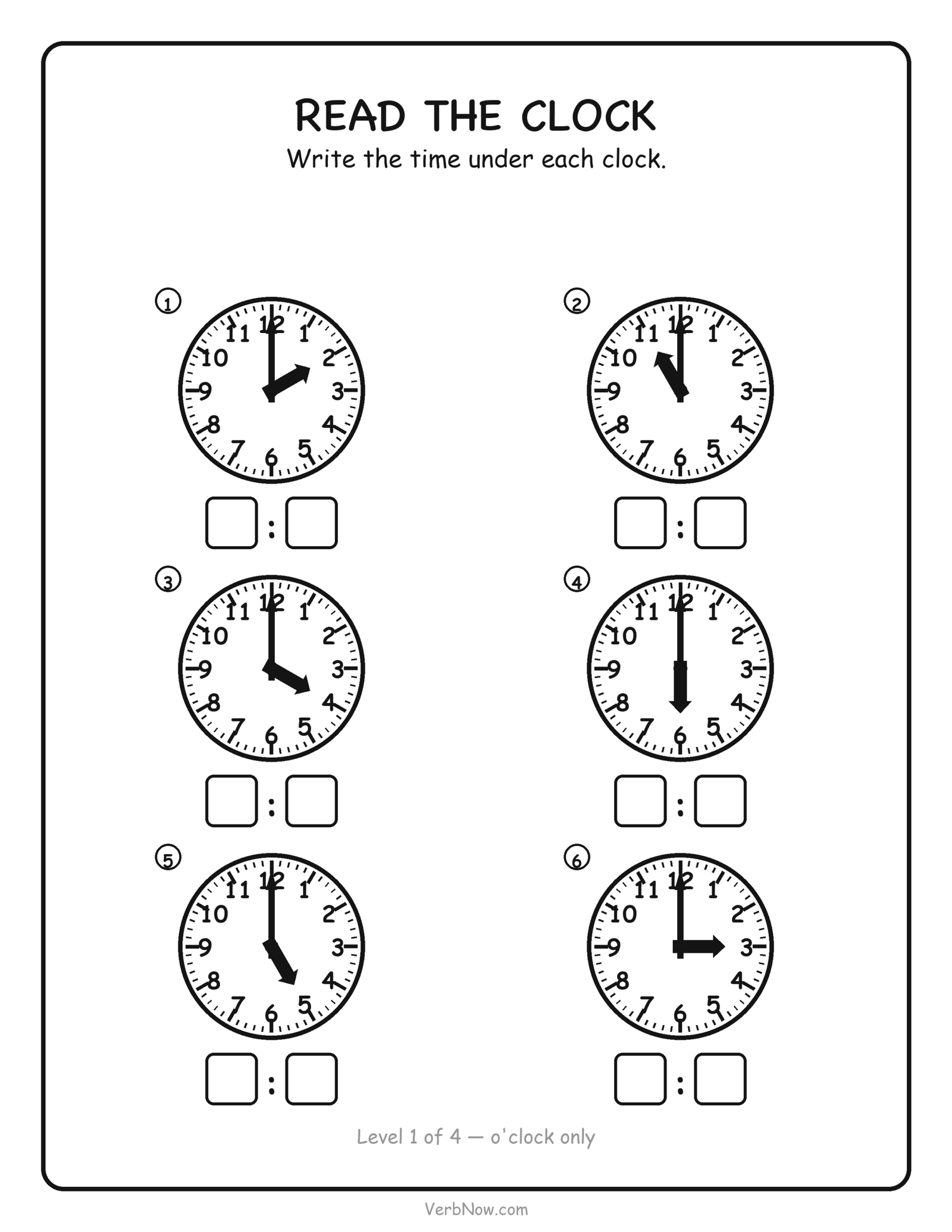
| 1 | o’clock only | Pages 1, 2, 3 | The minute hand stays on 12. Only the hour changes. |
| 2 | o’clock and half past | Pages 4, 5, 6 | The minute hand moves to 6, and the hour hand slides halfway between two numbers. |
| 3 | quarter past and quarter to | Pages 7, 8, 9 | The minute hand lands on 3 or on 9, and o’clock and half past keep appearing so the earlier levels stay in play. |
| 4 | to the nearest five minutes | Pages 10, 11, 12 | The minute hand can land on any of the twelve numbers, and the wording switches to “past” and “to”. |
Levels are cumulative on purpose. A level 3 page still contains o’clock and half past clocks mixed in with the quarter ones, and a level 4 page still contains quarters and halves. A page made only of the newest case lets a child answer by pattern instead of by reading.
The order these four levels follow, and the grade each one usually sits in
The four levels match the sequence US classrooms use. Telling time to the hour and the half hour is a first-grade expectation (Common Core 1.MD.B.3). Telling time to the nearest five minutes, with a.m. and p.m., is a second-grade one (2.MD.C.7). Quarter past and quarter to are not pinned to a grade in that standard at all; they sit in the gap, which is why they get their own level here rather than being folded into the five-minute pages.
Three things make that order work rather than just being conventional. O’clock isolates the hour hand, because the minute hand never moves off 12. Half past gives the minute hand exactly one destination, the 6, so a child is reading a position rather than counting. Quarter past and quarter to introduce the two remaining landmark positions, 3 and 9, and also introduce the word “to”, which is the first point where the hour a child says stops matching the number the hour hand is nearest. Five-minute times then need all of that at once plus skip-counting by fives.
If a child stalls, the level number on the page tells you where to drop back to. That is the whole reason it is printed.
Reading a clock and drawing the hands are two different jobs
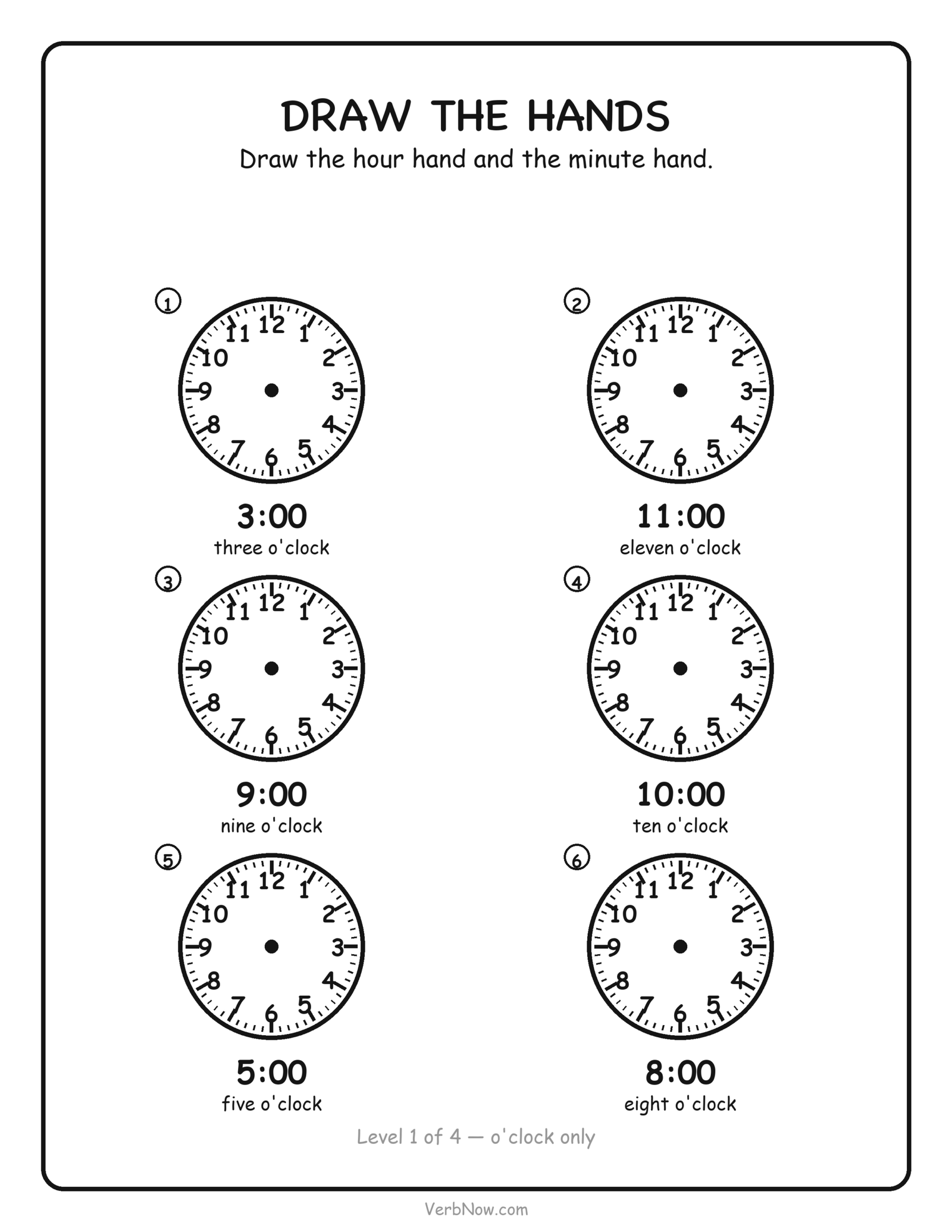
Reading is recognition: the hands are already in position and the child names what they see. Drawing is production: the child has to decide where each hand goes and how long to make it, with nothing on the face to copy. A child who reads clocks confidently can still put a full-length hour hand on a drawing page, or draw both hands the same length, which is the moment you find out the hour-hand-versus-minute-hand distinction has not landed yet.
That is why the split is eight read pages to four draw pages, one draw page closing out each level. Read twice, then produce once, at every difficulty step.
How the hour hand is drawn on these clocks
On every clock in this set the hour hand moves with the minutes, at half a degree per minute. At 4:30 it does not point at the 4. It sits exactly halfway between the 4 and the 5, because half an hour has passed.
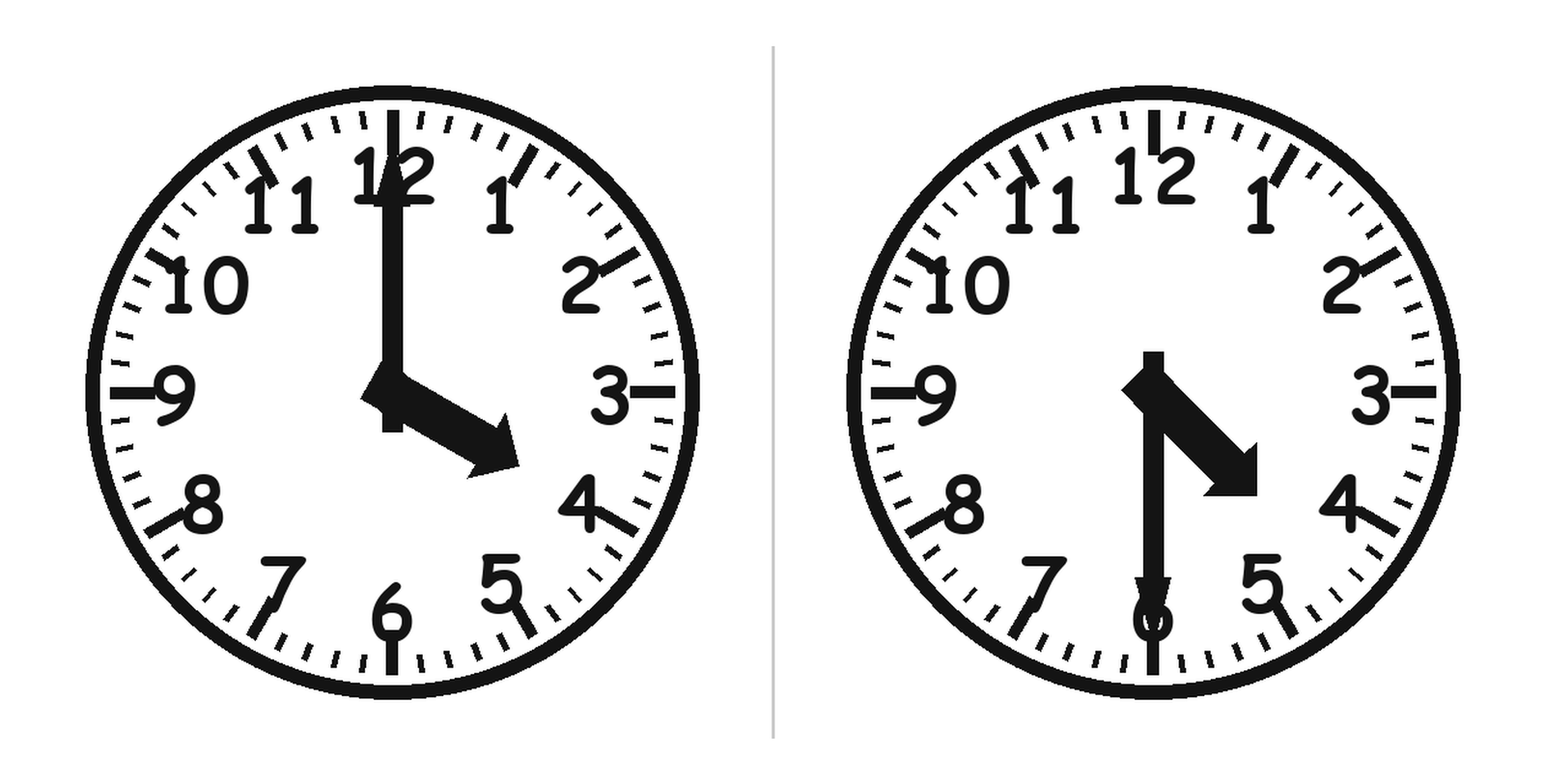
That detail is worth being fussy about. A clock face that parks the hour hand on the number regardless of the minutes teaches a child to read a real 4:30 wall clock as five o’clock, and it is a habit that has to be unlearned later. Every clock in this set is generated from the two angle rules a real clock movement follows — minute hand at six degrees per minute, hour hand at thirty degrees per hour plus half a degree per minute — and each of the 72 faces is measured back off the finished drawing and checked against its own answer before the page is saved.
Two more drawing decisions follow from the same concern. I draw the hour hand short and wide and the minute hand long and narrow, so the two stay tellable apart even when they lie along one line, as they do at six o’clock. And I left three times out of the set on purpose — 12:00, 1:05 and 2:10 — because at each of those the hands sit on top of each other, and a child looking at the face can see only one hand to read.
Answer key for the eight read-the-clock pages
Clocks are numbered 1 to 6 down each page, left column first. The four draw-the-hands pages are not listed here because the time is already printed under each clock on the page itself.
| Page | 1 | 2 | 3 | 4 | 5 | 6 |
|---|---|---|---|---|---|---|
| Page 1 — level 1, o’clock | 7:00 | 3:00 | 2:00 | 5:00 | 9:00 | 11:00 |
| Page 2 — level 1, o’clock | 2:00 | 11:00 | 4:00 | 6:00 | 5:00 | 3:00 |
| Page 4 — level 2, half past | 5:00 | 2:30 | 8:00 | 4:30 | 11:30 | 3:30 |
| Page 5 — level 2, half past | 10:30 | 2:30 | 8:30 | 4:00 | 5:30 | 6:30 |
| Page 7 — level 3, quarter past and quarter to | 5:45 | 3:45 | 10:15 | 2:45 | 6:00 | 7:15 |
| Page 8 — level 3, quarter past and quarter to | 2:15 | 10:45 | 1:15 | 8:15 | 7:00 | 3:00 |
| Page 10 — level 4, five minutes | 2:05 | 11:40 | 9:55 | 1:10 | 6:30 | 4:25 |
| Page 11 — level 4, five minutes | 4:15 | 7:10 | 6:35 | 2:20 | 12:55 | 10:30 |
How to print these
Print at US Letter, actual size. Nothing a child reads or writes on sits closer than a third of an inch to the paper edge, so “fit to page” or “shrink to fit” is not needed and will only shrink the clock faces below the size they were drawn at. Each clock face is 1.67 inches across and each answer box is a 0.47 inch square, which is what those settings would eat into. Black and white is fine — there is no color anywhere in the set, so grayscale or draft mode costs nothing but toner.
For repeat practice, one page in a sleeve with a dry-erase marker works out cheaper than reprinting, and the draw-the-hands pages in particular are worth reusing.
Telling time worksheets: questions parents and teachers ask
How do you teach telling time to kindergarten?
Start with the hour hand alone. A kindergartener can read “it is about four o’clock” from the short hand long before they can count minutes, so level 1 in this set holds the minute hand at 12 on every clock and changes only the hour. Once o’clock is solid, half past is the next step, because the minute hand lands on a single obvious number (the 6) instead of somewhere a child has to count to. Quarter past, quarter to, and five-minute times come after that, and they are levels 3 and 4 here. If you want the teaching sequence in more detail rather than the pages themselves, that is covered in how to teach time to kids.
What age should a child learn to tell time?
In US classrooms, telling time to the hour and half hour is a first-grade expectation (Common Core 1.MD.B.3), and telling time to the nearest five minutes with a.m. and p.m. is a second-grade one (2.MD.C.7). Quarter past and quarter to sit between those two standards and are usually taught late in first grade or early in second. That is the sequence these four levels follow. Children move through it at their own pace, and how a particular child is developing is a question for their teacher or pediatrician rather than a worksheet page.
Do these worksheets cover digital clocks?
The clock faces are analog only, but the writing side is digital. On the eight read-the-clock pages, a child reads the hands and writes the time into an hour box and a minute box separated by a colon, which is digital notation. On the four draw-the-hands pages, the time is printed in digits (for example 9:40) and again in words (“twenty minutes to ten”), and the child converts that to hands. So both notations appear on every page; only the clock faces are analog.
Is there a printable blank clock face in this set?
Yes — the four draw-the-hands pages are blank clock faces. Each of those pages gives six clocks with numbers, minute ticks and a centre dot, and no hands at all. If you want blank faces without any assigned time, print one of those pages and ignore the printed time underneath, or fold it off. The four blank-face pages are pages 3, 6, 9 and 12 in the grid above.
Are there clock coloring pages too?
Yes, and they are a separate set. The pages here are worksheets: line-weight clock faces sized for reading and writing, not for filling in with color. If what you want is a clock to color rather than a clock to read, use the clock coloring pages instead — bigger shapes, open areas, no answer boxes.
More math printables
Everything in this set lives in the math section: browse the rest of the math printables for the other number pages. If you are working with a younger child who is not yet reading clocks, the counting worksheets cover numbers 1 to 10 with the same US Letter, black and white layout. And for a clock to color rather than read, there are the clock coloring pages.